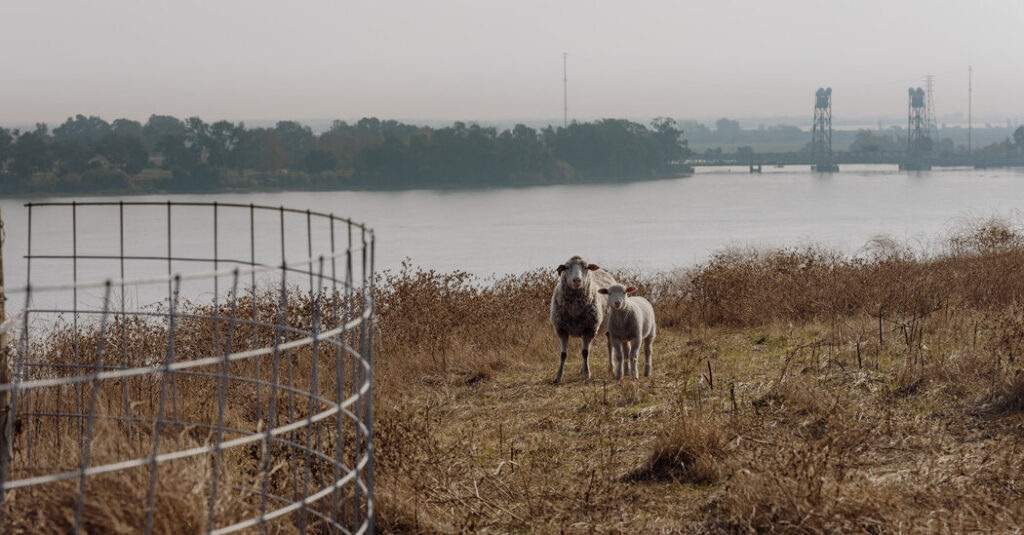
California Forever, a company backed by Silicon Valley billionaires, calls its proposal to build a new city in Northern California a remedy to the state’s biggest problems.
California needs homes; the company aims to put several thousand of them about an hour’s drive from San Francisco. The state is desperate for middle-class jobs; California Forever would create a shipyard and manufacturing center ready to hire. The plan is well funded, is backed by labor unions and has the implied support of Gov. Gavin Newsom.
And yet a move that would have given the project a definitive push died quietly in a behind-the-scenes scramble during the final days of California’s legislative session, which ended this week. Although not before a stuffed monkey made an appearance and protesters delivered public comment in song.
California Forever hasn’t given up. The company and its army of consultants will almost certainly be back to lobby state legislators in 2027. But by then there will be a new governor with new priorities. Whatever the project’s future, its failure in this legislative session is another proof point of how hard it remains to build in the nation’s largest and richest state — and why a growing backlash against the billionaire class could make it even harder.
“It’s just incredibly hard to do large projects in California,” said Ben Metcalf, managing director of the Terner Center for Housing Innovation at the University of California, Berkeley.
Mr. Metcalf listed some of the many examples: A high-speed rail line that voters approved in 2008 but that has yet to lay a track. A large housing project outside Los Angeles and the redevelopment of a Navy yard, both in planning stages for decades.
The state has arguably the nation’s worst housing crisis, with rent and home prices that far exceed the national average. The high cost of living, combined with strict environmental and land-use regulations, has led to a steady migration of companies and residents to less expensive states.
The main problem, Mr. Metcalf continued, is that California’s overlapping regulatory processes, scattered among state and local agencies, make it nearly impossible to approve — or even outright deny — a project. Even when the governor or state legislators get behind an idea, local governments often have effective veto power. Delay becomes the normal course of nonaction.
“Think of any large development in California over the past 20 years, and it has taken 20 years for that development to break ground,” Mr. Metcalf said.
A Well of Mistrust
California’s regulatory bloat is not the only reason California Forever is stuck. The company’s stated goal — to build a city for 400,000 people on a rolling expanse of wind turbines and sheep farms — is so audacious that it is impossible to say what a normal process might look like. The company has often been its own worst enemy, plagued by inexperience, shifting plans and a series of political blunders that have dug a well of mistrust.
Suspicion about the company’s intentions began a decade ago when a California Forever subsidiary started buying up farms in Solano County, on the northeastern edge of the San Francisco Bay Area. As the company spent close to $1 billion anonymously gobbling up 70,000 acres — almost five times the size of Manhattan — the vacuum of information was filled with rumors that the buyer might be connected to foreign spies.
Those fears were not assuaged in 2023 when The New York Times uncovered the plan and its Silicon Valley backers, including the venture capitalists Michael Moritz and Marc Andreessen, the LinkedIn founder Reid Hoffman, and Laurene Powell Jobs, founder of the Emerson Collective and the widow of Steve Jobs. It also didn’t help that California Forever’s landholding subsidiary had begun suing a group of holdout farmers whose families have worked Solano’s land for more than a century, on the grounds that they were colluding for more money.
Since then, California Forever has become a political force, spreading money across Solano County and hiring high-profile consultants, including former legislative leaders. The company’s initial plan was to win approval to build the city through a local ballot initiative, but the measure was pulled in 2024 after polling showed it had a good chance of failing.
“They’ve never tried to build relationships in the local community, and that has been their downfall,” said Lori Wilson, who represents Solano County in the State Assembly.
The company has since pursued a backdoor plan to develop a new city by getting a nearby existing city to annex some of its unincorporated land. (That effort is ongoing.) But many locals remain skeptical of putting their trust in a company that is backed by tech money and has no record of development. Public meetings to discuss the project routinely feature shouting matches and epithets like “oligarch city.”
Delay or Denial?
When Governor Newsom entered office eight years ago, he pledged to streamline bureaucracy and speed up building. And he has succeeded in signing a slew of big housing bills and transforming state agencies to make “yes” easier than “no.” But for the most part the changes have focused on existing cities, where homeowners and low-density zoning rules have often blocked new housing. Projects like California Forever, which aim to build on undeveloped land and layer on complexity by mixing industrial uses with housing, remain as elusive as ever.
Over the past year, California Forever shifted its focus to its plan for a shipyard near the mouth of the Sacramento River, where the company owns land. It was a chance to redirect the conversation to jobs at a time when Solano’s blue-collar employment base is ailing.
The shipyard was also a potential path into a larger project — create jobs and housing will follow.
Mr. Newsom’s administration positioned California Forever as a means of reigniting investment in blue-collar jobs. In July, Dee Dee Myers, the director of the Governor’s Office of Business and Economic Development, praised the shipyard and suggested that moving fast could help the state repair its reputation as a difficult place to build by sending “a broader signal that California can compete for and deliver transformational projects.”
By August, draft legislation was circulating around Sacramento. It aimed to speed up local permitting, but the crucial detail was that it would have allowed the shipyard to essentially sidestep the California Environmental Quality Act, or CEQA.
CEQA is the ultimate boogeyman for California developers, legendary for its ability to add years of red tape even to small developments and environmentally conscious projects like public transit and bike lanes. The draft bill aimed to get around the law by allowing California Forever to use a 2008 environmental impact report instead of spending years producing a new one, while also shielding it from future CEQA litigation.
To win approval, though, the bill needed buy-in from the local legislators. Ms. Wilson, the Assembly member, and Christopher Cabaldon, the state senator from Solano County, signaled that they would not support state legislation to help the shipyard without the affirmation of the county’s Board of Supervisors. The board had scheduled a meeting to discuss the potential legislation on Aug. 25, three days before a deadline for new bills in the State Legislature.
Lobbyists both for and against the project assumed that the board’s approval was close to certain.
But first came hours of boisterous public comment at the meeting from protesters in “STOP California Forever” T-shirts. The group included a man in a blue vest who voiced his displeasure with the project to the tune of “Pop Goes the Weasel,” as he threw stuffed animal tails over his shoulder. He ended the ditty by pulling a toy monkey out of his vest and imploring the board to vote no.
Finally, in the late evening, the board voted. But instead of voting to support or oppose potential state legislation to help California Forever, it pushed a decision to an unspecified date, killing the chances of passing a bill this year.
As it happened, Mr. Newsom was scheduled to make an appearance in Solano County the next day to announce a state investment unrelated to California Forever. Afterward, he answered questions about the county board’s vote and expressed his disappointment with the outcome.
“I would have voted for that in a nanosecond,” he said. “Delay,” he added, “can be denial in the context of the competitive landscape that’s out there.”
Mr. Newsom, a Democrat, is in his final months in office but is widely expected to run for president in 2028. A deal to help California Forever had the potential to cut both ways. At a time of populist rage, helping the company could be characterized as a handout to billionaires. But it could also have helped the governor show that he is serious about cutting through the cat’s cradle of regulations that have helped make the state so expensive.
Where the project goes from here is unclear.
“That vote was unfortunate, but it’s not the end of the story,” said Darrell Steinberg, a former member of the State Legislature who is now a consultant for California Forever.
The first step, elected officials say, is for the company to mend bridges and to soften the enmity it has created in Solano.
“The county has shown that they are interested in shipbuilding and interested in jobs, so it’s time to build on that over the fall,” Ms. Wilson said. “California Forever should take a hard look and realize that a city is more than just buildings and streets and water — it’s about building in the context of an existing community.”
The post A Shipyard? A Bunch of New Houses? In California, Not This Year. appeared first on New York Times.