Frances Hui is the policy and advocacy manager at the Committee for Freedom in Hong Kong Foundation.
When I first met Joshua Wong in 2013, he was 16, an activist who had led a student movement that forced the Hong Kong government to shelve plans for Chinese nationalist education in our schools. I was 14, one of many students inspired to believe that young people did not need permission to shape our city’s future.
Joshua is 29 now and has spent more than 2,000 consecutive days behind bars. He faces the possibility of life imprisonment, while I live in exile in the United States under a bounty of one million Hong Kong dollars set by the same government that is prosecuting him.
On Sept. 2, Joshua is scheduled to return to Hong Kong’s High Court for plea and sentencing proceedings in a new national security case. The sentence he is already serving could have allowed him to leave prison in early 2027.
Chinese authorities appear determined not to let that happen.
The new charge accuses Joshua of conspiracy to collude with foreign forces. It stems from allegations that he appealed to foreign governments for action against Beijing over its dismantling of Hong Kong’s freedoms, which have been steadily eroded since Britain ceded its longtime colony to China in 1997. In cases deemed “grave,” this offense can carry a life sentence.
Joshua’s new prosecution is not simply another case against an activist. It is the culmination of a years-long effort to silence one of the most recognizable voices of my generation and accustom the rest of the world to his disappearance.
The world watched Joshua grow up. He co-founded the student group Scholarism in 2011, when he was 14, to oppose the brainwashing that the Beijing government wanted to interject into the curriculum of Hong Kong schools. The following year, tens of thousands joined the campaign, and the government retreated.
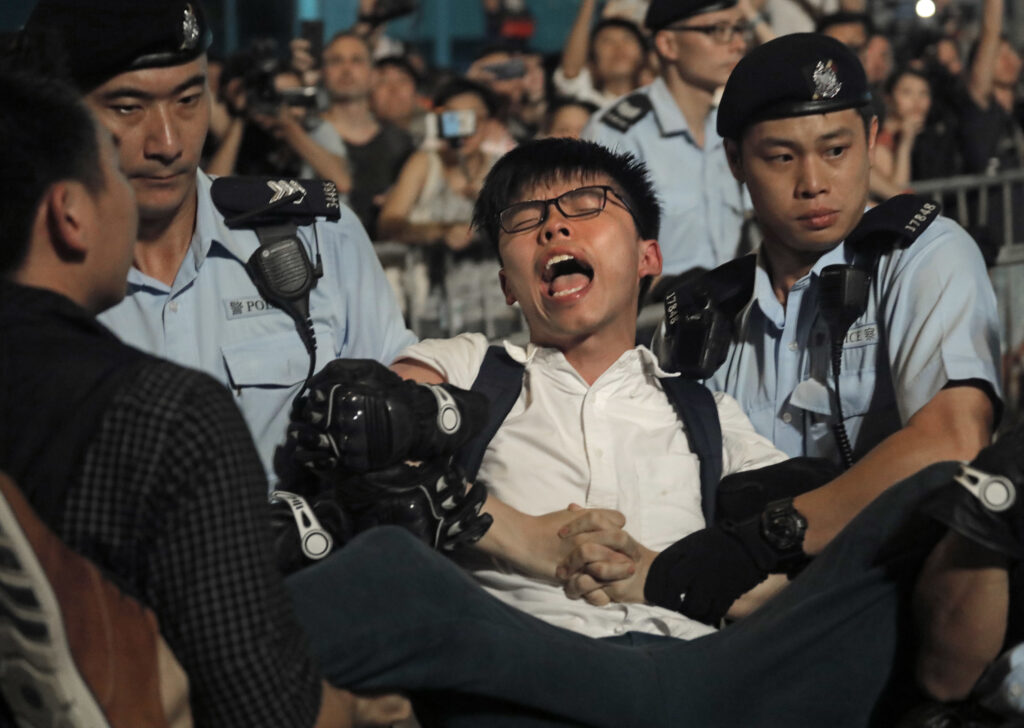
At 17, he made the cover of Time magazine as one of the leaders of the 2014 Umbrella Movement, when Hong Kongers demanding free elections shielded themselves from pepper spray as they occupied major roads for 79 days. In 2016, he co-founded the political party Demosistō, which promoted self-determination for Hong Kong. He became an international advocate for the freedoms Beijing had promised in 1997.
Over the next few years, Joshua was repeatedly arrested and prosecuted by the Hong Kong government, at one point facing six charges across multiple cases at the same time.
On June 30, 2020, Beijing imposed a sweeping national security law on Hong Kong. Demosistō was among more than 60 civil organizations forced to shut down. In November of that year, Joshua was detained again. This time, he never returned home.
One jail sentence followed another. He was imprisoned over protests during the 2019–2020 pro-democracy movement, including Hong Kong’s now-banned annual Tiananmen Square vigil. He was charged for conspiracy to commit subversion under the national security law for participating in an unofficial primary election in 2020 and sentenced to four years and eight months.
And in June 2025, when he was in the maximum-security Stanley Prison, police arrested him on the conspiracy charge to which he will plead guilty on Sept. 2.
Joshua had seen all this coming. When he was banned from traveling in 2020, he warned that the authorities would keep stacking cases against him, restricting his movement and silencing his voice. Six years later, that warning has become the reality of his adulthood.
We now learn about Joshua’s life largely through courtroom reports and accounts from friends. He exercises. He’s taking university courses and learning to play the guitar. He reads whatever he can obtain to follow a world that continues to change beyond the prison walls. In October, he will spend his 30th birthday in prison. These fragments remind us that Wong is still very much alive.
As I write these words in exile, I often think about the teenagers we were in Scholarism, brought together by the desire for a better future in the city we loved. Without Joshua stepping forward at such a young age, many of us might never have realized that we too have a voice.
Exile is not freedom in its fullest sense. But each morning in the United States, I wake up able to speak and organize. Joshua cannot. That freedom gives me a responsibility to use the voice he has been denied.
Joshua would not want his case to eclipse the hundreds of other political prisoners in Hong Kong. Before his imprisonment, he regularly drew attention to people facing even greater risks than his own. But forgetting Joshua would serve the authorities’ purpose.
The U.S. and other democratic governments should publicly make Joshua’s release — and that of other political prisoners in Hong Kong — a priority in every high-level discussion with Beijing. Leaders who once praised his courage should not fall silent when defending him requires taking concrete actions and spending diplomatic capital.
China’s government can keep Joshua from speaking to the world. It cannot keep the world from speaking about him. Wong’s chances of seeing freedom again depend on whether the people who watched him grow up are still willing to act. His fate should not become just another fact about Hong Kong that the world learns to accept.
The post As a teen, he led Hong Kong protests. China is still punishing him. appeared first on Washington Post.