Every time you open an email on your laptop or smartphone, it looks the same. The same words appear in the same order. Now, imagine if the email changed each time you read it, shifting in response to everything else you were reading on your computer.
In a paper published on Thursday in the journal Science, a team of Google researchers showed that the company’s experimental quantum computer exhibited behavior along these lines — though the particulars were much weirder and even harder to wrap one’s head around. This mind-bending phenomenon, called quantum contextuality, is a strong sign that quantum computers will one day do powerful things that no traditional machine could ever do.
“All of that weirdness can fit on a chip,” said Rodrigo Cortiñas, a Google researcher who was part of the study. “That is what we are building.”
A quantum computer is a machine that leverages the power of quantum mechanics, the strange physical properties of subatomic particles and other exotic matter. Google is among the many companies that, together with academic labs and government institutions, have spent decades working to realize this idea, which could help discover new medicines, create new materials, accelerate the progress of artificial intelligence and more.
But as the Google researchers show in the new paper, the calculations performed by a quantum computer are nothing like those made by a classical machine. When you read a piece of information from a quantum computer, what you read is not fixed in advance but instead depends on all sorts of other information you are reading from the machine.
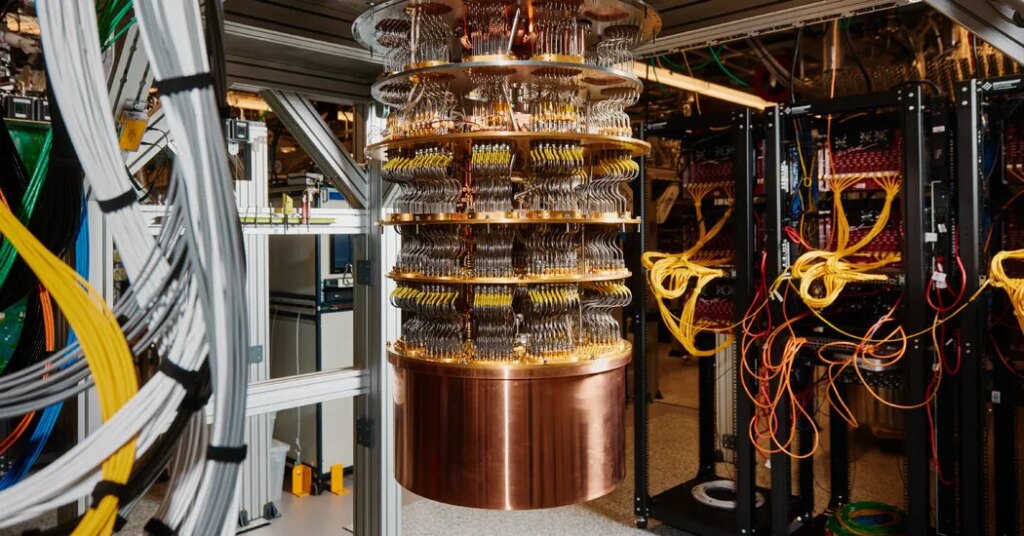
In their paper, the Google researchers demonstrate this phenomenon using the company’s quantum computer in Santa Barbara, Calif., which relies on what are called “superconducting qubits” — metals cooled to nearly 460 degrees below zero. Thanks to quantum contextuality, the paper shows, Google’s machine outperforms the best possible classical strategy on “the magic square game,” an elaborate mathematical contest.
This game is a bit like Sudoku: Two teammates work to fill a three-by-three grid with numbers that meet certain mathematical criteria. But the two teammates are not allowed to communicate.
By exploiting the weird way that information is created only when they read individual qubits — the “quantum bits” that these nascent machines are built on — teammates can settle on a common strategy more often than they do in the classical realm. And that means they win the game more often.
Google’s magic square game is a “toy problem” — a puzzle that demonstrates the power of a technology but provides no practical benefit. Researchers at Google and inside many other labs are still working to refine their quantum computers, so that they can tackle big, practical tasks. But if a quantum computer can crack problems like the magic square game, Google’s researchers believe, it could open the door to calculations that really mean something.
“You can describe quantum contextuality as the superpower of quantum mechanics,” said Michel Devoret, a Google researcher who won a Nobel Prize for his work on quantum mechanics.
To explain quantum contextuality, one of the paper’s authors, the Google researcher Shashwat Kumar, uses the example of a coin flip.
When you flip a nickel or a quarter into the air and cover it with your palm before actually looking at it, the result of the flip has been determined. Under your palm, the coin is either heads or tails. And that won’t change when you lift your palm.
But with quantum contextuality, he says, this familiar dynamic changes. If you also measure the size of the coin as you are checking for heads or tails, the result of the coin flip will change.
“The outcomes of quantum measurements are not predetermined,” Dr. Kumar said. “They are not ready to be read from a list. They come into existence while you are making the measurements, and they are shaped by other measurements around them.”
If that seems hard to understand, don’t worry. Like so much of quantum physics, it does not make sense to human beings accustomed to thinking about the world through the lens of classical physics.
For Mark Howard, a physicist at the University of Galway in Ireland who was not involved in the study, the point is that quantum computers behave in a way that classical computers do not. If scientists can harness this power, they can run calculations that would never be possible on a traditional supercomputer.
“The dream is that contextuality is the fuel that makes a quantum computer superpowered,” he said.
The post Quantum Computing Is Even Weirder Than You Think appeared first on New York Times.