For almost a decade, a Google lab in Santa Barbara, Calif., has led the global race to build a computer that harnesses the power of quantum mechanics: the unseen physical properties that allow light, subatomic particles and other exotic matter to behave in ways that defy common sense.
But this year, a brand-new lab in Colorado — developing a totally different path to a quantum machine — has changed the narrative and accelerated the competition.
The most surprising part of all is the new lab’s funder: Google itself.
Forty-five years after scientists first floated the idea of a quantum computer, the race to build one has turned into a sprint, with many experts now believing that the first viable machine could arrive before the end of the decade or soon after. This new excitement has unlocked enormous investment, with tech giants like Amazon, IBM and Microsoft racing alongside Google. In May, after China vowed to pump more than $15.2 billion into quantum research, the Trump administration fed $2 billion into a long line of American start-ups and chip makers.
But not all companies are approaching this big idea in the same way, and it is increasingly unclear which method will prevail — which is why Google has decided to hedge its bets.
To understand this twist, it’s necessary to go back to 2014, when Hartmut Neven, a German American physicist, founded the Google lab in Santa Barbara, hiring more than 20 scientists from the physics department at the University of California campus a few miles down the road.
Like several other tech giants, the Google scientists chose to build their quantum computer with a technology called a superconducting qubit, which relies on cooling metals to extremely low temperatures. And over the next five years, Google appeared to edge ahead of its rivals. In 2019, the company announced that its machine had achieved “quantum supremacy,” defined by the completion of a task that traditional computing couldn’t solve. In under four minutes, Google’s machine performed a calculation that would have taken an existing supercomputer 10,000 years.
Even as the field has progressed, one major hurdle to the creation of a usable quantum computer has remained: the problem of “error correction.” Error correction is an essential part of any computer, ensuring that calculations aren’t skewed by heat, electrical inference or other physical forces. The silicon microchips we use every day rely on robust electrical devices and sophisticated algorithms that eliminate such errors before they crash programs or corrupt data.
But the same methods of error correction used in conventional computing and communication don’t work with quantum computing. In recent years, even as Dr. Neven’s lab made progress on the problem, he began to see research from competitors using a totally different kind of quantum computing — the “neutral atoms” method, which involves trapping individual atoms with beams of light — that seemed to make error correction easier.
Faced with that research, Dr. Neven and Google took a bold step. In April, after a decade of investment in the Santa Barbara lab, the company opened a second, competing lab in Boulder, Colo., to explore neutral atom technology.
“Superconducting will get us there, but I wanted to avoid that last moment when some other technology might pass us by, even if it is only temporary, ” Dr. Neven said. “Neutral atoms have that chance.”
Dr. Neven is among the luminaries in the field who now think that powerful quantum computers are imminent. When they do emerge, they won’t replace the computers we rely on every day. But their facility with certain types of calculations could transform the world we live in — helping researchers discover new medicines, create new materials and accelerate the progress of artificial intelligence, among other things.
A quantum computer “can allow you to look at corners of the universe where you have never been,” said Mikhail Lukin, a physics professor at Harvard.
Like Tweezers Pinching a Fly
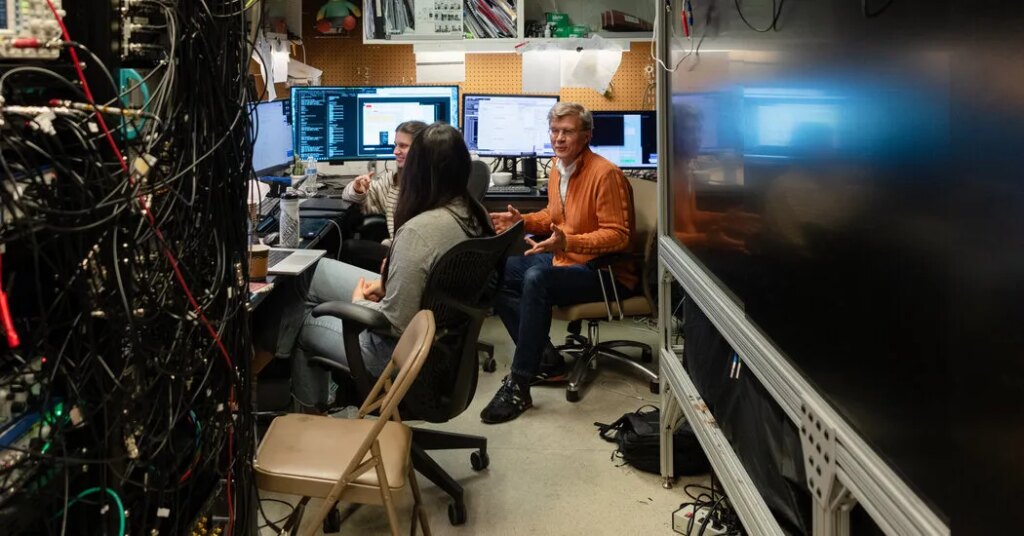
In the basement of the Harvard Physics Laboratory — a 100-year-old building in the North Yard of university’s campus in Cambridge, Mass. — a door opens into a small room filled with computer screens, oscilloscopes, keyboards, surge protectors and a rat’s nest of electrical cables.
The floor is barely visible, mostly because the room is dominated by a rectangular enclosure surrounded on all four sides by a black curtain. As Dr. Lukin pulls back the curtain, he reveals a maze of lasers, lenses and mirrors designed to bounce beams of light into a tiny vacuum chamber in the middle of the enclosure. This is a quantum computer built from neutral atoms.
“See that little glow?” Dr. Lukin said, pointing to a nearby computer screen on which an optical microscope provided a live image from inside the tiny vacuum chamber. “That is a cloud of atoms.”
Traditional computers perform calculations by processing “bits” of information, with each bit holding either a 1 or a 0. Even the largest supercomputers, which span several buildings the size of football fields, operate in this simple way. But a quantum computer does not. It uses a new building block called a quantum bit, or qubit.
A qubit relies on superposition, a quantum-mechanical phenomenon that allows a single object to exist in multiple states — or even in multiple places — at the same time. By harnessing this strange behavior, a qubit can store a combination of 1 and 0 — two values held in the same place, at the same moment.
This means that two qubits can hold four values at once. Three qubits can hold eight values. And as the number of qubits grows, a quantum computer becomes exponentially more powerful than a traditional machine.
If this feels nonsensical, that is only natural. Famously, the Nobel Prize-winning physicist Richard Feynman once said, “Nobody understands quantum mechanics.” The point is: Quantum systems do not behave like objects encountered in everyday life.
Out in Santa Barbara, Google’s researchers have built qubits by cooling metals to temperatures near absolute zero. They wire these metals into microchips that look a lot like the ones sitting at the heart of conventional computers.
But here in the Harvard Physics Laboratory, Dr. Lukin and his colleagues lean on a very different process. Four floors below the Harvard Yard, they drop atoms of rubidium into a vacuum chamber, where lasers can slow the movement of these tiny objects and separate them from one another. These lasers can grab hold of each atom — like a pair of tweezers pinching a house fly — and carefully isolate it from the rest of the world.
As they do, each atom becomes a qubit. Dr. Lukin and his colleagues can perform calculations by manipulating these qubits, reading and writing information through subtle changes to their physical behavior. Much as a classical machine writes data into a bit by changing its charge, a quantum computers writes data into a qubit by shifting its quantum state.
The neutral atom technique is particularly effective because it gives researchers fine-grained control over each qubit. Because these atoms are neutral — because they are separated from the rest of the world — researchers can readily move them and manipulate them. Then, exploiting a phenomenon called the Rydberg blockade, individual atoms can be excited to high-energy states that let them trade information over long distances, without interacting with other atoms close by. This allows researchers to build the equivalent of circuits, capable of running complex calculations.
But arranging clouds of atoms into viable machines involves years of work. Dr. Lukin started working on the problem in the early 2000s, and the technology is only now reaching the point where it can start to realize its promise.
Dr. Lukin is also one of the founders and the chief scientist of the Cambridge start-up Quera, which aims to commercialize the technology. Increasingly, others are following his lead. In October, he attended the Nobel Symposium on Quantum Computing in Cape Town, where Jian-Wei Pan, widely known as China’s “father of quantum,” told him that no fewer than 20 Chinese companies were building machines using neutral atoms in the city of Shanghai alone.
“We have finally demonstrated all the elements that we need to get there,” Dr. Lukin said. “For the first time, the ideas that people had three or four decades ago are now within our line of sight.”
Harnessing the Power of Entanglement
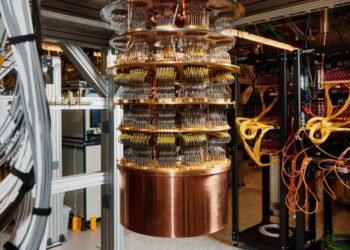
In Santa Barbara, Google’s quantum computer looks more like a Byzantine chandelier than a maze of lasers. This silver-and-gold lattice holds computer chips made from exotic metals that Dr. Neven and his team drop into massive refrigerators, cooling them to temperatures nearly 460 degrees below zero.
For years, these superconducting qubits looked like the surest path to a viable quantum computer. Like Amazon, IBM and others, Google strung together hundreds of qubits, showing that these quantum contraptions could perform increasingly complex calculations.
Google’s research indicates that a quantum computer is capable of the feats that scientists have promised for decades. But first, like all researchers in the field, they must solve the error correction problem.
Why is error correction so much harder in quantum computing than in traditional computing? Quantum systems are plagued by the famous “Heisenberg uncertainty principle,” which explains that with superposition — the state that quantum computers use to achieve their advantage over traditional machines — measuring one of the many properties of a particle will cause others to become unmeasurable. This means that merely looking at the information in an individual qubit causes it, in the terminology of quantum mechanics, to “collapse”: It slips back in the world of classical physics and transforms into an ordinary bit.
To deal with this problem, researchers design quantum computers that span far more qubits than they need for each calculation. That way, they can then read some qubits while leaving others undisturbed.
This is effective because quantum systems exhibit another strange property called “entanglement.” Through entanglement, one quantum system can influence the behavior of another, even when very far away — a phenomenon that Albert Einstein described as “spooky action at a distance.” Thanks to entanglement, researchers can glean information from a qubit by reading other qubits inside the same machine.
Part physical and part mathematical, this elaborate process is how researchers aim to crack error correction.
“It is intricate and complicated,” said Chris Langer, a fellow at Quantinuum, a company that is using a third quantum technique called “trapped ion” computing. “The basic idea is that you don’t measure the individual bits themselves. You measure information about the collection state.”
As far back as December 2024, Google said its machine had surpassed the “error correction threshold,” meaning that as its researchers increased the number of qubits, they could exponentially reduce the number of errors. Quantinuum recently showed similar progress with trapped ions — charged particles that researchers trap and isolate in much the same way they isolate neural atoms. But other researchers argue that error correction could be most efficient with the neutral-atoms method, because it offers more freedom to rearrange the qubits, tinker with their behavior and make the process more efficient.
When you build a quantum computer from neutral atoms, you have more room to manipulate them, to move them from place to place, to reconfigure them into new logical circuits, said Adam Kaufman, a professor of physics at the University of Colorado, Boulder. That means you have more freedom to do error correction.
“You have a way of turning their interactions on and off,” Dr. Kaufman, who leads Google’s new team in Colorado, added. “This gives you the flexibility to realize a quantum circuit that you can rewire as you evolve you quantum computer over time.”
‘Nature Isn’t Classical, Dammit’
Dr. Neven still isn’t sure which method will reach the finish line first. Even if neutral atoms win the day, he believes, superconducting qubits will be more effective in the long run. Regardless, he has faith that Google is on track to solve the error correction problem in the coming years.
The result would be a machine that is nothing like today’s supercomputers. One long-feared consequence will be the breaking of today’s encryption technologies, which rely on huge factoring problems that quantum computers will, in theory, be able to solve; earlier this year, Google vowed to overhaul its encryption techniques before 2030.
“In 2022 or 2023, I would have a told you that the encryption scare was far out,” Dr. Neven said. “The timelines have come down.”
But such a machine will also provide a way of examining the world through the lens of quantum mechanics — helping to better understand biology and disease, the world around us and the ways we navigate that world. All are dependent on the strange behavior of the quantum realm.
If you want to build a computer that simulates the natural world and helps unlock its deepest mysteries, it must operate at a level that today’s computers do not, Dr. Feynman, the physicist, explained during an 1981 lecture. “Nature isn’t classical, dammit,” he said. “If you want to make a simulation of nature, you’d better make it quantum mechanical.”
The post The Race to Build a Quantum Computer Has Become a Sprint appeared first on New York Times.