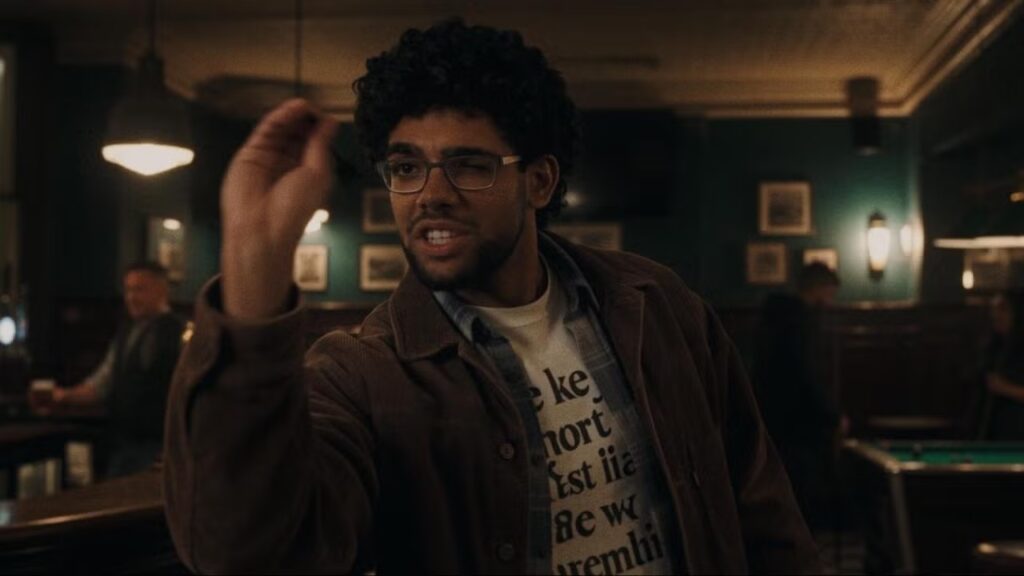
Startup Higgsfield AI caused a stir in May when it released its 95-minute AI-generated film “Hell Grind” at the Marché du Film at the Cannes Film Festival. While it was criticized for its nonsensical plot, the film impressed some audiences with its stunning technical visuals.
And now it’s letting people in on the prompts used to create the movie.
The San Francisco AI startup launched Higgsfield Academy in August, opening up the techniques used to create AI film in an effort to educate the next generation of filmmakers (and get them to use its AI platform, Cinema Studio). The company does not claim to be a film studio but instead sees its feature-length films as tools to teach the next generation of filmmakers.
The debut of this program comes amid a broader debate over AI, with studios and some creatives increasingly embracing the technology while large swaths of the Hollywood community continue to reject it on principle.
Higgsfield has benefited from the increased appetite for AI. Within the last 14 months, the startup has surpassed a $500 million annual run rate, which it claims makes it the fastest-growing generative AI company in history (although in the constantly changing world of AI, these records tend to shift quickly). Higgsfield.ai sees over 31 million monthly visits and serves over 26 million users worldwide.
The company has been teaching users how to use its technology with videos on YouTube and providing one-on-one assistance to its enterprise clients, but the newly minted Academy feature allows users to become “certified” in the technology for free.
The technique behind AI consistency
Mahi de Silva, Higgsfield’s co-founder and CEO, said the company sees the opening up of the prompts that created “Hell Grind” as a way to close the gap between the AI demos that have proliferated across the film industry and the reality of actually using the technology in production.
“One of the early criticisms of generative AI platforms is that people walked into the studios, they showed them a demo. They said, ‘Look, for a limited time, you can sign an exclusive deal with us. You have to commit $100 million to a contract, and trust us, we’re going to make it work for you,’” de Silva told TheWrap. “And I think the companies that did that have completely overpromised and underdelivered.”
Higgsfield’s approach, he said, has been informed by that skepticism. Rather than asking filmmakers to abandon the skills they have spent years honing, the company wants to incorporate them into the AI workflow.
“That gap between that great demo and how people actually get their hands dirty and get to use their platform — that’s really the motivation around this open sourcing,” de Silva said.
The company believes that a filmmaker who understands cameras, lenses, lighting and set design can apply that knowledge to generative media even if the tools themselves are new.
The Academy tool goes beyond simply video tutorials and now offers a more formal curriculum, allowing users to study the same workflows behind Higgsfield’s films.
The prompts are intentionally detailed. A single shot can require instructions around characters, environments, camera movement, lighting, action and continuity — as well as assets that have already been built within Cinema Studio. These intricacies make it so that, according to de Silva, consistency can really only be gained within their proprietary platform.
“You can cut and paste a prompt right out of our system and play it somewhere else, but you’re likely not to get the visual coherence, the visual fidelity from scene to scene,” de Silva said. “That’s part of our magic.”
Users can study how each scene was constructed and then begin changing it themselves.
The company said its platform is already used by 390 of the Fortune 500 companies and more than 170,000 corporate accounts. De Silva declined to characterize the company’s Hollywood customer base in detail, but said Higgsfield has also supported filmmakers with tasks including reshoots and visual effects.
For a company trying to establish itself in the entertainment industry, that distinction is deliberate.
“Our purpose in life is to be a tooling platform,” de Silva said. “I think it sends mixed signals to studios if they think we’re going to try to compete with them. So we’ve been very careful to be very clear. We are not in the content creation business. We’re in the tools distribution business.”

The company created two feature-length AI films, “Hell Grind” and “The Cully Hill Boys,” which featured the likenesses of two-time UFC champion Israel Adesanya, MMA veteran Quinton “Rampage” Jackson and livestream creator N3on, to give two stark examples to users attempting to make AI films of their own. The former is a sci-fi adventure film filled with visual effects, and the latter is a comedic action movie using real celebrities’ likenesses.
Teaching Hollywood to spot “AI Slop”
Higgsfield’s content lead and YouTube host Adil Alimzhanov has effectively become the public face of the platform, appearing throughout Higgsfield’s website and educational materials. His role is less that of a traditional AI evangelist and more of a translator between the technology and the people learning to use it.
One of the first things he wants new users to learn is how to recognize when an AI-generated image or video looks askew.
“With a lot of models, when you generate images, you get that AI slop look,” Alimzhanov told TheWrap. “The plastic look, where the skin is too smooth, the lighting is too perfect, and then the uncanny valley effect, where everything is too symmetrical, too perfect.”
Higgsfield attempts to bake some of that naturalistic look into its generation process, so the users can skip the slop step. Even a relatively simple prompt, such as a “girl standing in a park,” can produce a shot with a more deliberate camera angle, film grain, skin texture and lighting rather than requiring the user to specify every cinematic attribute from scratch, Alimzhanov said.

But the AI educator argued that users still need to develop their own visual literacy.
“First you need to learn how to identify slop,” he said. “We just show you a ton of visuals, and you have to identify what’s wrong in the image or the video.”
The reason, he said, is that audiences may not consciously identify a specific flaw, but they can still sense that something is off — and that can pull them out of a story.
That emphasis on taste and visual judgment could prove to be as important to Hollywood as it implements the technology itself. The industry already has no shortage of AI tools capable of generating images and video, but the harder question is how filmmakers can use those tools without losing the visual storytelling, continuity and intentionality that audiences expect from professionally produced entertainment.
For Higgsfield and its global filmmaking partners, they want to work in tandem with creatives rather than replace the existing production process.
Higgsfield is betting that the fastest way to get there is not to tell Hollywood that AI will replace its existing production process, but to teach filmmakers how to incorporate it into the one they already have.
“We firmly believe that machines are not going to be a substitute for humans. The machines are good at taking very complex tasks and simplifying them, but art doesn’t exist without a storyteller,” de Silva said. “We see this as really a celebration of creators and talent, and giving them access to realizing their creative talent at a tiny fraction of what it used to cost.”
The post The Company Behind AI Film ‘Hell Grind’ Wants to Teach You How to Make AI Movies for Free | Exclusive appeared first on TheWrap.