It has not been a good summer for eaters of fresh food.
Just as Americans are starting to come to grips with the cyclosporiasis wave and iceberg lettuce recall, jalapeños from Mexico were reported as suspected of being contaminated by salmonella.
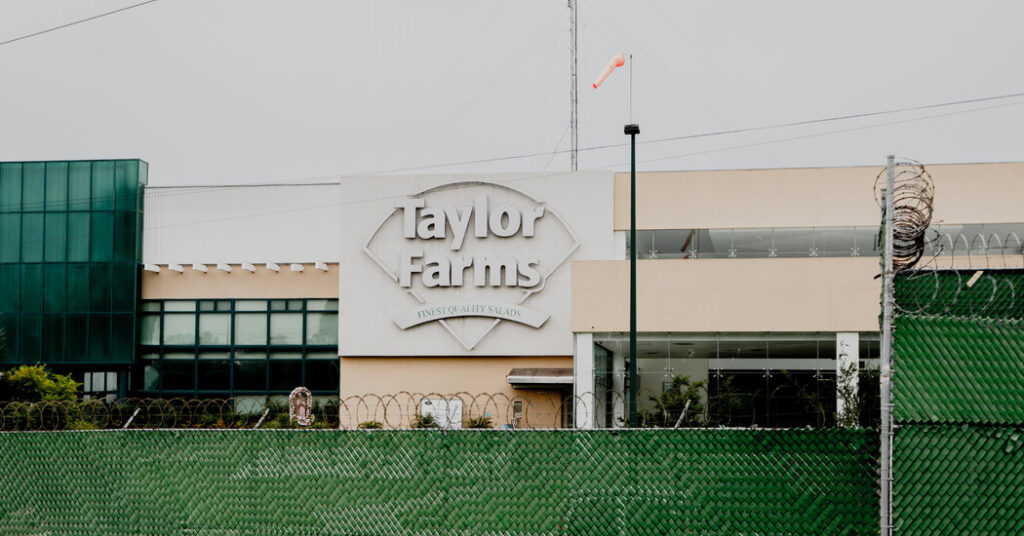
Both contaminations involve Taylor Farms, one of the country’s largest fresh produce companies, and both are linked to farms in Mexico.
Taylor Farms initiated a jalapeños recall on Sunday. It involves numerous products containing fresh peppers grown in Sinaloa, Mexico, that have been linked to 345 cases of salmonella nationwide.
You probably have questions. We have some answers.
What are the details about the latest Taylor Farms recall?
The U.S. Food and Drug Administration’s recall notice said the affected jalapeños had been shipped to more than half of the states in the country, and were used in prepared foods sold at retailers like Kroger, Target and Whole Foods.
The products recalled ranged from simple sliced jalapeños to rice-and-bean burritos that include the fresh peppers. The largest number of affected products are prepared foods like guacamole and salsa sold under the Taylor Farms brand or the house brand of the retailer.
A Taylor Farms spokeswoman pointed to information about the recall on the company’s website and said the company’s standards exceeded those mandated by the F.D.A. The F.D.A. did not have an immediate comment.
Is this recall related to the farm or facility involved in the iceberg lettuce recall?
It appears unlikely.
Taylor Farms recalled iceberg lettuce last month on concerns it could have been tainted by the cyclosporiasis parasite. The lettuce was grown on a farm either owned or contracted by Taylor Farms in central Mexico, and was processed at a Taylor Farms plant nearby. Most of the lettuce that Taylor Farms recalled on July 17 was supplied to food service customers, like restaurants, not retail customers, so it was minimally processed and sold in large volumes.
Generally, that is a different kind of facility and supply chain from one that produces foods like guacamole for retail sales.
Taylor Farms initiated the jalapeños recall, but the contaminated peppers did not originate with the company. Taylor Farms bought the produce from Coast Citrus Distributors, which sourced the jalapeños from a farm in the Mexican state of Sinaloa, hundreds of miles from the central Mexican farm and processing plant linked to the iceberg lettuce recall.
Representatives for Coast Citrus and GrubMarket, which acquired Coast Citrus last year, did not respond to requests for comment.
What else do we not know about the jalapeños recall?
While it seems the potentially contaminated food products were manufactured in the United States, that has not been confirmed, and we do not know what food safety inspections the jalapeños may have undergone when being imported.
We also don’t know which facilities processed the jalapeños and whether there was possible cross-contamination with other food made at the facility that may not contain jalapeños. It is also unclear whether those facilities are still running or temporarily shut down.
A Taylor Farms spokeswoman said the company would no longer accept products from the farm in Sinaloa that grew the jalapeños. She also said the company had the “most advanced and rigorous sanitation practices and programs” in the produce industry.
Was Taylor Farms the only company that received potentially unsafe jalapeños?
No.
The F.D.A. says Coast Citrus also supplied jalapeños to Chipotle Mexican Grill and Qdoba restaurants, and the investigation by public health agencies seemed to have started there. More than 90 percent of people interviewed by public health officials said they had eaten at a “Mexican-style” restaurant before becoming ill. Chipotle pulled the jalapeños on July 20 and Qdoba on July 28 — two weeks before Taylor Farms initiated its recall — suggesting the growers, the companies and public health authorities were in conversation well before the recall.
The Agriculture Department, which oversees the country’s meat supply, also issued a recall of numerous prepared meat products that included jalapeños. While many of those products, according to the department’s list, seem to have been manufactured by, or had jalapeños supplied by, Taylor Farms, some of the recalled products seem to have been manufactured by Bakkavor, a food manufacturing company.
How common is this type of recall?
Pretty common.
The F.D.A.’s recall database, which includes recalls, market withdrawals and safety alerts, has 23 notices linked to food products since the beginning of July, and 130 so far this year. Almost a quarter of those were linked to possible salmonella contamination.
Last year, the agency initiated 26 investigations into food-borne illnesses. More than half involved salmonella. Among those were mangos, moringa leaf powder, sprouts and pistachio cream, although not every investigation resulted in a definitive conclusion.
This year’s recall involving cyclospora is less common, however. Cyclospora cases surge each summer, and typically there are a few thousand annually, but so far 2026 has had over 13,000 confirmed cases.
Taylor Farms had two recalls in quick succession. Is that a lot?
Yes, but most cases of food-borne illness never attract the attention of public health officials, and even fewer of those end up in a recall.
In many instances, by the time officials think they know what’s making people sick, weeks or months have passed and the contaminated products are no longer in the food system. There is nothing left to recall, so no report is made public.
While recalls may be some of the best data we have, they are not a particularly precise indicator of whether a company is safely handling food.
Take, for instance, a case in late 2024 in which Taylor Farms supplied onions contaminated with E. coli to McDonald’s, causing 104 people to become sick. The F.D.A. said at the time that the onions had been voluntarily recalled, but it does not appear in the recall database.
Or take this week’s jalapeño case. It is listed on the F.D.A.’s database under Taylor Farms, but as stated above, the jalapeños were provided to Taylor Farms by Coast Citrus, and it is quite possible Taylor Farms did little wrong. But the company’s name is still attached to the recall.
As one of the largest fresh produce companies in the country, Taylor Farms is more likely than smaller companies to be involved in recalls. Still, some might say Taylor Farms should have better food handling and safety procedures than smaller companies.
Should we be eating produce right now?
Although the number of cyclospora cases is still growing, the F.D.A. says the last onset of illness from jalapeños was three weeks ago, meaning that outbreak is probably over.
Kyle Diamantas, the acting commissioner of the F.D.A., said Americans shouldn’t be concerned.
“Americans should have full confidence in the food supply in this country,” he said on CNBC on Monday. “We have the safest food supply in the world.”
The food industry, in large part, regulates itself and sets its own safety standards. Taylor Farms, and almost every other producer of leafy greens in the United States, belongs to either the Arizona or California Leafy Green Marketing Agreement, voluntary groups that commit their members to farming and food safety standards that are backed by state audits. Taylor Farms says it spends more than $200 million annually on food safety.
But while the Agriculture Department has inspectors in slaughterhouses ensuring the meat supply is safe, there is no similar federal program for produce. Very little foreign produce is tested at the border — and even if more was, finding a case of cyclospora in the billions of pounds of produce imported each year from Mexico would require finding the proverbial needle in the haystack. Taylor Farms’ processing facility in central Mexico was last inspected by the F.D.A. in 2019, according to the agency’s records.
The post What We Know About Taylor Farms’ Food Recalls appeared first on New York Times.