Just for the record, a celestial dragon will not eat the sun on Aug. 12, 2026. Nor will a mythic wolf named Sköll chase the sun through the sky, catching it and biting it. And nor will the sun be swallowed by a giant squirrel. But don’t tell that to the long-ago Chinese, Norse, or Choctaw people respectively, who believed that that’s what was happening during the course of a total solar eclipse.
Now we know better, but if we don’t look at solar eclipses with the same fear or fables that the ancients did, we still regard them with a combination of wonder, delight, and appreciation for the movement of the cosmic clockworks. The eclipse that will begin in the Arctic, over northern Russia at 7:54 p.m. local time on Aug. 12 and pass over and down through Greenland, Iceland, Spain, and the Mediterranean Sea—nipping the northeast corner of Portugal on the way—will be no different. And it will be the first total solar eclipse to pass over central Europe since 1999.
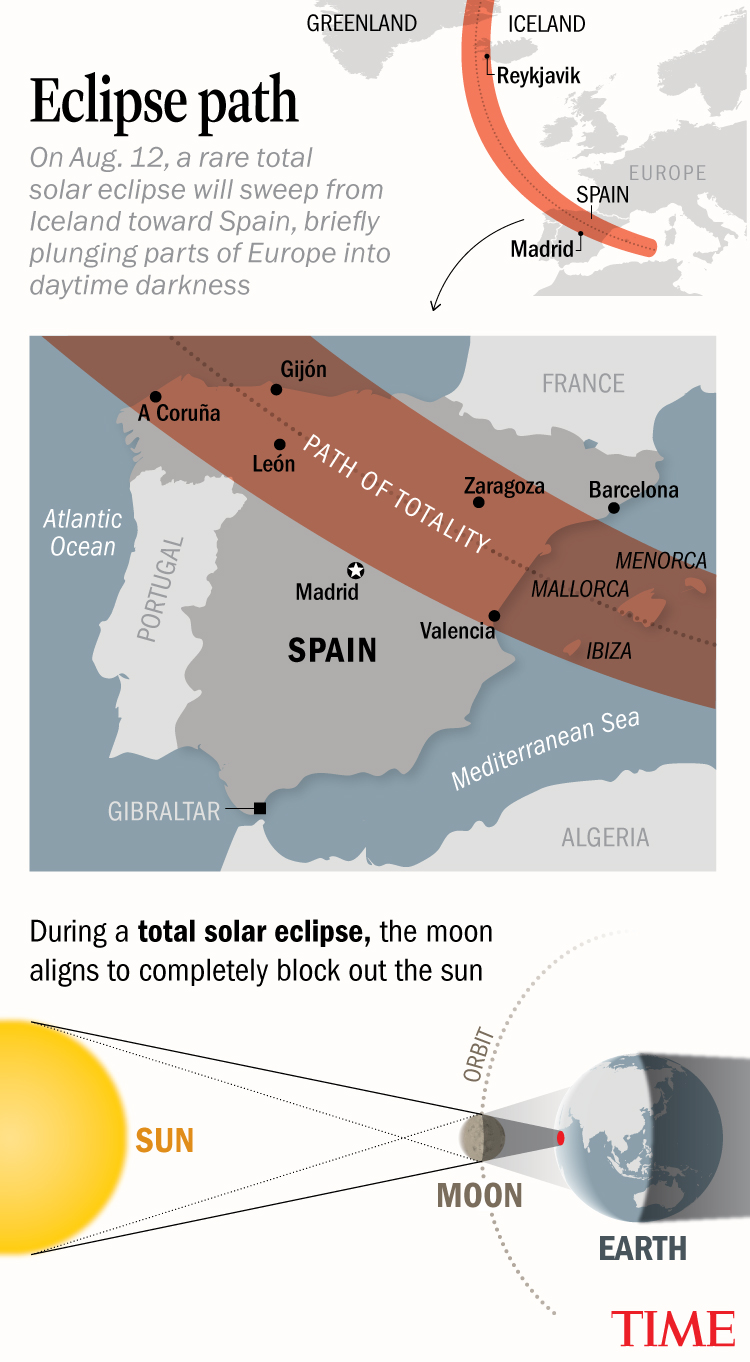
Total solar eclipses—when the disk of the moon entirely blocks the disk of the sun—are uncommon events. On average, one will occur somewhere on the globe only once every 18 months. At any particular spot on Earth an eclipse will happen just once every 350 years—whether that’s the heart of Paris, the fields of Stonehenge, or in this year’s case, the Snæfellsjökull National Park in Iceland, where the upcoming eclipse will cast its shadow at 5:45 p.m. local time.
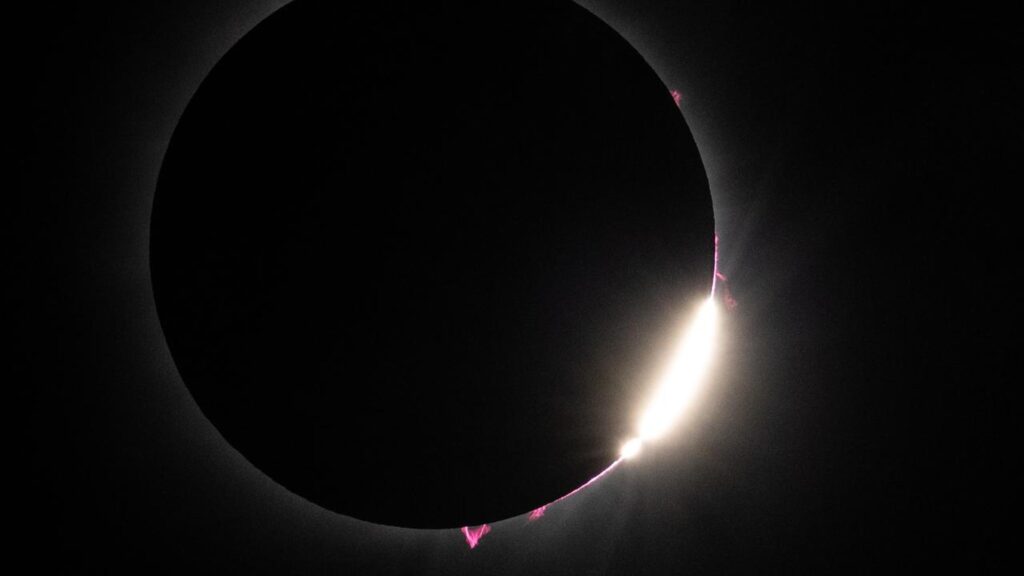
It’s only by a bit of celestial serendipity that perfect solar eclipses occur at all. The sun is about 865,000 miles wide—or 400 times larger than the 2,159-mile wide moon. But the sun is also 93 million miles away—or close to 400 times further than the moon, which is, on average, 239,000 miles from Earth. The result is that the disks of both bodies appear to be roughly the same size in the sky. When the moon passes in front of the sun in the just-so juxtaposition of a total eclipse, it thus causes the solar body to be blacked out entirely and the solar fires to flare brilliantly around the intervening moon.
Not every solar eclipse is total, of course. Partial eclipses, when the moon covers only a portion of the sun, are more common than total eclipses, occurring on average two times a year. Even total eclipses aren’t total everywhere. On Aug. 12, observers will have to be standing somewhere within a relatively narrow 182-mile-wide, 5,157 mile-long path—a stripe of shadow from Siberia to the sea—to get the full effect. Even then, the period of totality will be brief—no greater than two minutes and 18 seconds, depending on location. Western Iceland will see that longest totality. The farther outside that band of totality the less of the sun’s surface the moon appears to obscure.
There is, too, a third kind of eclipse known as an annular eclipse—caused by the vagaries of the moon’s orbit. The path the moon inscribes around the Earth is elliptical rather than circular. At its closest approach—or perigee—the moon is about 226,000 miles distant. At its farthest—or apogee—it drifts out to a 251,000-mile remove. The more distant the moon, the smaller it appears; if a solar eclipse happens when the moon is at apogee, the lunar disk is thus not large enough to cover the entire body of the sun, creating a so-called ring of fire effect, with part of the solar body visible around the entire circumference of the moon. On average, annular eclipses occur two times a year.
A total solar eclipse is not just an occasion for skygazing, it’s an occasion for science. The most celebrated experiment conducted during an eclipse occurred on May 29, 1919. Four years earlier, in Nov., 1915, Albert Einstein first presented his theory of general relativity, arguing, among other things, that gravity can warp space-time and bend light as it passes around a massive object like the sun. That bending would be slight. Starlight passing by the sun would, Einstein calculated, be diverted by just 1.75 arc seconds, with a single arc second measuring one=3,600th of a degree. It would be impossible to observe that phenomenon in real time, of course, since the brilliant fires of the sun would wash out something as faint as starlight. During an eclipse, however, those fires would be briefly blotted.
To take advantage of that opportunity, two expeditions of astronomers—one from the Greenwich Observatory and one from Cambridge University—set out for Sobral, Brazil and the island of Principe off the west coast of Africa, where the approaching 1919 eclipse would be visible. During the brief minutes of totality, they charted the precise positions of stars near the sun that popped into view when the lights went out. On subsequent evenings, after the sun had set, they mapped the positions of the same stars and found that they indeed differed slightly from the measurements taken during the eclipse.
“LIGHTS ALL ASKEW IN THE HEAVENS,” announced The New York Times in its Nov. 10, 1919 edition, after the results of the observations were published. “Stars Not Where They Seemed or Were Calculated to be but Nobody Need Worry.”
No such sensational studies will be conducted during the upcoming eclipse but some work will get done. During totality, NASA plans to fly a chase plane at 50,000 ft.—above cloudtop level—to observe the sun’s corona in different wavelengths of visible and infrared light. Moving at 480 miles per hour, the on-board cameras will see three minutes of totality—longer than any point on the ground will get. Elsewhere, students from universities around the U.S. will travel to Iceland and Spain to take part in the Nationwide Eclipse Ballooning Project, releasing research balloons before, during, and after the eclipse to study atmospheric dynamics when things go suddenly dark and just as quickly brighten again.
For the vast majority of the lucky 15 million people—or just 0.2% of the world’s population—living in the path of totality, however, the eclipse will be all about the sky show. The presence of the sun in the daytime sky is one of nature’s great verities—but only until it isn’t. Bearing witness to that vanishing is a rare and fleeting privilege.
The post Europe Will Get Its First Total Solar Eclipse in Over 25 Years. Here’s What You Should Know appeared first on TIME.