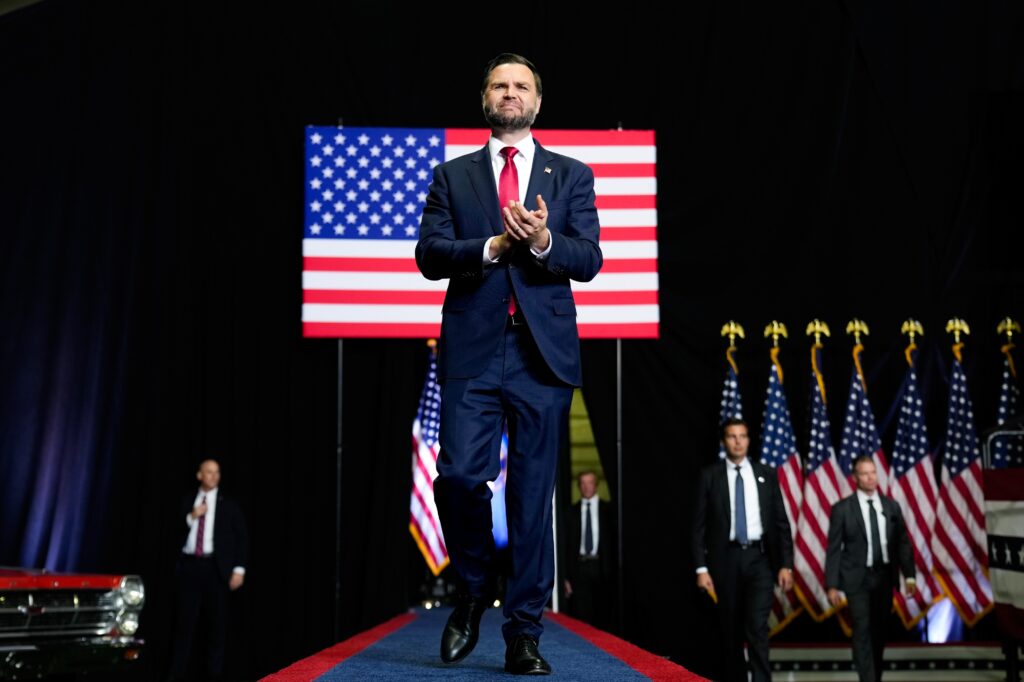
Vice President JD Vance isn’t out of the 2028 presidential race — at least not yet.
Detractors and even some well-wishers began writing his political obituary after Republicans’ historic drubbing in the midterm elections, surmising that the vice president — tied to a president with an all-time-low approval rating — sees the 2028 election as a lost cause.
But Vance is still more likely to run for president than not, according to several close allies with knowledge of his thinking. In interviews, more than a dozen people with a view into the vice president’s orbit, who spoke on the condition of anonymity to candidly discuss his future, described Vance as keenly aware of the headwinds against the Trump administration — but also of the potential for those winds to shift as Democrats increase their power in Washington.
“Two years is such an eternity in politics, and people are very easily prisoners of the moment,” said one person close to Vance, describing the vice president as someone who is largely able to resist “panicky inclinations.”
Vance faces major hurdles to a presidential bid.
“The war needs to end,” for any Republican to have a chance of winning, said Curt Mills, the executive director of the American Conservative magazine, which has vociferously opposed President Donald Trump’s war against Iran.
Trump’s appetite for ending the war has changed by the day. On Thursday, the president posted to Truth Social that he had asked Vance to stop working on a deal with Iran, and instead focus his attention on fighting fraud against public programs in “Democrat run Cities and States.”
Beyond that, Vance in the coming months will have the difficult task of separating himself from allegations of wrongdoing by administration officials or advisers who will be the targets of investigations by congressional Democrats. The potential for those investigations to create havoc for Trump and those around him gained attention this week with the furor surrounding the president’s adviser, Nvidia founder Jensen Huang, who resigned as his company’s CEO after admitting to an affair with a woman who is alleged to be a Chinese spy.
Despite that, Mills said, Vance is still the Republican front-runner, the country is likely to be closely divided in the next presidential election and Vance is a “pretty good politician.”
“So people who would tell him not to run, to go do something else — this is the best shot he’s going to get,” Mills said. “I think he’s the single most likely person to be the next president of the United States,” he added.
Whether Vance will take his shot remains uncertain. The vice president and his wife, Usha, are still adjusting to the birth in July of their fourth child. He said before the midterms that he would begin contemplating his decision in earnest after the election, and privately told people close to him he wanted to take the holidays to do so, according to two people with knowledge of his thinking.
That remains his plan.
The trouncing Republicans faced Nov. 3, several allies said, didn’t fundamentally change Vance’s calculus. They remain confident Vance would win a Republican primary if he runs.
A Reuters-Ipsos poll released this week found that 41 percent of Republicans and Republican-leaning independents rated Vance as an excellent 2028 candidate, followed by Secretary of State Marco Rubio at 40 percent, Florida Gov. Ron DeSantis at 29 percent and Donald Trump Jr. at 15 percent.
Rubio, however, has said he would support Vance to be the nominee if the vice president runs, and Trump Jr. is a close friend of Vance’s and in recent days has continued to publicly express support for him.
Multiple allies of Vance said he doesn’t have to be in a rush to reach a decision, with some suggesting he will do so by the first quarter of next year, and others saying he could give himself even longer to decide, allowing more opponents to jump into the fray in the meantime.
If voters’ repudiation of Trump’s policies draws more Republican candidates into the primary, Vance would benefit from a divided opposition — and all the better for him if those challengers openly criticize Trump, his allies said.
Despite the large margins by which the GOP lost last week, some Vance allies argue there are silver linings for him.
Democrats controlling both chambers of Congress will serve as a useful foil for him, they say. Vance spent much of this year having to publicly sell aspects of Trump’s record that were deeply unpopular with voters, including the economy and the war. Over the next two years, he can do less of that while focusing on battling with Democrats, a second Vance ally said.
The ally argued Vance’s proximity to and frequent communication with Trump puts him in a better position than his rivals to understand where the president draws the line on breaking with his policies. Vance’s rivals are at risk of crossing those lines, potentially inducing the president’s rage, the person added.
The primary election is only one piece, though.
If the broader electorate remains as angry with Republicans in 2028 as it is now, “we’re going to have big problems,” the first person close to Vance said, arguing that in that case, which GOP candidate wins the nomination won’t matter.
“But do you know who the general electorate was really, really down on at the end of the 2024 election?” the person continued, referring to voters’ dissatisfaction with Democrats during the last presidential election — just two years before they turned dramatically on the GOP.
The day after the midterm election, Vance decided early in the morning to write a response to the defeat. His post on X made clear his belief that the Iran war had cost Trump’s party the election.
Republican commentators who already opposed Vance — believing he has not been sufficiently friendly to Israel and critical of his negotiations with Iran — condemned him as being disrespectful to Trump.
But the reaction elsewhere to the post, including from Trump, gave the vice president reason for hope, according to an ally. Trump told an aide shortly before Vance posted his message that he was good with it. He later told reporters that he agreed with Vance’s assessment, although he also maintained that he had made the right decision to start the conflict.
With the tap of a button on his phone, the vice president was able to grab the attention of his party and of the national media and set the terms of the post-election debate, his allies noted.
Vance watched the way the post seemed to energize core Trump supporters, receiving praise from MAGA-aligned influencers and commentators, even as it was panned by more traditional Republicans who Vance is aware have long been opposed to him, the ally said.
Close allies of Vance have routinely noted how Trump himself was widely written off during both the 2016 and 2024 presidential elections, including significant pushback from within the Republican Party during the primary process. Vance in 2022 was seen as a long-shot candidate when he sought the nomination for Senate.
One of those people argued that Vance will “ultimately prove his critics wrong again” in 2028.
Eric Levine, a Republican fundraiser and board member of the Republican Jewish Coalition, who has opposed Vance’s rise since his 2022 election, said he has heard from four or five “pretty substantial donors” that they don’t want to back Vance.
“I can’t speak to every donor that’s out there, but the large donors that I’ve spoken to, there’s no support for the guy, and they’re looking where they can put their money,” said Levine, who supported Sen. Tim Scott (South Carolina) in the 2024 Republican primary. “Let’s hope he concludes that he can’t win in a general election and he wants to spend more time with his family and he decides not to run.”
People around Vance have embraced criticism from Republican backers of the war. Vance’s goal has long been to make “the right enemies,” and he is doing so now, another ally said.
The prospect of potentially losing some top traditional Republican funders hasn’t fazed people around Vance.
Earlier this week, a Silicon Valley-influenced donor group that Vance co-founded years ago, the Rockbridge Network, gathered in Texas to dissect the results of the midterms. Vance further cultivated his relationships with major party donors over the last year while serving as finance chair of the Republican National Committee, a job that required frequently traveling to meet with donors at fundraising events.
Still, it’s rare for sitting vice presidents to win a general election to succeed the president they serve.
Martin Van Buren did so in 1836 with Andrew Jackson’s backing. George H.W. Bush was the next, winning in 1988 while serving as Ronald Reagan’s vice president.
Trump at this stage, however, is no Reagan.
“Reagan was held in high esteem. I don’t think his numbers were stellar in ’88, but they weren’t bad,” said David Axelrod, who served as President Barack Obama’s chief political strategist. “This is a whole different kettle of fish.”
“You know, the times pick you, you don’t pick the times,” Axelrod continued. “But the question Vance has to determine is, are the times really picking him here, or are the times picking him for a fool’s errand?”
Vance’s young family remains a key consideration in his decision, and the vice president has been open with friends about the fact he dislikes raising his children in the constant shadow of the Secret Service.
Then he will also base his decision on the political reality, “the underlying effects of policy decisions and where the American public is,” said another ally.
“But it’s not the election” from last week that will determine Vance’s choice,” the ally continued. “That’s the misnomer.”
The post JD Vance still likely to run for president as GOP rivals circle appeared first on Washington Post.