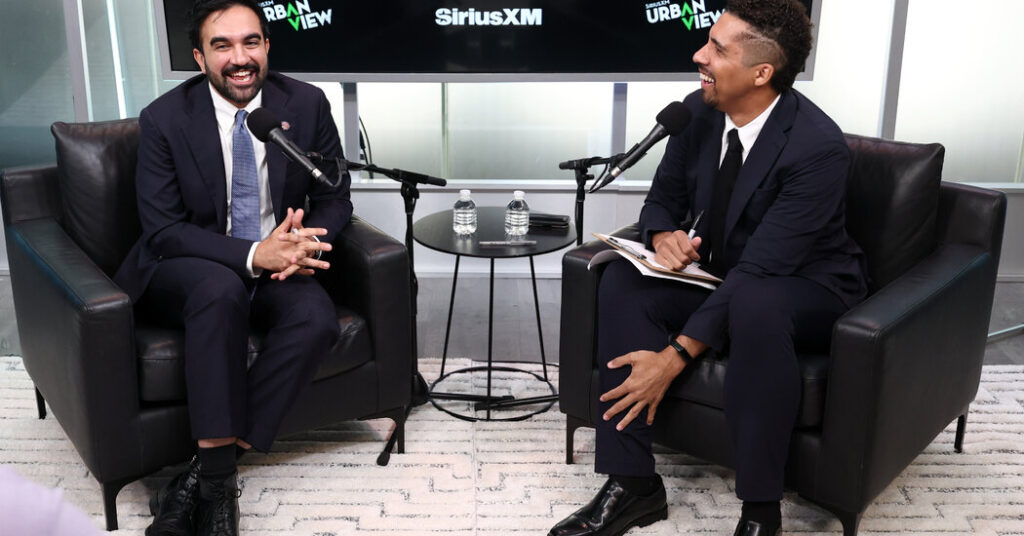
As he sat in a plush, dark leather arm chair, Mayor Zohran Mamdani seemed in his element.
He shouted out revered Black politicians, talked about his favorite Brandy album and picked his favorite New York-based musician (Mariah Carey if it’s around Christmas time, and Alicia Keys the rest of the year).
And he offered a hearty laugh when the host, Clay Cane, said that he often referred to Mr. Mamdani as “Mayor Kwame,” using the mayor’s middle name.
If the mayor seemed at ease, his recent familiarity with the format likely deserved some credit. The taped town hall on Thursday on the SiriusXM Urban View channel was among a blitz of interviews that Mr. Mamdani has given to Black media personalities in the last two weeks.
He appeared on Roland Martin Unfiltered and discussed whether taxing the wealthy would inadvertently hurt Black homeowners. He followed that up the same day with an appearance on The Shade Room, where he addressed everything from his comments calling Prime Minister Benjamin Netanyahu of Israel a war criminal to the Knicks’ championship run.
The next week, Mr. Mamdani appeared on the Lurie Daniel Favors Show on SiriusXM to discuss city-owned grocery stores. He told the former New York Times columnist Charles M. Blow in a sit-down interview for The Root that he supported offering reparations for the Black descendants of slavery.
A few days later, Joy Reid, a former correspondent for MSNBC, praised Mr. Mamdani’s policies and provided a robust defense of his stance on Mr. Netanyahu.
The extended outreach continues a strategy that the mayor began to embrace last summer, after he managed to capture the Democratic primary without winning a majority of Black voters — a traditional requisite for any citywide Democratic candidate.
Though Mr. Mamdani is popular among New York’s Black residents in polls, some leaders say he has committed a series of unforced errors that have antagonized their communities. They include his now-abandoned threat to raise property taxes by 9.5 percent, not initially hiring a Black deputy mayor and withdrawing references to diversity, equity and inclusion in the city’s first ever racial equity report.
Other leaders have also raised concerns about the Democratic Socialists of America’s electoral victories in gentrifying Black and Latino neighborhoods.
“There’s no question that there are parts of the coalition that need to be built and sustained,” said Andrew B. Epstein, a mayoral consultant who served as the creative director for Mr. Mamdani’s campaign. “I’m sure it’s very intentional where they’re spending their time and energy right now.”
Black residents aren’t the only group getting targeted attention. The mayor has had at least 10 interviews on Telemundo and Univision, launched El Chisme Oficial de NYC, a WhatsApp channel focused on Spanish-speaking New Yorkers, and relaunched the city’s Spanish-language Instagram account. On Friday, Mr. Mamdani held an ethnic and community media round table at City Hall on extreme weather.
Mr. Mamdani has also courted media influencers, doing 49 interviews with new media outlets or influencers, including 18 interviews with Black new media outlets.
Jeremy Edwards, a spokesman for Mr. Mamdani, said the mayor believes in an “all-of-the-above approach” to public communication, engaging with “legacy media, independent journalists, online creators and community outlets.”
The goal, he said, is to ensure that “Black New Yorkers hear from their mayor through trusted voices and platforms.” During his more than seven months in office, Mr. Mamdani has participated in at least two dozen interviews with Black media outlets with large Black audiences.
Mayor Adams tried a similar approach, appearing on nontraditional radio shows, podcasts and in small ethnic newspapers around the city. His administration also reorganized Room 9, the space where the media who covers City Hall sits, to limit traditional mainstream media outlets to one desk to increase access for ethnic media.
But while Mr. Adams’s moves seemed borne out of his frustration with how he was portrayed by mainstream media, Mr. Mamdani seems more motivated by a desire to pull every public relations lever he has at his disposal.
City Hall has built its infrastructure to support the increased media outreach, assigning Mr. Edwards, a deputy press secretary, to advise on Black media engagement. There is also a deputy for “creative partnerships” and Black media to work with Black content creators and influencers, and another deputy for ethnic and community media to engage with content creators that may “feel disconnected” from City Hall.
The flood-the-zone approach seems like a distant cousin to Mr. Mamdani’s initial campaign strategy as a little-known state legislator who was once polling at 1 percent in the Democratic primary for mayor.
The campaign focused on creating viral videos and on nontraditional progressive media such as podcasters, influencers on the left and content creators, hoping to draw in donations and volunteers. When Mr. Mamdani landed the cover of Little Africa News, a weekly newspaper focused on the African diaspora which had been a proponent of Mayor Eric Adams, the campaign celebrated.
“We were trying to make magic out of anything,” Mr. Epstein recalled.
Since his victory, Mr. Mamdani has become one of the most visible politicians in the country and no longer has trouble booking interviews. He has instead used his currency to create a media operation that can seemingly target niche audiences at will.
Ms. Daniel Favors said the administration reached out to her about appearing on the show to talk about the mayor’s announcement that planned city-owned grocery stores will offer a 30 percent discount for grocery staples like milk, meat and vegetables. She said the proposal will help to meet the goals of the Racial Justice Commission that she served on.
“Having a mayor who more readily centers nontraditional communities when it comes to outreach,” Ms. Daniel Favors said in an interview, “that’s a good thing.”
Mr. Martin, a veteran political commentator, said that he first interviewed Mr. Mamdani when he was running for mayor. Too often, he said, politicians come on his show when they are running for election “and then you never hear from them again.”
“I can tell you as someone who has frequently had Black mayors on my show, it is rare for non-Black American mayors to want to be this vocal in communicating with Black-owned media,” Mr. Martin said in an interview.
Sitting in a small Midtown studio with Mr. Cane and about a dozen audience members on Thursday, Mr. Mamdani took a listener question about the Democratic Socialists of America, of which the mayor is a member.
The listener said that the organization “appears to be more of a white movement that focuses more on class than race.” A recent survey of members of the New York City chapter of the D.S.A. found that 60 percent of its respondents were white, 9 percent Black or of African descent and 14 percent Hispanic.
“How is Mayor Mamdani working to make the D.S.A. have a better racial lens?” the question concluded.
The mayor answered that it was “criticism in good faith.” The D.S.A. has been one of the “engines behind the creation of a new generation of Black and brown leadership, the likes of which we hadn’t seen in quite some time,” the mayor said. Mr. Cane asked his mostly Black studio audience whether they had a problem with socialism or democratic socialism. No one raised their hands.
“The fear-mongering around it is just so interesting,” Mr. Cane said during the broadcast. “But when you’re engaging the people, it’s obvious that it’s about helping the working class outside of the labels.”
Mr. Mamdani agreed.
Mr. Cane said the mayor’s media strategy was a “brilliant” one that Democrats nationwide should be paying attention to.
“It really helps to build what we desperately need, which is a left-wing media ecosystem. We don’t really have that right now,” Mr. Cane said. “Mayor Mamdani is doing that.”
The post Now Coming to a Black Media Outlet Near You: Mayor Mamdani appeared first on New York Times.