
Is the economy still K-shaped?
The label came into vogue to describe an economy where the rich keep pulling ahead while the poor fall further behind. Recent comments from business executives and policymakers suggest that shape might be changing.
Hilton CEO Christopher Nassetta said that sales growth is spreading beyond just luxury. And Treasury Secretary Scott Bessent said the economy is now C-shaped, with outcomes at either end of the wealth spectrum starting to converge.
“I got sick of hearing about this K-shaped economy,” Bessent said in an interview with CNBC’s Squawk Box. “I can say here, definitively, the K-shaped economy is over.”
But the data suggests a more limited shift: lower earners have seen some gains, but higher earners are still spending and doing well enough that the broad trajectory of diverging economic outcomes has not fully changed.
“C-shaped would suggest that maybe we’re seeing some compression in inequality — that as the high end does a little bit worse and the low end does a little bit better, we start to meet more in the middle,” said Elizabeth Pancotti, the vice president of policy, advocacy, and research at the Groundwork Collaborative, a left-leaning think tank. “I don’t think we’ve seen any evidence to suggest that we’re closing the gap on those things.”
What would turn a K into a C?
In Bessent’s accounting, the C shape is defined by robust wage gains for lower earners, housing inflation moderating for renters and homeowners, and more favorable tax policies, such as no taxes on tips, under President Trump’s sprawling new package.
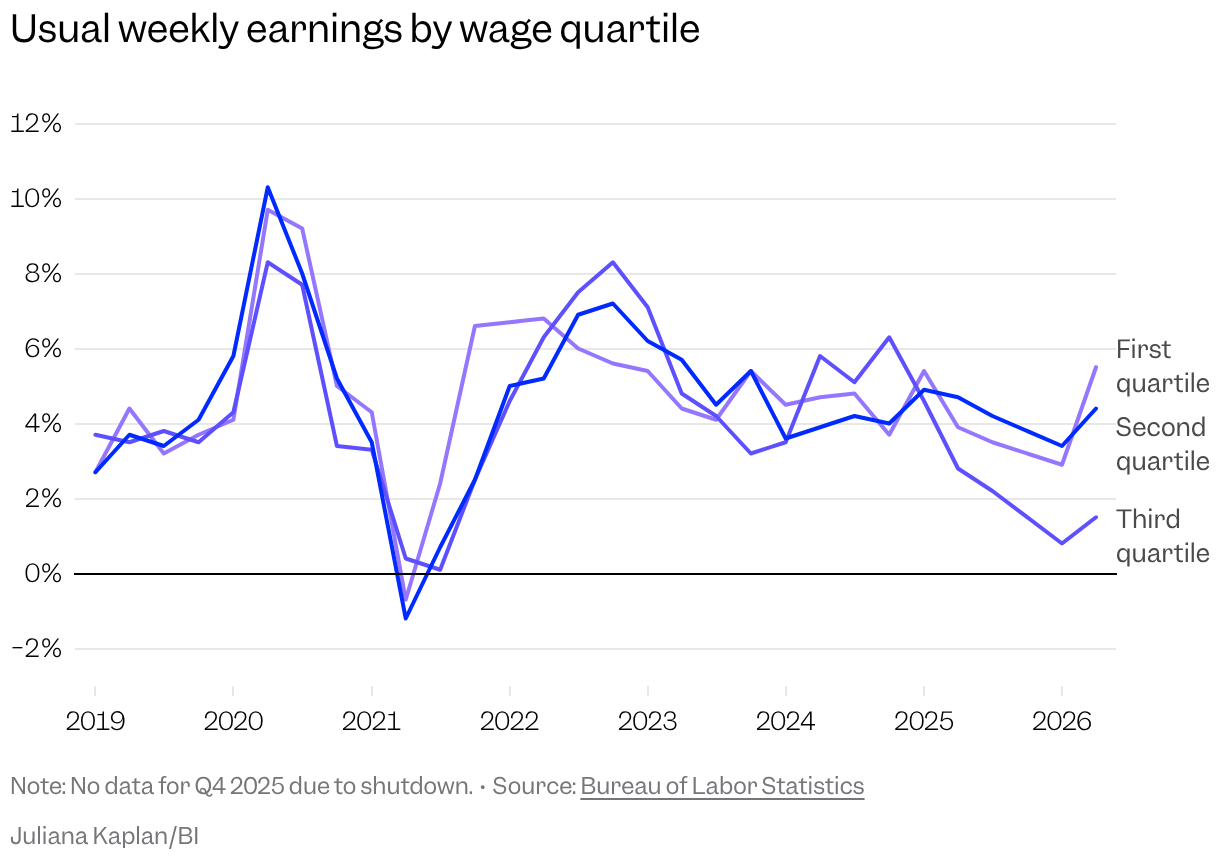
Bessent pointed out that wages for the lowest quartile of full-time workers grew 5.5% year over year. That tracks with Bureau of Labor Statistics data that tracks wage growth among full time wage and salary workers. Higher-paid full-time workers saw much slower wage growth — an indicator of a possible C formation.
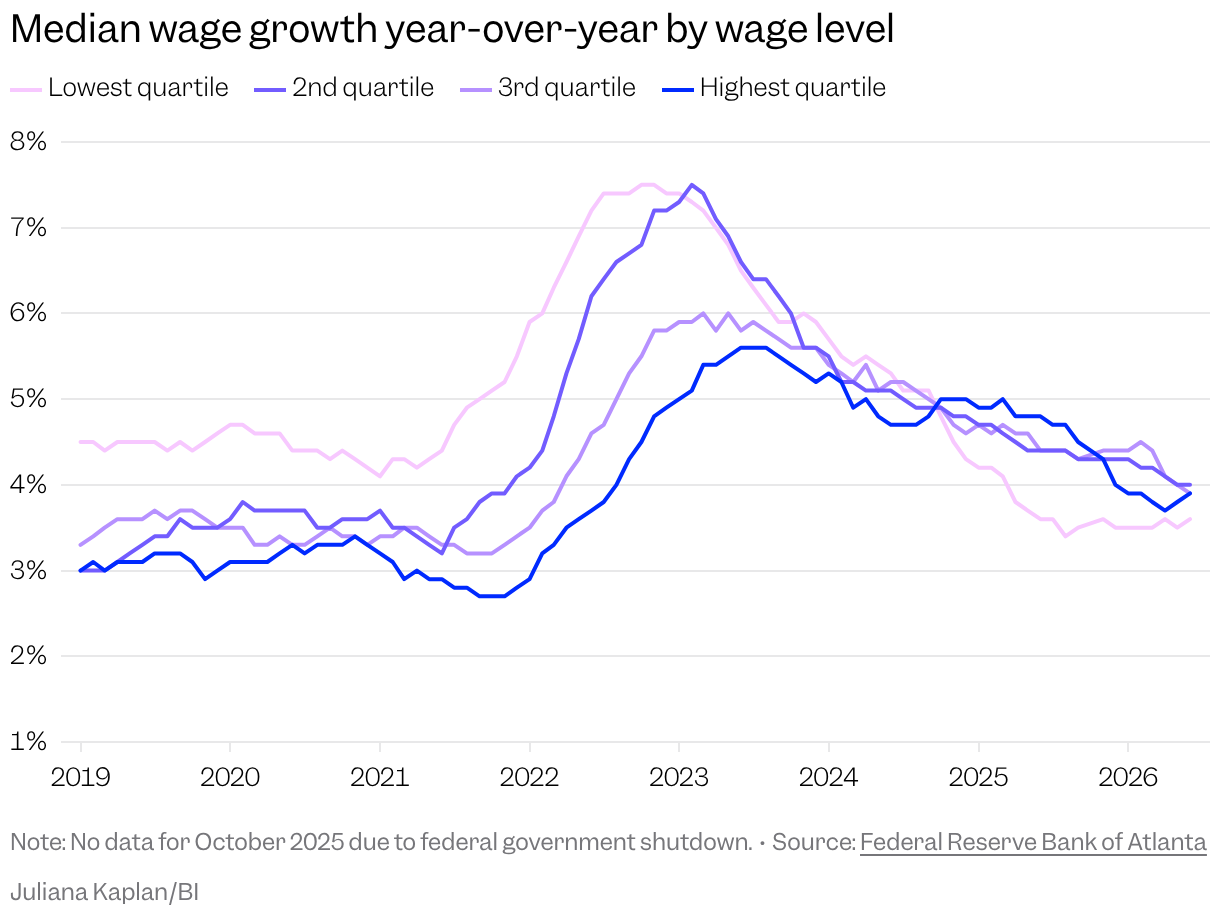
But including hourly or part-time workers in the analysis changes the picture. Earnings data analyzed by the Federal Reserve Bank of Atlanta, which includes such workers, shows that the lowest earners have seen the smallest gains since late 2024.
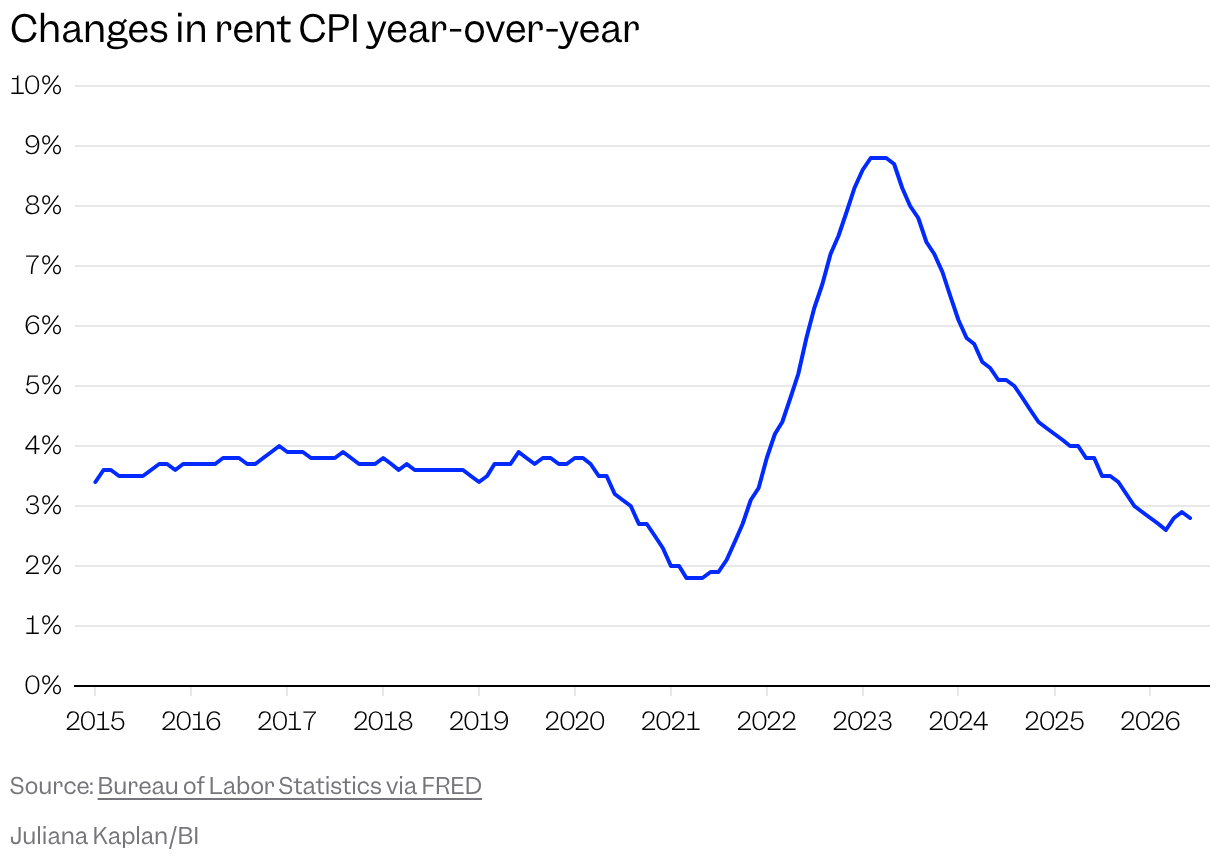
Bessent cited rent as an example of falling inflation. But housing costs for renters and homeowners continue rising, despite recent tempering. Rent CPI is slowing, but is likely not having a huge impact on bending the K.
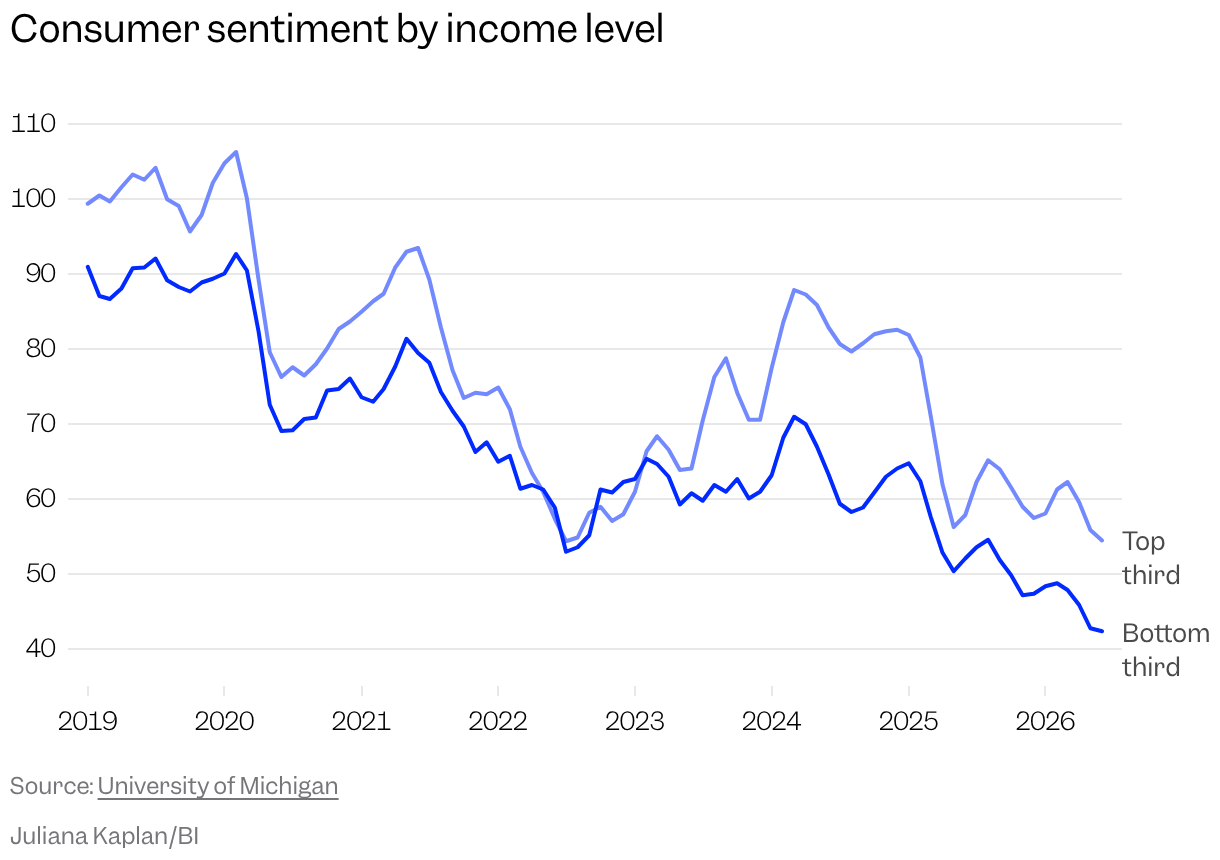
Higher-and lower-earners both feel dreary about the economy, with consumer sentiment for both groups falling in a similar shape since late 2024. Even so, lower earners continually feel worse.
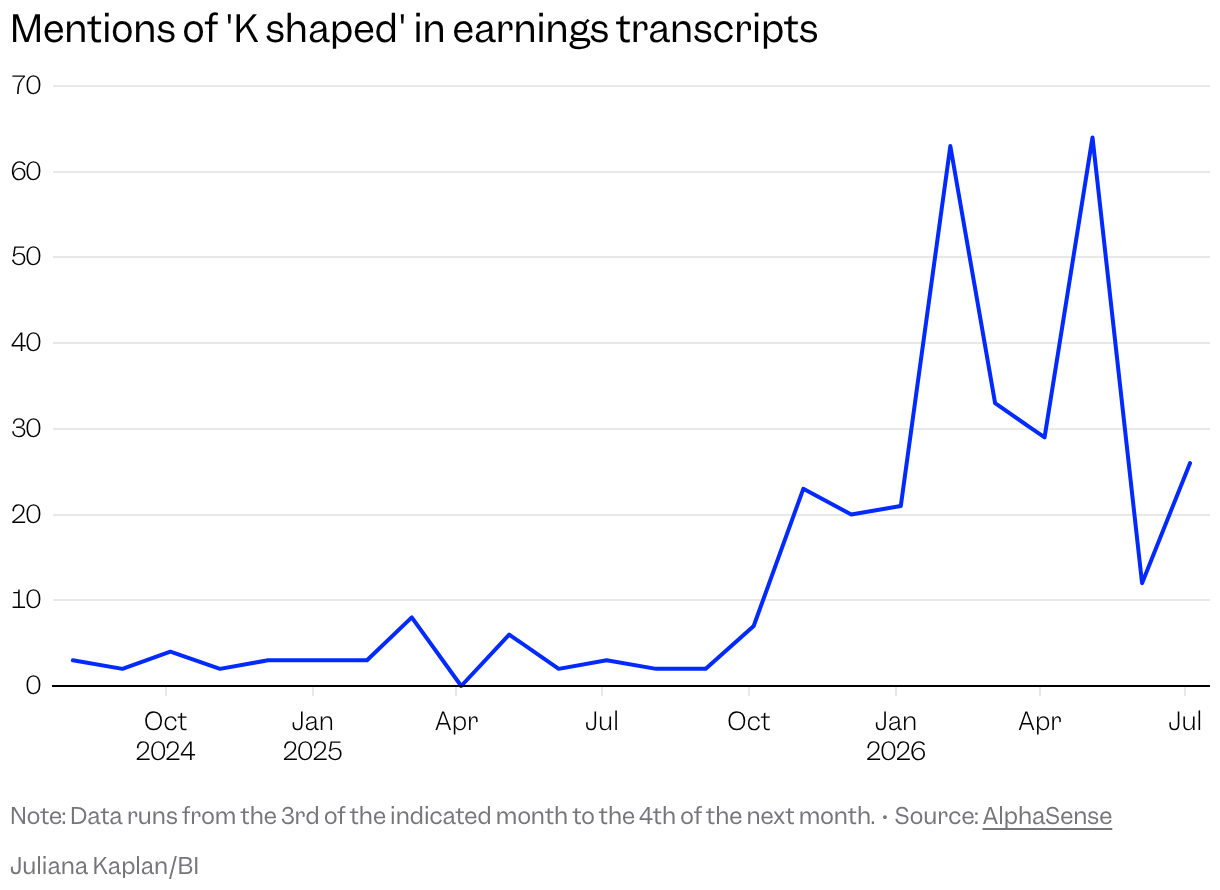
While firms are still mentioning the dynamic in earnings calls, the number of mentions has fallen from early and mid-year peaks. Conversely, there have been just eight mentions of a “C shape” in the past two years.
Finally, the K-shape still shows up clearly in consumer spending. A study from the Federal Reserve Bank of Atlanta found that, from 2021 through its most recent data in 2025, spending among the top 40% of earners grew the fastest, while spending among the lowest quintile grew the slowest.
“I think that in general, high income, high wealth consumers are doing just fine,” Pancotti said. “They have no issue buying first-class airfares even when they have doubled over the past few months.”
Instead, the dynamic that’s been shaping up is more akin to a K with slightly softer prongs: The trajectory for high earners hasn’t changed, and the lowest earners are seeing slightly more stability.
Ultimately, trying to describe the economy with a letter shape might just be alphabet soup.
“I don’t think we’re in a K-shaped economy when it comes to the consumer,” said Ernie Tedeschi, the chief economist at Stripe. “By definition, the rich always have more money. They’re driving some amount of consumer spending growth, and it just doesn’t look like the story in 2024 or 2025 or 2026 is meaningfully different from any other solid economy with a roughly 4% unemployment rate.”
Read the original article on Business Insider
The post The K-shaped economy isn’t dead yet appeared first on Business Insider.