Lucky are the cities exalted by their buildings. San Francisco has its Victorian rowhouses, and Paris has the Second Empire mansard roofs that frame nearly every vista. But some cities’ architectural treasures aren’t so obvious, and that’s one reason I found myself exploring Helsinki last year.
Tourism to Finland has boomed in recent years, with many visitors drawn by the country’s consistent ranking as the world’s happiest country, not to mention its forests, lakes and, yes, saunas.
I had traveled to Finland to research a biography I am writing about the early-20th-century Finnish architect Eliel Saarinen. Perhaps less famous in America than his architect son, Eero — who designed icons like the Gateway Arch and the TWA Flight Center — Eliel played a key role in creating Helsinki’s dreamy, modern look, before moving to the United States at age 50.
And what a look. Time and again I was beguiled by Helsinki’s charms. The city, founded in 1550, is a relative newcomer compared with its grander, older siblings Stockholm and Copenhagen. But Helsinki has a lyrical cast that speaks of fin de siècle optimism, defined by the radical architecture sweeping Europe circa 1900: Art Nouveau.
However whimsical it looks to us now, Art Nouveau — or Jugendstil (German for “youth style”) — was revolutionary, Modernism’s first stirrings 20 years before the Bauhaus emerged in Germany. While short-lived, the movement — with its emphasis on asymmetry and the curving line — would ultimately help lead to the more geometric Art Deco.
Art Nouveau was born in Brussels in the early 1890s, and quickly came to define large parts of cities like Barcelona and Paris. But Helsinki, with 600 Jugendstil buildings, is an overlooked wonderland that unspools like a series of stage sets. Block after block of sensuous facades form a surprisingly uniform urban fabric. Undulating towers and turrets define streetscapes, with an assist from idiosyncratic windows and doors. Curious woodland creatures carved in stone peer down from above.
A Nordic Pilgrimage
Eliel Saarinen, the son of a Lutheran pastor, burst onto the scene in 1897 as a 24-year-old university student, nabbing the commission for the Finnish Pavilion at the 1900 Exposition Universelle in Paris. His design, in the National Romantic style — a rough-granite version of Art Nouveau — took its inspiration from Finland’s medieval churches. It attracted widespread coverage, putting the country on the international creative map, and making Saarinen and his two architecture partners overnight stars.
I aimed to check out a series of Saarinen buildings on my self-guided tour, and made a plan to trace the evolution of early Finnish Modernism by visiting them chronologically.
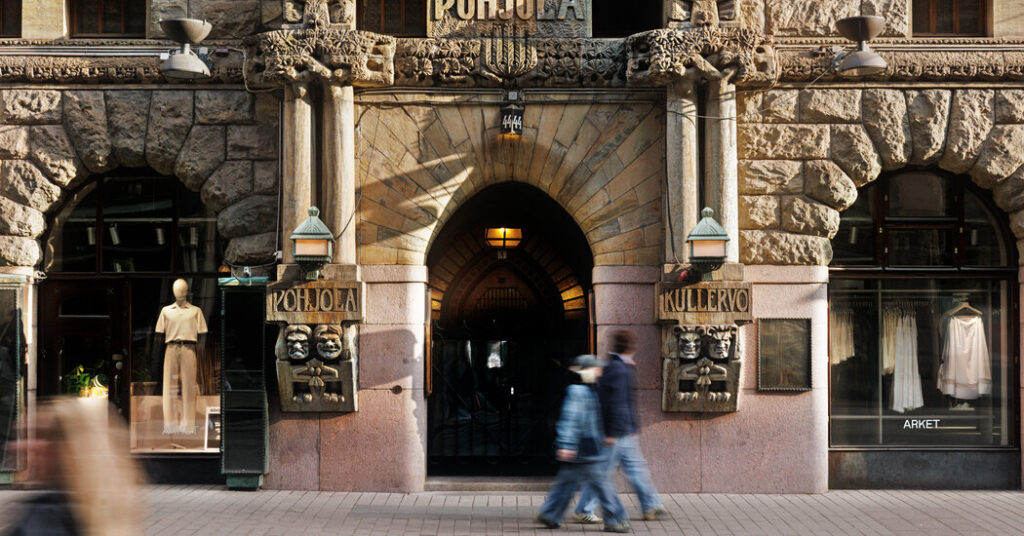
So my first morning, after two shots of espresso, I made a beeline for the 1901 Pohjola Insurance headquarters, Saarinen’s third big project, after the pavilion and a trendsetting apartment house.
Buildings rarely have a sense of humor. But Pohjola, a rugged stone structure with echoes of the Boston architect H.H. Richardson — famous for Trinity Church in Copley Square — is an exception. It’s hard to miss Pohjola, a corner landmark with a green-copper, pyramidal top, and soapstone and granite walls crawling with foxes, bears and grinning idiots, all drawn from Finland’s founding epic, the “Kalevala.” Most striking are the grotesque and hilarious goblins guarding the entrance. (In what some might see as a demonstration of public engagement with art, pedestrians sometimes deposit cigarette butts in their gaptoothed smiles.)
I dropped by Pohjola early one morning, and spent a giddy hour photographing the four-story circular staircase — a classic Saarinen touch — and its jewel-toned skylight, as well as the wraiths carved into wooden newel posts.
From Pohjola, I crossed the Esplanadi, a lively, linear downtown park, and continued up the hill to the Gothic Revival Architecture & Design Museum. I was headed to their archives for some research on Saarinen, but first I couldn’t resist spending 45 minutes in the main galleries, which featured two artfully designed shows — one on Alvar Aalto, the Finn who built Baker House at M.I.T., and another on the artist Tove Jansson, a polymath who created the beloved hippo-faced cartoon characters, the Moomins.
An Explosion of Art Nouveau
Just northeast of the museum, jutting out on a peninsula, the Katajanokka neighborhood offers rich opportunities for free-range Art Nouveau wandering, as well as parks, restaurants and the Allas pool complex, which features saunas and a seawater plunge.
By chance, my hotel, Noli Studios Katajanokka, was two blocks from three Saarinen apartment houses on my list, including the first Art Nouveau structure in Helsinki — the 1898 Tallberg House, whose success opened the floodgates. By 1914, the old city of two- and three-story wooden structures vanished under these types of apartment houses, a Jugendstil stampede powered by new industrial wealth and a jump in population.
Unlike the red-brick Tallberg, nearby Saarinen apartment buildings feature smooth plaster walls in a range of soft colors, a sunny yellow predominating. Olofsborg (1902) is an especially charming residential block with a large, red-tiled cupola, green copper roofs and oddball projections — oriels, towers and box windows.
A Home for Hobbits and Men
In 1903, the young Saarinen and his partners built Hvittrask, a rugged, National Romantic communal mansion and studio for themselves 18 miles west of the capital. Today, it’s a beautifully restored state museum. Alas, this libertine gambit did not end well, generating scandal and divorce amid inaccurate rumors of wife swapping.
Still, the partners could take a joke: A stained-glass window in Hvittrask’s dining room commemorates this odd ménage, in which Saarinen’s first wife abandoned him for his partner Herman Gesellius, and Saarinen married Gesellius’s sister, Loja. The three architects and their partners continued to live together.
One of my Finnish friends calls the house “very ‘Lord of the Rings,’” and indeed, it could well be a great abode for hobbits or elves. With tours in English, Hvittrask is a time capsule from a vanished avant-garde, and a work of art where everything from curtains to furniture to the exterior facade was designed as a unified whole. The studio, with its skylight and vast windows overlooking the forest and lake beyond, is a treat.
Unfortunately, I missed another Saarinen landmark, the National Romantic Finnish National Museum — half castle, half cathedral — which was closed for renovations and cocooned in scaffolding. The museum is set to reopen in 2027 with a new annex that resembles a sleek flying saucer.
Saarinen’s greatest monument, and an icon of early Modernism, is his 1914 Helsinki Central Railway Station. But the current building wasn’t the architect’s original design. Saarinen won the 1904 depot competition with a churchlike, granite National Romantic structure similar to the National Museum. But this victory provoked a pair of scathing rebukes by two young architects in an architectural journal.
One was Gustaf Strengell, who deplored the proposal’s “quasi-nationalistic, archaic, archaeological romanticism” as wholly inappropriate for a building housing cutting-edge technology. Saarinen may have been Finland’s most celebrated young architect-artist, but that didn’t save him from a public drubbing.
But the next year, according to Timo Tuomi, an adjunct professor at the University of Helsinki and the author of the forthcoming “From Form Follows Everything: Eliel and Eero Saarinen,” Saarinen returned with a new proposal for what Dr. Tuomi calls a work of “monumental poetics.”
That design is simpler and more geometric than the original, pointing the way toward Finnish Modernism. With its copper-clad tower looming over Railway Square, and four giant, bas-relief lantern bearers holding great glass globes that light up the night, the depot remains one of Helsinki’s most arresting sights.
Saarinen Tours, run by Eliel’s great-grandniece, offers one-hour visits to the clock tower and its high balcony, which has fabulous views (24 euros, or about $27.30).
A Global Legacy
Saarinen took second place in the Chicago Tribune Tower competition and moved to America in 1923. His design won far more ecstatic praise than the winning entry by the New York architects John Mead Howells and Raymond Hood — the latter would go on to head the team that designed Rockefeller Center.
Saarinen settled in Bloomfield Hills, Mich., north of Detroit, where he built the three campuses of the Cranbrook schools, which the former New York Times critic Paul Goldberger called “one of the masterworks of American architecture.” Saarinen also designed First Christian Church in Columbus, Ind., a building that Frank Gehry said knocked him to his knees; an open-air concert hall for the Tanglewood music festival in the Berkshires; the museum at the Des Moines Art Center; and Kleinhans Music Hall in Buffalo. He died at Cranbrookin 1950.
Throughout his life, Saarinen remained unafraid to evolve and grow, and never let himself be captive to any particular style, an achievement that made my tour of Helsinki deeply illuminating. A world of difference separates works like Cranbrook and the Pohjola Insurance headquarters, yet a current of inventive genius unites them, exalting the Finnish capital city and a leafy Michigan suburb alike.
Michael H. Hodges, an author in Ann Arbor, Mich., is writing a biography of Eliel Saarinen, to be published in 2028 by Wayne State University Press in Detroit.
Follow New York Times Travel on Instagram and sign up for our Travel Dispatch newsletter to get expert tips on traveling smarter and inspiration for your next vacation. Dreaming up a future getaway or just armchair traveling? Check out our 52 Places to Go in 2026.
The post Beguiled by the Dreamy Streetscapes of Helsinki appeared first on New York Times.