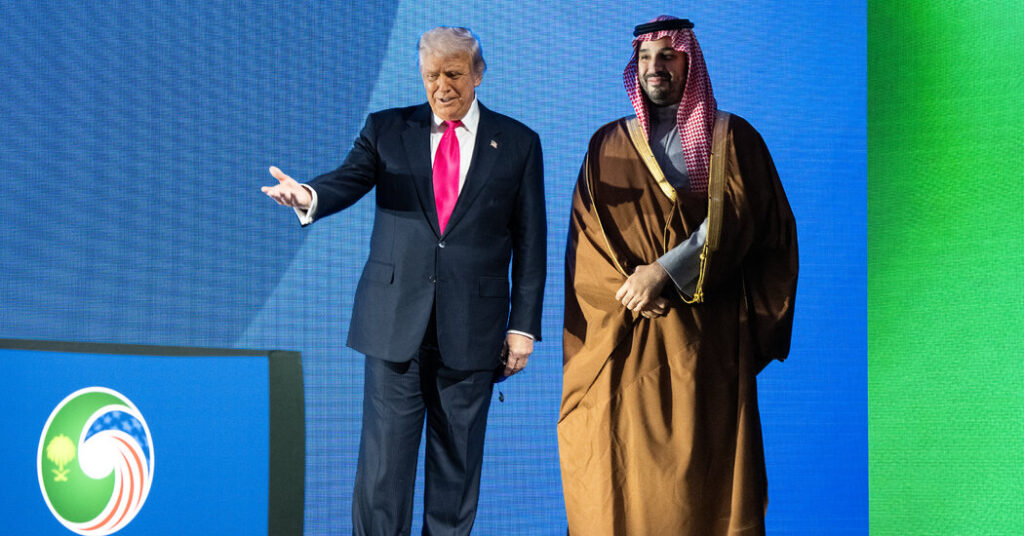
The Trump administration is expected to announce on Wednesday that it has reached an agreement with Saudi Arabia to develop a civilian nuclear program that could lead to the country enriching its own fuel for reactors.
This type of deal is known as a 123 Agreement, pronounced 1-2-3. Such legally binding agreements set out the conditions for nuclear cooperation between the United States and other governments, aimed at preventing the development of nuclear weapons and setting out safety rules. The United States has 26 such agreements with 51 governments and the International Atomic Energy Agency.
Such agreements govern deals for American companies that manufacture and export nuclear material and equipment, and provide a framework for diplomatic negotiations. They also require congressional approval.
Here’s a look at such agreements.
What is a 123 Agreement?
According to the State Department, the agreements are named for Section 123 of the Atomic Energy Act of 1954, which lays out the rules of transfer and storage of nuclear material, though the president can choose to exempt countries from specific requirements.
The guidelines include:
-
Countries must ensure the safe transfer of nuclear material and equipment.
-
They must adhere to safety standards outlined by the International Atomic Energy Agency.
-
Nuclear material and equipment from the United States may not be used for military purposes or in any nuclear explosive devices.
-
The United States can demand the return of the material or device if the other country detonates a nuclear explosive device or fails to meet I.A.E.A. safeguards.
-
Countries must get approval before enriching or reprocessing any of the nuclear material.
-
Countries cannot transfer highly enriched uranium or plutonium without advanced approval from the U.S.
How are such agreements typically reached?
The State Department leads the negotiations for 123 Agreements with interested countries, while the Department of Energy and the Nuclear Regulatory Commission provide technical assistance, according to the State Department.
The State Department then submits an assessment of the country’s request to the president, as well as the director of National Intelligence. It’s then up to the president to sign off on any deal, which must be submitted to Congress for approval.
Trump Administration: Live Updates
Updated
- The U.S. trade representative, Jamieson Greer, calls Trump’s tariff policy a success.
- The House narrowly passes a stopgap spending bill, but a shutdown fight still looms.
- Trump threatens to impose steep tariffs on generic drugs.
The president also has the power to exempt an agreement from any of the 123 Agreement criteria. So far, according to the Congressional Research Service, all the agreements passed have been without exemption.
Congress has 90 days to review, and possibly object to the signing of such an agreement. If Congress does not pass a resolution to block the agreement, it goes into force. In the case of a Saudi Arabia deal, the agreement would likely pass because Congress would need a veto-proof majority to override Mr. Trump’s initiative.
In the past, lobbying groups have called for greater Congressional oversight and stronger guarantees that partner countries will not pursue the development of nuclear weapons.
What are the limitation of 123 Agreements?
Some materials used in commercial or civilian nuclear programs can be used in weapons technology. A 123 Agreement does not prevent countries from enriching or reprocessing material not obtained as part of the initial deal with the United States, according to the Center for Arms Control and Non-Proliferation.
In 2009, the United States entered into a more restrictive agreement with the United Arab Emirates, which became known as the “Gold Standard” for nuclear nonproliferation. The U.A.E. agreed to forgo the right to produce its own fuel, cutting off the possibility that it would have the infrastructure to produce a weapon. It also agreed to stringent inspections, signing what is called an “additional protocol” with the I.A.E.A.
In his proposed deal with Saudi Arabia, Mr. Trump has allowed concessions that walk back some restrictions negotiated by the Bush and Obama administrations.
Which countries have signed 123 Agreements?
The oldest such agreement was signed with Canada in 1955, and the most recent deal was signed with Singapore in December 2024. The United States also has separate agreements with China and Taiwan. The U.A.E. is the only Middle Eastern country that has signed a 123 Agreement. Both Russia and Ukraine have also signed 123 agreements.
The post The U.S. Has Rules for Nuclear Deals With Other Countries. Here’s How They Work. appeared first on New York Times.