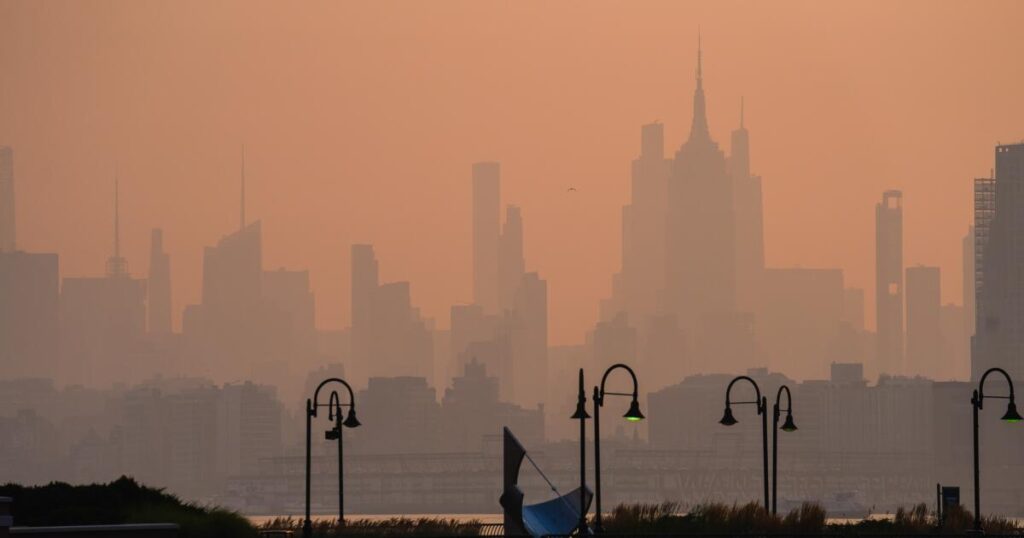
Warnings of unhealthful air quality remained in effect Saturday across a wide swath of the United States due to smoke from Canadian wildfires that has engulfed the Northeast in haze for days.
The smoke was expected to mostly clear from the New Jersey area in time for Sunday’s World Cup final, however, thanks to thunderstorms passing through the area, meteorologists say.
New Jersey Gov. Mikie Sherrill warned residents Saturday about the potential for damaging winds, tornadoes, flash flooding and large hail, and flooding caused scattered street closures in New York.
President Trump blamed Canada for the smoke crossing the border and threatened tariffs in response. Ontario Premier Doug Ford said threats from the United States were unacceptable and shortsighted.
This storm front will largely move the smoke out of the Northeast before the soccer final between Spain and Argentina, said Tyler Roys, a senior meteorologist at AccuWeather.
“There could be some lingering smoke that would make things hazy but very faint,” Roys said. “In terms of the thickest smoke, the smoke that has really been eye-popping and leads to poor air quality, that is not expected across New York City or much of the Northeast.”
Despite the respite, the smoky conditions won’t be gone anytime soon, as the fires continue to burn largely unchecked, cautioned Bob Oravec, a lead forecaster at the National Weather Service based in Maryland.
Wildfires are burning in the Ontario area of Canada as well as the Boundary Waters Canoe Area Wilderness in Minnesota, which U.S. officials have closed as they fight to put out the blazes.
“The source of the smoke is going to continue on for certainly a week, probably,” Oravec said. “It’s just going to depend upon which way the wind’s blowing as to where the smoke is going to affect the most.”
On Friday, communities in Minnesota, Illinois and Michigan, including Detroit, again registered some of the worst air quality in the world, according to IQAir, an air quality monitoring website.
Not far behind Detroit was Washington, D.C., where the smoke created eerie scenes. The Washington Monument, the Lincoln Memorial and other national landmarks were enveloped in an orange-hued haze throughout much of the day.
People, particularly those with heart or lung disease, older adults and children, were urged to limit or avoid going outside until air quality improved.
Long-term exposure to smoky conditions can complicate existing health problems and lead to chronic and deadly issues, including respiratory illness, cardiovascular and neurological diseases, and premature death, officials warned.
For Maria Travela, Friday was her first day outside since after smoke from the wildfires blanketed the Chicago area early Thursday.
“Now it’s better. This morning, it was bad,” said Travela, who has asthma and wore a mask as she crossed a bridge over the Chicago River downtown. “They were saying that, for people like me, with asthma, any kind of issues like that, it would be bad for your lungs.”
Trump said on his social media platform, “We are holding Canada responsible” for the smoke caused by the wildfires. He added that the U.S. “is being unnecessarily invaded by filthy, polluted, and unhealthy air, the quality of which is dangerous, and totally unacceptable!”
Canadian Prime Minister Mark Carney addressed the topic of U.S. officials complaining about smoke from during a news conference Thursday. Carney said climate change is the responsibility of everyone, including the United States.
Ford said Canada has contributed to fighting fires in the U.S. and offered assistance when Georgia was hit by a hurricane in 2024 because “that’s what neighbors do.” Ford called the rhetoric “absolutely unacceptable” when Canada is “trying to get through this.”
Wildfires have been igniting across Canada and northern Minnesota this month. Meteorologists monitoring them say they are burning longer and faster because of climate change. The Canadian Wildland Fire Information System showed hundreds of active fires Saturday. Environment Canada issued air quality warnings across the country and into the Northwest Territories.
The fires prompted evacuations, including in Nova Scotia where there’s a large fire that local and provincial crews have been fighting since Wednesday, and in northwestern Ontario, where some of the most intense fires are burning.
In Ontario, nearly 200 wildfires have already scorched more land than all of last year’s fires. In Thunder Bay, Ontario, Fire Chief Dave Tarini said this fire season is unprecedented in his more than 35 years as a firefighter.
In British Columbia, about 100 fires are burning, a huge jump from the 20 firefighters were facing Wednesday. The BC Wildfire Service says the fires are largely the result of 4,000 lightning strikes that hit the province Friday.
The post Thunderstorms will clear wildfire smoke from Northeast, but unhealthy air persists appeared first on Los Angeles Times.