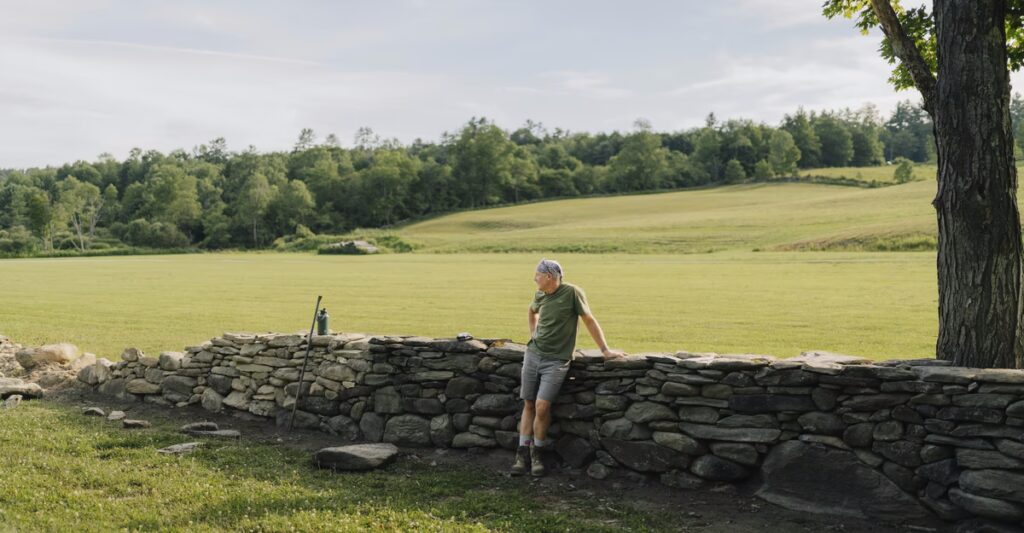
“Something there is that doesn’t love a wall,” Robert Frost wrote in the famous opening line of his 1914 poem “Mending Wall.” That something sends the “frozen-ground-swell” of winter that “spills the upper boulders in the sun,” leaving Frost and his New Hampshire neighbor the springtime duty of picking up and replacing the rocks. Plenty of things want to get a wall down—above all, gravity—but, I have found, there is a countervailing force: Something there is that does love a wall.
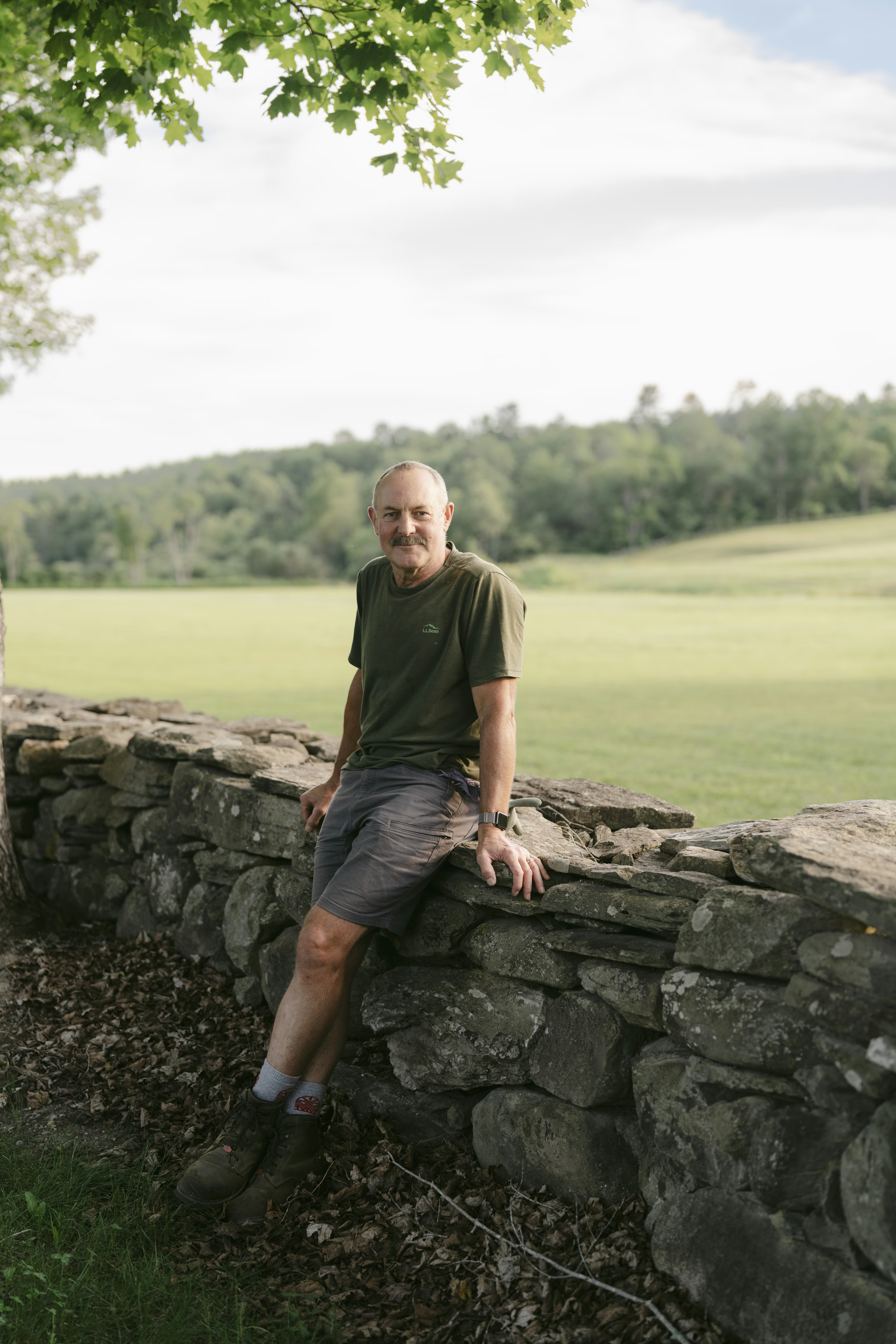
People love walls, especially the weather-grizzled, lichen-blotched stone walls that crisscross the woods, hills, fields, and gardens of New England. I am one of them.
By the time Frost was composing those verses, on the eve of the First World War, many of the wall builders were gone, having abandoned the depleted soil of New England. Fewer hands were mending stacked-stone boundary markers and livestock fences, which were disappearing back into the forest. And yet, today, we live with a solid remnant of that astonishing feat of human labor—the quarter-million miles of stone walls that an 1871 survey measured in the American Northeast. Where those walls still stand, we cherish them as charismatic markers of the Yankee landscape. Contoured lines of stacked stones running across fields help organize the vista. Their geometry implies a reassuring sense of something permanent—and permanently right—about a deeply American scene, along with white clapboard houses, red barns, rolling hills, goldenrod.
I first became properly acquainted with stone walls after my wife inherited her parents’ Vermont home, in 2010. A ramshackle line of piled rocks ran between the garden and the meadow. One section had gotten pulled aside and left in a heap, and there the stones had lain for several decades, slowly gathering humus and turning into something resembling a small burial mound—until I came along and decided to disinter the stuff and pile it back up. My work was rudimentary, but I was enraptured.
[Read: How hobbies infiltrated American life]
Other modest efforts followed, and then came the coronavirus pandemic. In need of something to counteract the alienation of desk-bound remote work, I turned to the collapsed and spreading 70-foot vestige of a wall that bounded the beginning of the meadow. I attended a day course at the Stone Trust, an educational foundation in southern Vermont, where I learned the principles of building to a line, “battening” (the English style of tapering a wall inward toward its apex), and reinforcing with through-stones and copestones; my building became more proficient.
Bit by bit—which is the way with walls—my interest and knowledge deepened until what had begun as recreation morphed into a hobby job, mending other people’s walls. Eventually, I realized not only that I liked building walls, but also that I could scratch a subsistence living at it. In what probably struck friends and family as an act of lunacy, I quit my day job as an editor at this magazine and became a part-time waller.
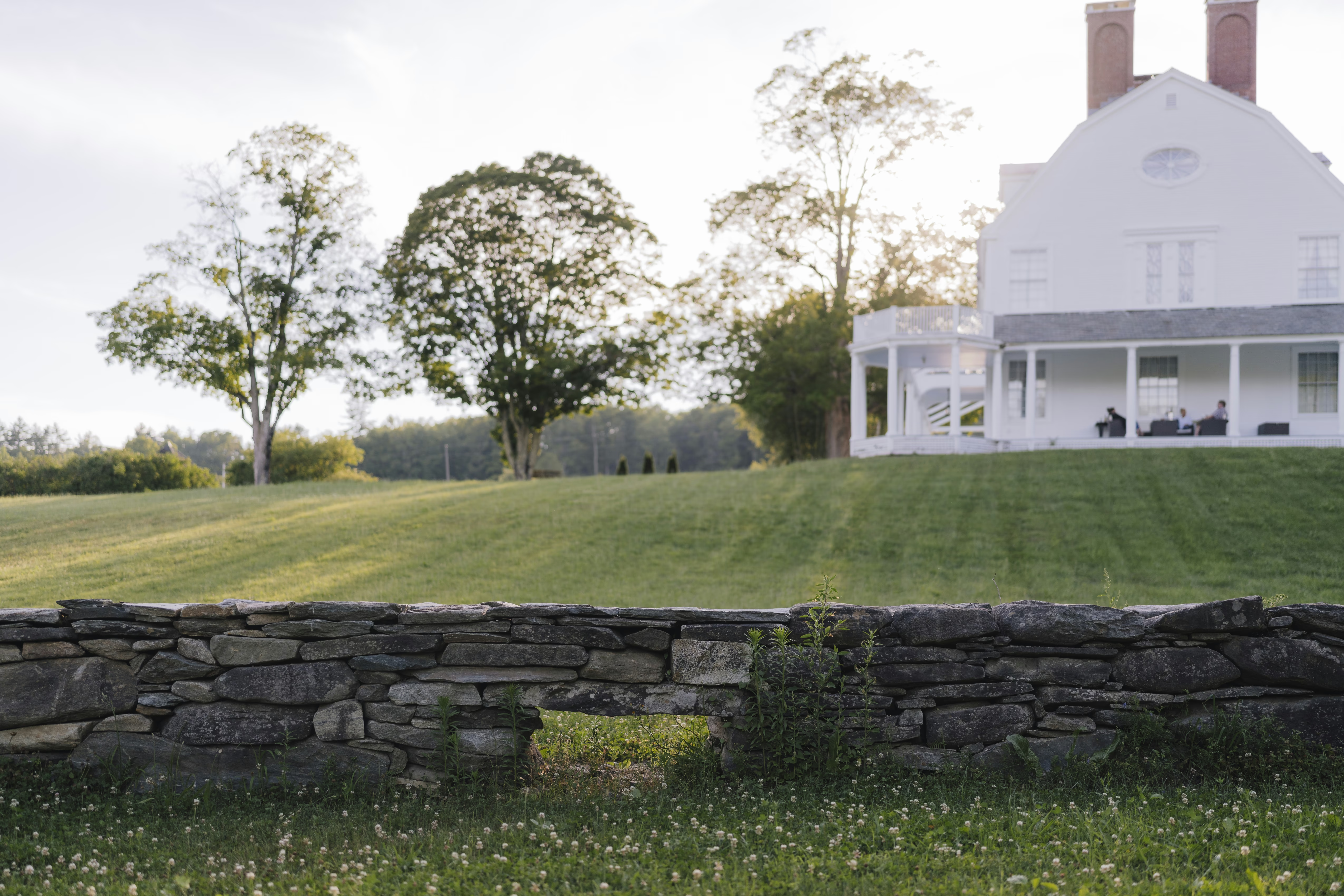
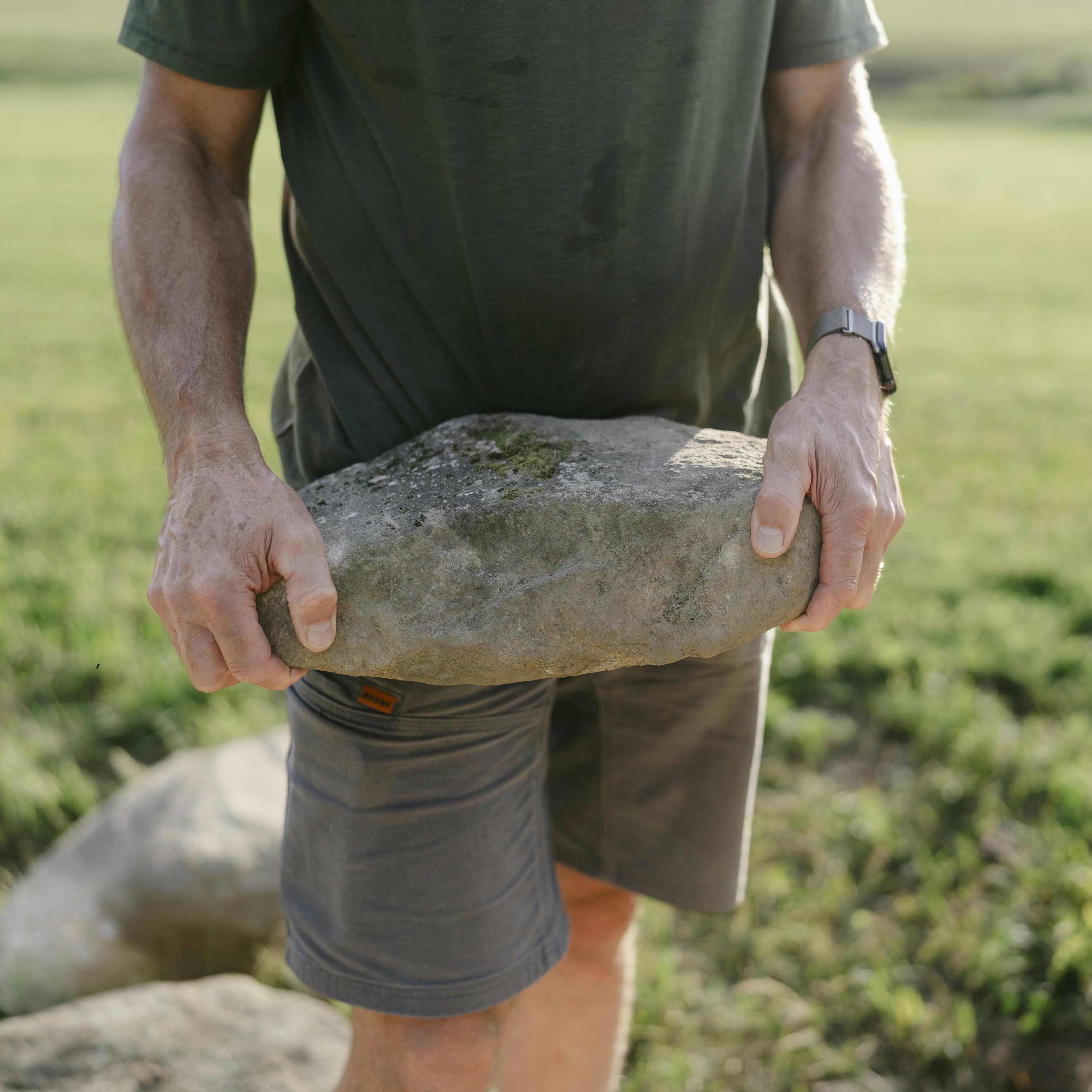
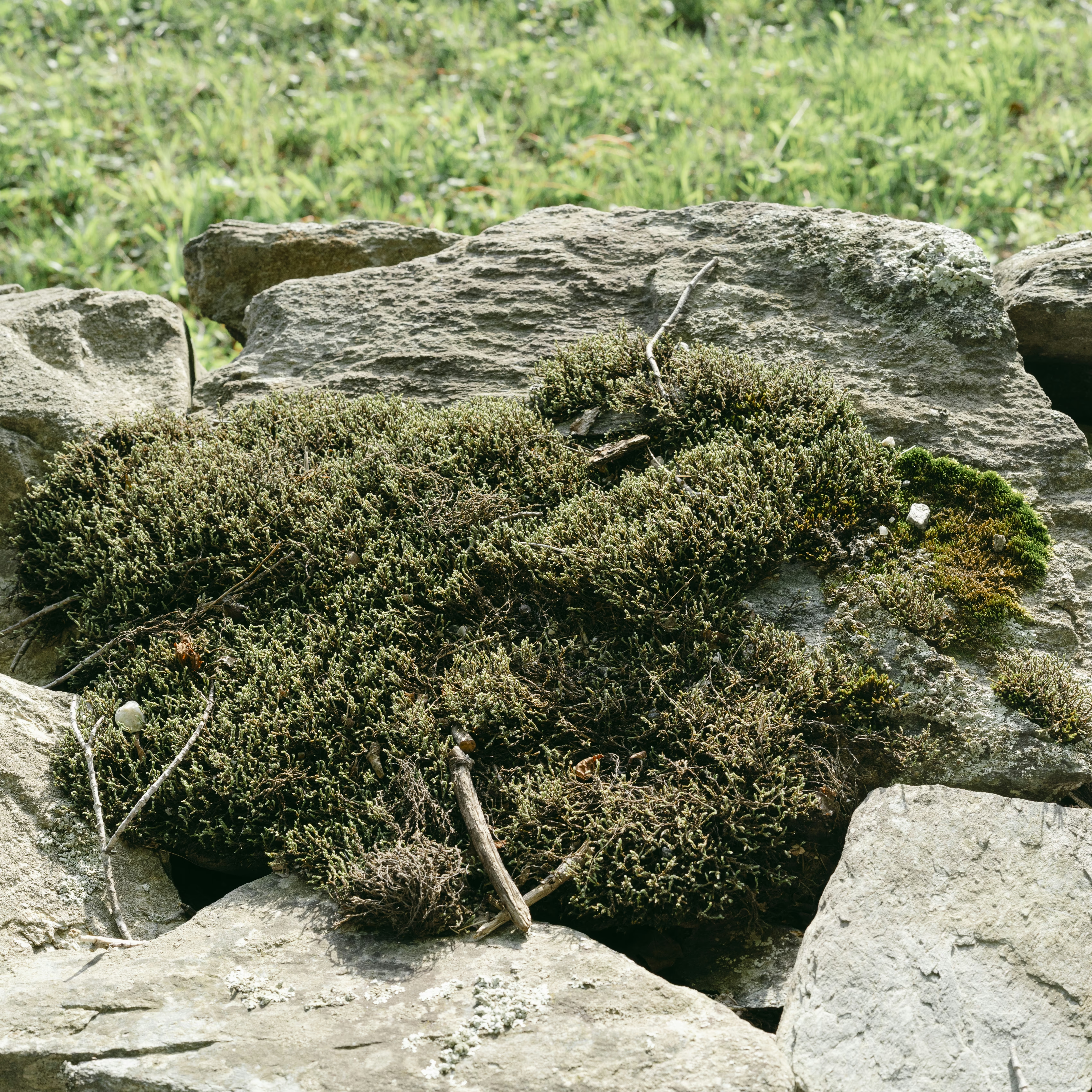
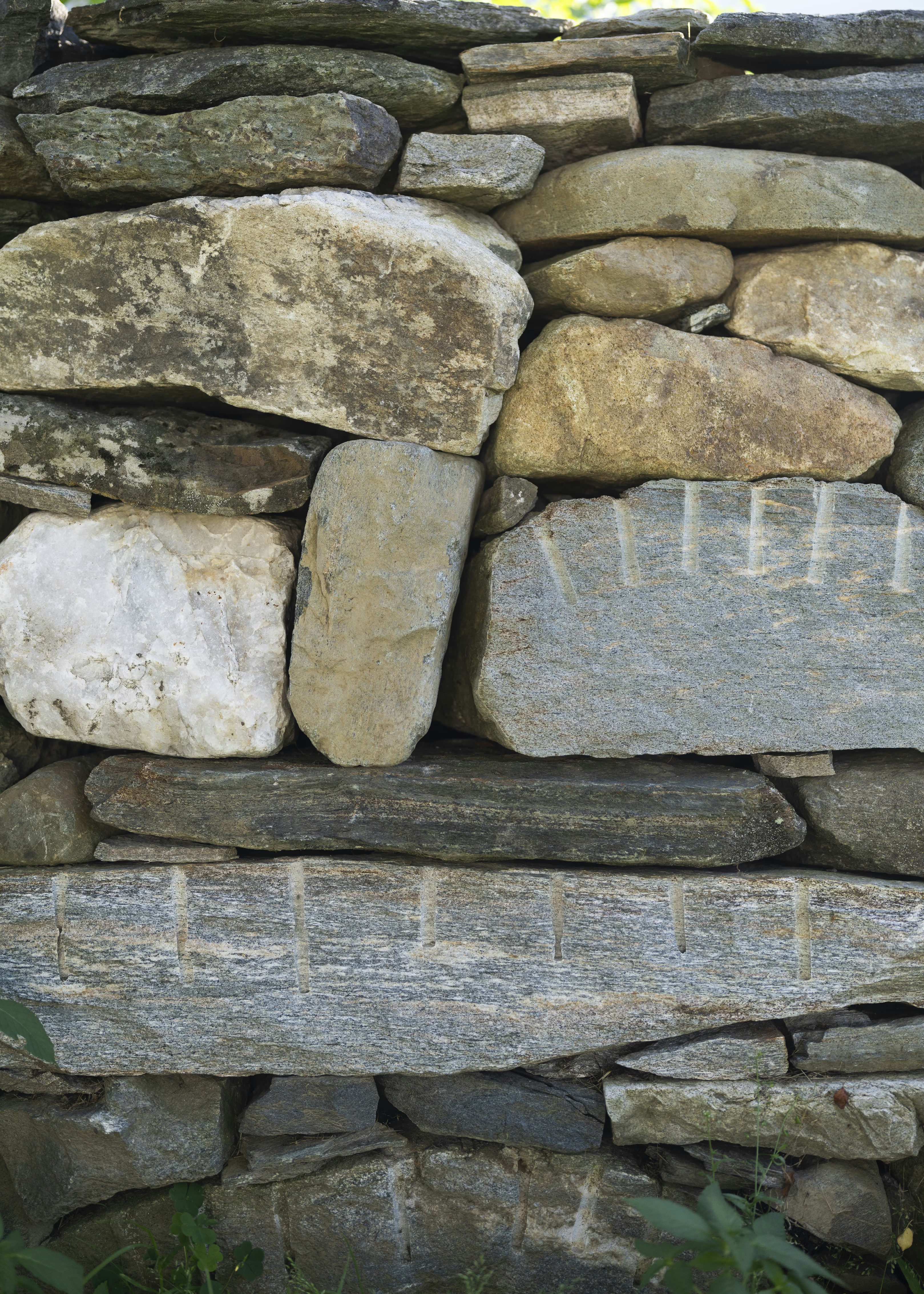
Just about everyone seems to like seeing stone walls, perhaps without looking at them quite as avidly as I do. My wife teases me when she catches me at it. As we drive around, she sees rural panorama; I’m examining the way a wall has been chinked and capped. Given the chance, I want to examine the particular construction, grasp the techniques of laying and locking stones together, try to divine the original waller’s signature. It’s not that anyone ever put their name to this work, but I’ve learned to see characteristic differences in how they tackled the subtle variance in the rocks that came to hand. If you get hold of a geological map, you’ll see that the underlying strata can change from town to town, changing, in turn, how you might make a wall stay up. Here, all schist and slate; there, all gneiss and feldspar. Never forgetting the occasional “glacial erratic,” a random massive boulder stranded by the retreating ice some 12,000 years ago and incorporated into a wall—because what else are you going to do with it? The way I love a wall is, in other words, to want to take it apart and put it back together.
In his paean to manual trades, Shop Class as Soulcraft, Matthew B. Crawford quotes the ancient Greek philosopher Anaxagoras, who believed that “it is by having hands that man is the most intelligent of animals.” Crawford, who swapped one career running a D.C. think tank for another as a motorcycle mechanic, argues that our postindustrial cleavage between work by hand and work by brain is wholly artificial—destructive, even.
His proposition appeals to me in two ways. First, living in the country, one is surrounded by people who make, build, and mend things. I am constantly awed by the brisk competency at technical tasks I see all around me. This type of applied intelligence doesn’t come naturally to me, though I aspire to it.
The second thing I find appealing in Crawford’s Anaxagoras axiom is that I don’t for a minute feel that, after some 30 years as a writer and an editor, I have abandoned the life of the intellect. Building a wall that looks good and won’t soon fall down involves plenty of hand work, for sure, but it is also a knowledge game.
I do still depend, in part, on being paid to move words around, to bring sense to sentences and coherence to an essay. This skill strikes me as closely allied to what it takes to mend a wall. When I leave my desk to spend an afternoon outside, I’m doing much the same work—just manipulating stones instead of words. I’m bringing sense to a random pile of rocks. I’m striving for coherence in the structural integrity and pleasing appearance not of an essay but of a double-faced, flat-capped wall.
Building a wall may even be its own kind of narrative project—a peculiarly linear one. Each element falls into place, and the sum becomes greater than its parts. That’s on a good day, when the stone that comes to hand finds its rightful place, almost without conscious thought, like a mot juste in a well-turned phrase. I am not a puzzle person, but one reward of walling is the continuous process of problem-solving in three-dimensional space. At first, it looks like nothing; then, all of a sudden, it looks like a wall.
On a good day. But that is not every day. Sometimes the stones just won’t fit, which really means that I’m not visualizing the shapes and spaces well. I sweat, curse, pinch a finger—the “granite kiss,” as one waller-author calls it—curse again.
There are days, too, when the whole enterprise can seem wearisome, pointless, artificial. I’m reminded of Paul Auster’s The Music of Chance, in which a drifter and a hapless card shark find themselves indentured to a pair of eccentric millionaires and are forced to build a wall out of 10,000 stones. The wall is a folly, in both the architectural and regular sense of the word.
To stave those feelings off, I’ve tried to conjure a sense of kinship with my great-grandfather, who was a stone mason in South Wales. Arthur Seaton was a skilled artisan, working with hammer and chisel to make the blocks that graced the municipal buildings of Pontypridd, but he became a prosperous Tory burgher. He was also a terrific imperialist, who named his villa Jacobsdal in homage to the Boer War victory in which his son George, my grandfather, played a part. Despite the seduction of finding some affinity down the generations, we have nothing in common but genes.
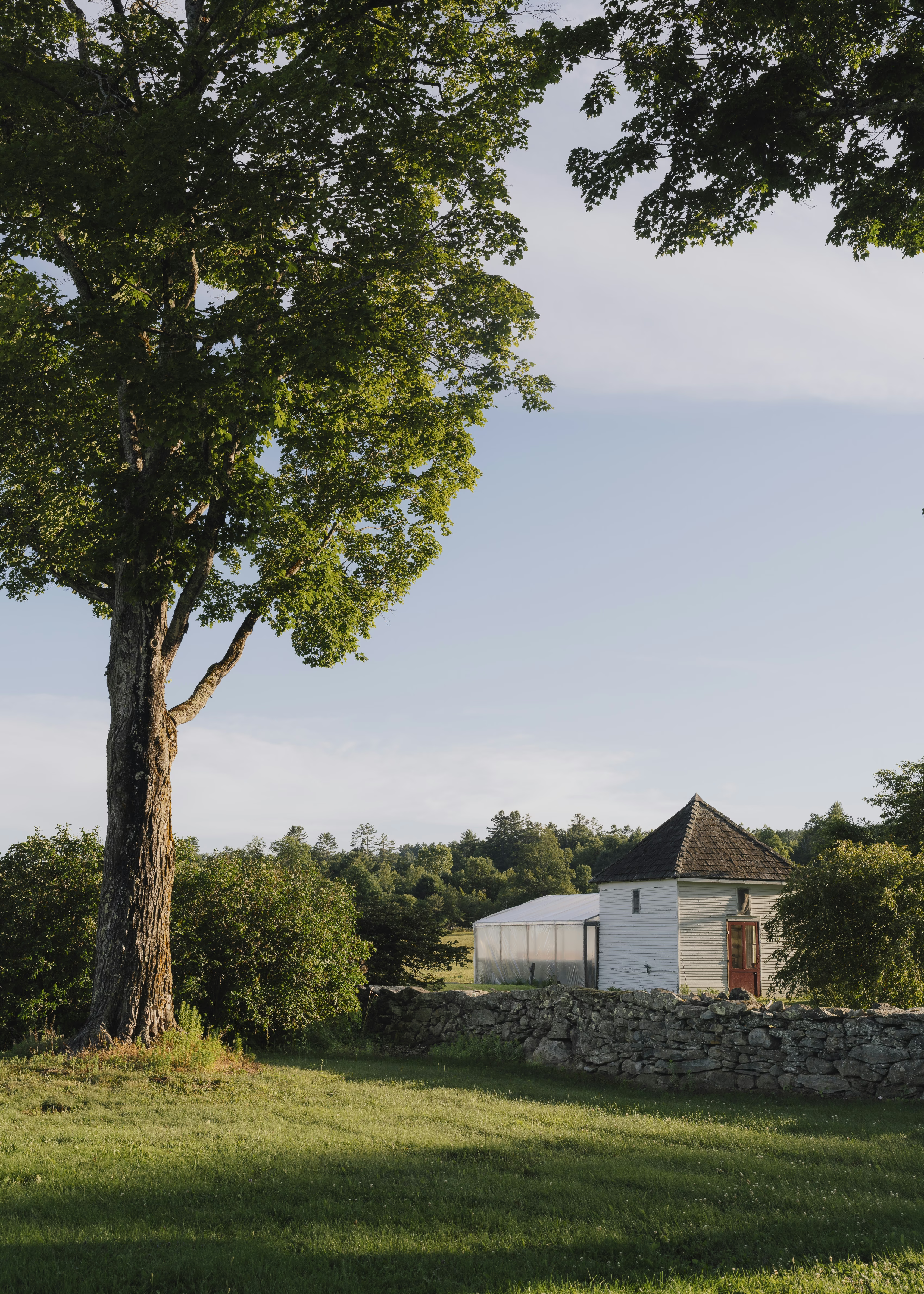
Many stone walls started as crude piles of cobbles tossed out of the fields and onto the boundary lines. Most were built higher into livestock fences only in the last decades of the 18th and early decades of the 19th centuries, when sheep farming became the dominant form of agriculture in New England. But the “Merino craze” that provided the raw material for a short-lived boom in wool production soon ended, when New Englanders couldn’t keep up with the sheep farmers of Australia and Argentina.
Many of those farm walls still stand; you can literally stumble over them in the woods, where they run largely unseen through fields that have yielded back to forest. Over the past 150 years, the ratio of cultivated to forested land in Vermont has flipped. About 80 percent was farmland; now about 80 percent is trees. The remaining farm walls we see today signify not the confidence of yeomen farmers investing their labor for generations to come but the last desperate measures of people trying to stave off Appalachian hardship and failure before heading out West.
[Read: The simple, ancient idea that can replace concrete walls]
No one’s likely to pay me, or anyone else, to mend the type of farm wall that Frost and his neighbor were fixing in the early 20th century. The walls I work on are essentially ornamental. My main employ is on a property that was bought in the 1890s by a New York manufacturer and turned into a model farm with a mansion. The walls had a nominal utility as fences for the dairy herd that was milked in the great white cow barn, but this was only ever a Gilded Age fantasy of the rustic idyll.
Many massive stones were clearly hauled in from a quarry, presumably when horses or oxen could pull a sled over hard-packed winter snow. It’s an unceasing wonder to me how the walling crew maneuvered them into place using only hand tools—a laborious and hazardous job that now takes me mere minutes with a tractor’s modern hydraulics.
These were walls built for show, a luxury good then, and now. The only other example of such tidy, well-made walls you’ll see regularly are those that surround country graveyards. If I go past one of those small cemeteries and see a stone down, it’s all I can do to resist the urge to stop and replace it.
What does Frost mean by that wonderfully indeterminate something that is always trying to reduce a wall? The word hints not at physical forces but at metaphysical ones, an ill spirit of antagonism that lurks in his neighbor’s repeated refrain: “Good fences make good neighbors.”
But where Frost sees veiled hostility, I see the vanity of human wishes. Time is the great leveler of stone walls. Given time enough, gravity will return those rocks to their long sleep in the loam. Ice will split them; rain will wear them. Sometimes I pry up a slab of schist that’s lain in the ground only a few years, and it shears into new, more delicate planes as it comes. Whatever we build will one day come to dust.
Yet we build. Because it’s also in us to make something handsome to behold. And I know people take pleasure in this beholding, because the man walking his dog along the road where I’m working pauses to tell me so.
The post The Beauty of a Stone Wall appeared first on The Atlantic.