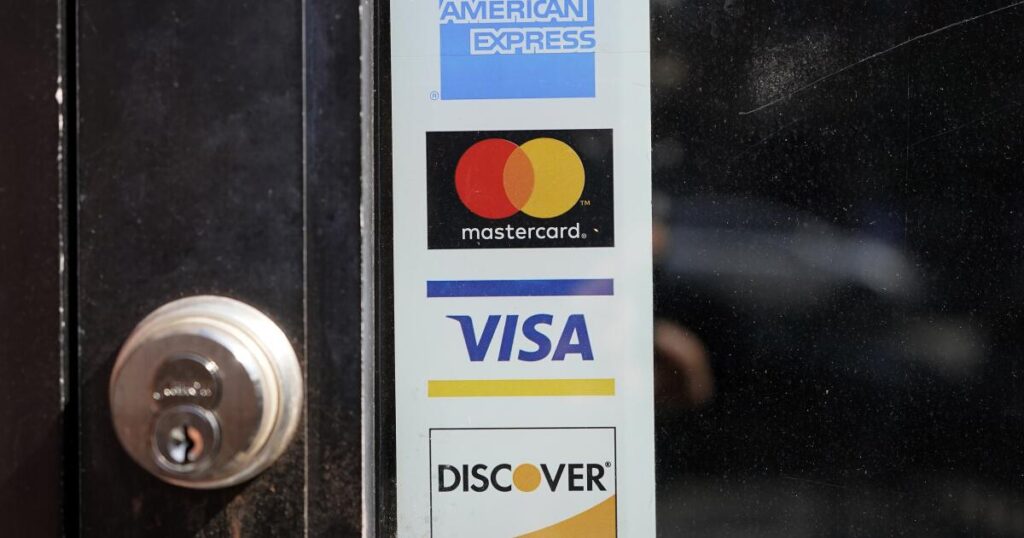
Dear Liz: Lately, I’ve encountered businesses charging a fee to use a credit card either online or at the point of service. This practice seems to be steadily increasing, as I have been hit with fees to use my credit card at my car repair shop, gym and restaurants. Gas stations have been doing this for years. The IRS also has a fee to pay taxes online with a credit card. Is there a federal or state law that prohibits this? Is it the banks that are reaping these fees from the consumers who use their credit cards to pay for goods and services? The fees are 1.5% to 3% of the total amount paid, but it is starting to add up.
Answer: Federal law doesn’t prohibit credit card surcharges. Some states do, including California, but California’s law was found to be unconstitutional and so is not enforced.
(Visa and MasterCard used to ban surcharges in their merchant agreements, but the card networks dropped that restriction in 2013 as part of a lawsuit settlement.)
These fees aren’t a profit grab by the banks but a way for merchants to recoup the costs of accepting credit cards. Merchants have to pay interchange fees to the bank that issued the card as well as payments to the credit card network and the company processing the transaction. Those costs typically equal 1.5% to 3.5% of the transaction.
Federal law does prohibit surcharges on cash, prepaid and debit card transactions, however. If you want to avoid the fees, you can opt for one of those methods or look for businesses that don’t add such surcharges.
Dear Liz: I’ve been retired for 17 years due to illness. My wife has passed away. I know nothing about finances. She did it all. I have an IRA with my wife. I want to withdraw from it but not be penalized on taxes. I know there is a way, but I don’t know the proper way.
Answer: Please find a good tax professional to help you. Retirement accounts have a lot of rules and some stiff penalties if you get things wrong. Even people who know a lot about finances can get confused and make costly mistakes. Since you’re starting from zero, you’ll definitely want expert advice to guide you.
Let’s start with the fact that withdrawals from traditional retirement accounts are typically taxable. That’s only fair, since people usually get a tax break for putting money into the account and the balances grow tax-deferred for many years. At some point, Uncle Sam wants his due. Withdrawals from IRAs usually must start by a certain age (currently 73) and are added to your taxable income. You can face penalties if you don’t make these withdrawals on time. You’ll also face penalties if you try to tap retirement accounts too early (typically before age 59½).
Roth IRAs are the exception to these rules. You don’t get a tax break on contributions to a Roth, but withdrawals in retirement are typically tax free and there’s no requirement to make withdrawals by a certain age. Also, you can withdraw the money you contributed directly to a Roth IRA at any time without facing taxes or penalties.
You mentioned that you have this account “with” your late wife, but you can’t own an IRA with another person. If you’ve inherited your wife’s IRA, the rules about when you have to start taking withdrawals can vary. Again, you’ll want to consult a tax pro who can give you individualized guidance.
Dear Liz: I’m a widow about to go into independent living which means I will be selling my home. I need to find the best place to park my money to have payments to me but still earning on the balance. What would you suggest?
Answer: FDIC-insured savings accounts at online banks can earn a higher interest rate than typical brick-and-mortar banks while still giving you instant access to your money. Currently such banks are offering 3% to 4% annual percentage yields, compared to traditional banks which offer as little as .01%.
Liz Weston, Certified Financial Planner, is a personal finance columnist. Questions may be sent to her at 3940 Laurel Canyon, No. 238, Studio City, CA 91604, or by using the “Contact” form at asklizweston.com.
The post Are businesses allowed to charge me to use my credit card? appeared first on Los Angeles Times.