By 1966, Britain’s time as a world power was pretty much over, even if it was hard to admit. The country had been humiliated during the Suez crisis just 10 years earlier. Not far off loomed a currency collapse and an International Monetary Fund bailout. The stink of decline was in the air.
What 1966 also had, as every single human being in the British Isles knows, was Gordon Banks, Bobby Charlton, Geoff Hurst and the patrician tones of Kenneth Wolstenholme’s narrating the World Cup final at Wembley Stadium between England and West Germany. “Some people are on the pitch,” Wolstentholme said, his voice rising, with England 3-2 in the lead. “They think it’s all over.” Whomp went Geoff Hurst’s left boot, clumping the ball into the roof of the net in the final minute. “It is now!”
Those two hours are among the 20th century’s most enduring contributions to Britain’s national mythology. Little else comes close, especially for the still-dominant English part of the country. It remains the first and only time England won the World Cup and the mark by which Britain measures itself — not only in soccer but also, in that squishy phrase, its place in world affairs. That moment, alongside the Beatles, Twiggy and miniskirts, Britain told itself perhaps it remained a world-beater after all.
Little good comes when a country measures itself by looking backward: Misty nostalgia makes the real problems of the present harder to tackle. Ever since 1966, the English soccer team, like Britain itself, has been burdened by the dead weight of impossible expectations, yearning for past glories while failing to grasp why things, in general, are not glorious. In political terms, that helped usher in Brexit, economic stagnation and six prime ministers in 10 years, all of whom tried and failed to restore Britain to something like its former self.
The sporting equivalent comes every four years, when England somehow convinces itself, despite a pile of evidence to the contrary, that it ought to win the World Cup. And every four years, this ends badly.
My earliest memory of disappointment was the 1982 World Cup, when I was 9. I remember filling out my World Cup wall chart in my parents’ house in North London with the string of zeros that marked England’s exit. The team made it to the quarterfinals in 1986 only to meet Argentina. Britain had recently defeated the country in what remains its last imperial war, over a strategically irrelevant archipelago of islands in the South Atlantic. The legendary attacker/cheater Diego Maradona scored twice, once brilliantly and the other time with what he later called “the hand of God,” although it was just his literal hand. That still rankles.
1990 was Germany on penalties in the semis. No one talks about 1994. Four years later was another tragic blowout against Argentina. 2002 was grim. I’d moved to New York by then and watched the loss to Brazil in a sticky pub on Third Avenue surrounded by my gloomy, pale compatriots. On to 2006: quarterfinals, again; lost on penalties, again. 2010 was a 4-1 drubbing by the old enemy, Germany. The less said about 2014 the better. In 2018, the team somehow ended up fourth. In Qatar four years ago, England lost to its other, older enemy, the French.
There is an undeniable pattern here, in addition to not winning. England is stuck in some kind of middle rank — not the best, not the worst, always flattering to deceive, usually grinding it out until the gravity of reality takes over. This isn’t the cheery optimism of the Brooklyn Dodgers’ “Wait ’til next year.” This is deeper — an aching sense that things just won’t work out.
And yet. Here is a lightly edited Slack conversation between an English colleague and me the morning before England’s first 2026 World Cup match in June against Croatia.
Me: I don’t think I can watch
Colleague: general disquiet or something more specific?
Me: general disquiet
Colleague: yes, that’s understandable
Me: I don’t know when this started, but at some point I stopped enjoying watching England. It brings only pain. And any joy is merely the absence of pain.
Colleague: I’m not one to dissuade a man from well-earned angst, but this side does look very functional. I have them getting to the semis at a minimum. this might make it all more painful for you
Me: stop this right now. none of this false expectation nonsense!
Colleague: Germans know how to win, that’s all I’m saying.
The current England coach is German. He succeeds a handful of Englishmen, an Italian and a Swede. What Britain lost by leaving the European Union it seems to be reimagining through the management of its national soccer team.
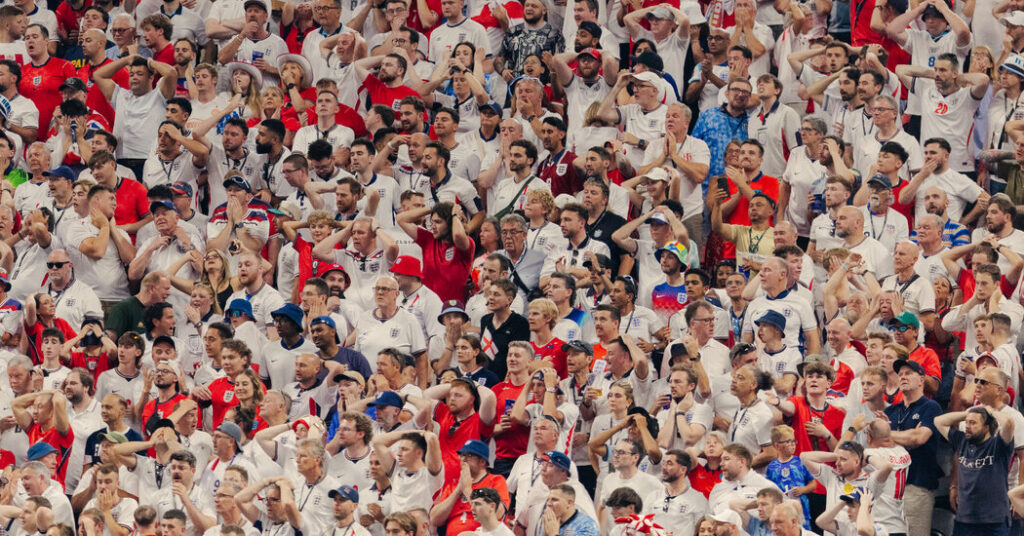
It took 47 minutes of the Croatia game, when Jude Bellingham tore up half the pitch to put England in the lead, for the old sense of possibility to flicker. Maybe they could do it. Maybe this German knows what he’s doing. I immediately started scanning the calendar to make sure I would be available for the later stages of the tournament.
Britain, or, to give the country its full title, the United Kingdom of Great Britain and Northern Ireland, plus a handful of overseas territories and self-governing islands, was teetering on its pedestal around the time of World War I. Heavily in debt, it never truly recovered. Within earshot of the conclusion of World War II, India, the empire’s cornerstone, was independent. By 1966, the number of people under colonial rule had collapsed. In Britain, all of this registered as loss. Few stopped to think about what it meant for countries to win their freedom.
Despite a late spasm of imperial violence through the early 1960s, and the Falklands War of 1982, Britain’s time as a world power was over. Tony Blair’s New Labour may have governed over Cool Britannia, but plain old Britain, despite its nuclear weapons and undeserved seat on the United Nations Security Council, could no longer punch above its weight. Until the 2008 financial crisis, Britain suffered under the delusion that everything was, as they say, tickety-boo. A banking collapse that was among the severest in any major economy put an end to that.
In the two decades since, economic growth and labor productivity have stalled, and a traditionally phlegmatic nation is seething at Brussels, prime ministers, immigrants — anything except its own decline. In just a few years, Poland’s gross domestic product per capita is set to catch up with Britain’s. If you extract London from the data, the picture is even more bleak.
Why amid these struggles, you might ask, would Britain cut off relations with the gigantic trading bloc next door? An answer comes from the Brexit campaign itself, whose slogan was “Take back control.” That implied there was a past to which Britain could return that would be more prosperous and more British. In fact, Brexit incinerated economic growth, and public services worsened. Even today, there is little talk of reversing such an obvious act of self-harm.
It’s a short hop from the Brexit slogan to the unofficial English soccer anthem, “Football’s coming home,” which was co-written in 1996, appropriately enough, by two comedians who dotted the song with examples of how it hadn’t actually come home. This is typical of a country that takes its biggest failures and turns them into moments of glory. Dunkirk was, in fact, a retreat, the Battle of Britain was a brutal aerial pummeling, and the Charge of the Light Brigade was a blunder that killed or injured nearly half of the British forces. And still, Tennyson asks us, “When can their glory fade? / O the wild charge they made!”
In the 1990s, The Sun, a spicy tabloid owned by Rupert Murdoch, superimposed the head of a particularly hapless England soccer manager onto a turnip. In 2000, the newspaper lobbied for a donkey called Jack Ass to take the job. And yet after England’s June win over Croatia, even it fell victim to the ancient habit. “Spooky omen is good news for England fans,” the paper intoned. What was this spooky omen? The final score, 4-2, was the same as the final score in ’66.
For a month, England clawed and grimaced its way to the semifinals, accompanied by fans chanting “IN-GER-LAND” to the tune of “The Stars and Stripes Forever.” The Sun, changing its tune, said the team was “one-dimensional.” The Guardian called it “turgid.” England edged the Democratic Republic of Congo, defeated Mexico in a match that resembled the siege of Leningrad, and somehow didn’t lose to Norway. Finally, the agony of hope was mercifully extinguished by Argentina (yet again).
Maybe by the 2030 World Cup, Britain will be back in the European Union, just one country among many. Maybe England’s undeniable stars will function as a team. Maybe the country will embrace its position as a midtable perennial, and be just fine with that. And perhaps then it might be able to win.
Matthew Rose is an Opinion editorial director.
The Times is committed to publishing a diversity of letters to the editor. We’d like to hear what you think about this or any of our articles. Here are some tips. And here’s our email: [email protected].
Follow the New York Times Opinion section on Facebook, Instagram, TikTok, Bluesky, WhatsApp and Threads.
The post England Lost. They Were Always Going to Lose. appeared first on New York Times.