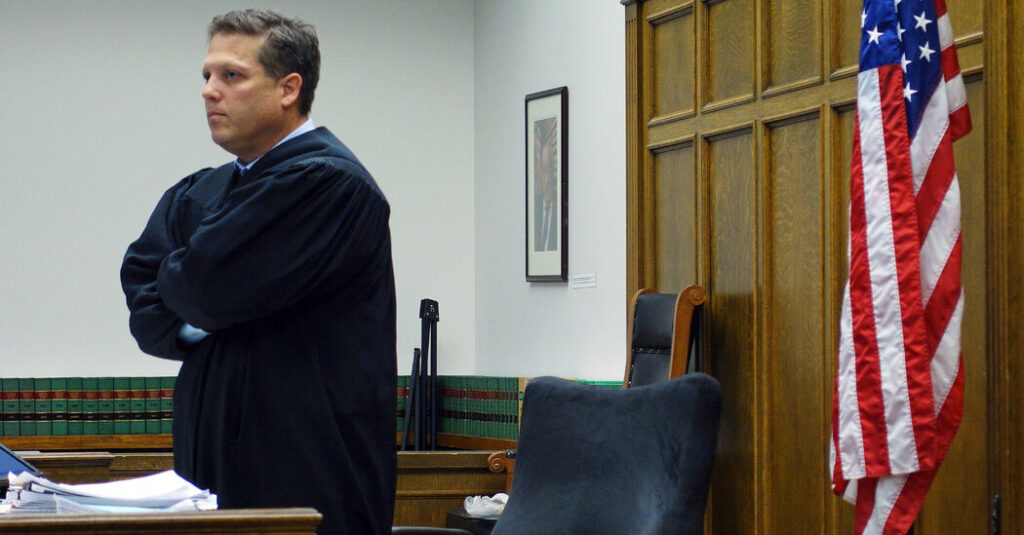
The Trump administration fired a federal prosecutor on Wednesday, less than an hour after he was appointed to lead the United States attorney’s office in Seattle, setting the stage for a likely legal battle.
Federal judges in the Western District of Washington had unanimously appointed Roger Rogoff to be the Justice Department’s top official there, filling a vacancy that the president has never addressed. But the Trump administration has largely defied attempts by federal judges to fill vacancies, leading to Mr. Rogoff’s swift dismissal, via email, after 54 minutes.
Unlike in similar Trump administration firings, Mr. Rogoff has retained an employment law firm and is weighing a legal fight over his dismissal.
Such a challenge would almost certainly entail a lengthy, difficult court battle and raise the extraordinary prospect that a U.S. attorney could operate quasi-independently of the Trump administration. It could also mean that Charles Neil Floyd, the first assistant United States attorney who has been the Trump administration’s pick to lead the office, could eventually have to answer to Mr. Rogoff.
Because the president has not formally nominated Mr. Floyd to serve in the top job, his appointment has not been approved by the Senate and the senior post has remained vacant.
Mr. Rogoff, 57, told The New York Times that he envisioned his job as U.S. attorney would be to “carry out the priorities of the administration” and said the high-level priorities that had been laid out, like illegal immigration, human trafficking and drug gang prosecutions, were “pretty normal.”
But he was also critical of the administration’s practice of circumventing the Senate’s role in approving top federal prosecutors.
“I don’t think it’s the way to run the Department of Justice,” he said. “When you have this sort of made up way of putting people in these positions, the process breaks down,” he added.
“Morale breaks down in each office,” he said. “The ability to do the work breaks down. The ability for the work to be respected and to be credible with judges and defense attorneys and victims and defendants is hurt. So it’s just not a way to run an office and by the way, it’s also unconstitutional.”
In a statement, the Justice Department said that “the district court did not coordinate with D.O.J. on this selection.” The agency also referred to a letter that Todd Blanche, the acting attorney general, wrote to The Times in February. “It should come as no surprise that when judges inappropriately act unilaterally, the outcome is simple,” he wrote. “A prosecutor selected solely by the judiciary will not remain in office.”
Federal judges in Washington State began a public job search in January. Applicants were asked how they would respond to being fired. Mr. Rogoff recalled telling judges, “I would consider whether there’s a legal option to challenge the decision.”
The situation has been an ongoing source of frustration among state officials.
“Their current practice is just unlawful,” said Nick Brown, Washington State’s attorney general — and another former Seattle U.S. attorney — in an interview last October.
“I don’t know if you remember the movie ‘Casino’ with De Niro and Pesci,” Mr. Brown, a Democrat, added. “But De Niro, they kept changing his title so the Nevada gaming officials couldn’t track what was happening. That’s what it feels like here.”
Mr. Rogoff, who has also worked for Microsoft, was most recently appointed by former Washington Gov. Jay Inslee, a Democrat, to run a state office that investigates the use of deadly force by the police. He was appointed to lead the U.S. attorney’s office by the seven federal district judges in Seattle, who are all Biden appointees.
While any lawsuit would most likely lead to protracted legal sparring, it’s unclear if the Trump administration would seek to take the case to the Supreme Court. Last year, after a federal judge said Alina Habba, a former personal lawyer for Mr. Trump, was not serving lawfully as U.S. attorney in New Jersey, the administration threatened to take the case to the Supreme Court, but ultimately did not.
There have been instances in which the Justice Department has cooperated with district judges in choosing a prosecutor. After a trio of Ms. Habba’s successors were also found to be leading the office unlawfully, judges in that district appointed a top prosecutor, Robert Frazer, after discussions with the department.
Permanent U.S. attorney appointments typically require approval by either the Senate or federal judges in the affected district. Interim appointments expire after 120 days, but the Trump administration has extended terms by naming its preferred choices acting U.S. attorneys, or leaving them in charge as first assistant U.S. attorneys.
Winning a legal challenge would most likely be difficult.
“A statutory provision empowers district courts to appoint a temporary U.S. attorney to ‘serve until the vacancy is filled’ by a traditional appointee,” said Elizabeth G. Porter, a law professor at the University of Washington, in an email earlier this year. “It is possible to argue that this language insulates the appointee from being fired without cause by the president. But I think this is a tough argument.”
The post Trump Administration Fires U.S. Attorney Minutes After His Appointment appeared first on New York Times.