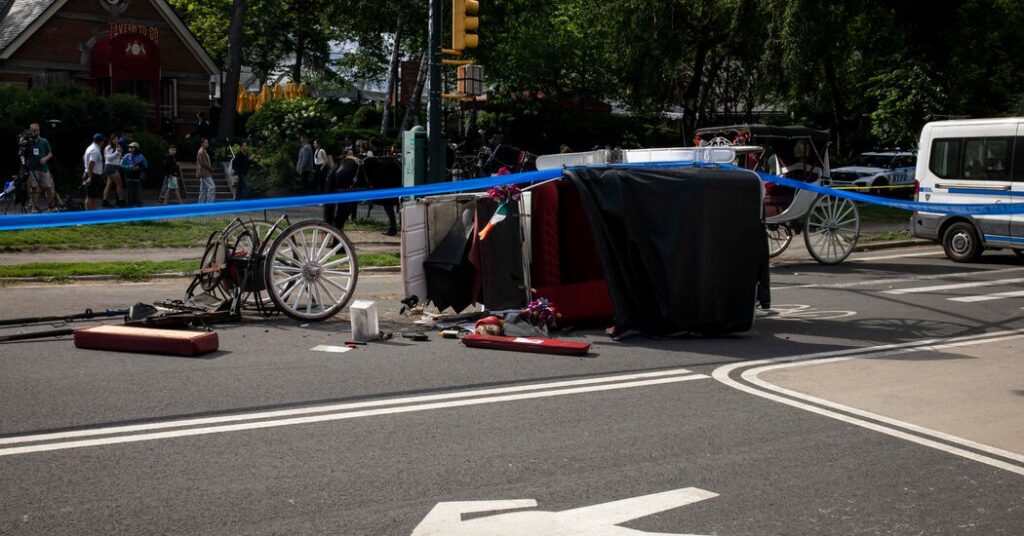
The family of a teenage tourist who was killed last month in an incident involving a runaway carriage horse in Central Park made an emotional plea to New York City lawmakers on Wednesday to end the 167-year-old carriage industry.
The impassioned appeal by the parents of the teenager, Romanch Mahajan, came during a City Council hearing on a bill that would banish the carriages from the city in two years, most notably from the Central Park roadways they have traveled since the park opened.
Mr. Mahajan’s father, Deepak, and mother, Priya, attended the hearing via videoconference from their home in India. As her husband addressed members of the Council’s Health Committee, Ms. Mahajan held up a photo of her son, who was 18 when he died.
“Our whole family is shattered,” Mr. Mahajan told the crowd in a City Hall hearing room packed with animal-rights activists and carriage drivers. “We came to New York as a family of four. We are learning to cope with life as a family of three.”
The driver of the carriage the family was riding in had stepped out to take their picture when the horse bolted and Ms. Mahajan fell out. The younger Mr. Mahajan jumped down to help her, fell and hit his head on the ground.
“I cannot properly describe to you the real, true fear inside that carriage,” his father said on Wednesday, crying as he spoke. “It was shaking, it was speeding, there was no one holding the reins. We could do nothing but hold on to each other and scream.”
Animal-rights activists have long argued that horse-drawn carriages are outdated and cruel to animals but had not previously attracted enough political support to achieve their goal of outlawing them. Mr. Mahajan’s death appears to have changed that.
The hearing, which was expected to last well into the evening, came a day after Julie Menin, the Council speaker, said she supported banning horse carriages. A similar bill did not even get a hearing in the Council’s last term.
Lynn Schulman, the committee chair, began the hearing with a moment of silence for Mr. Mahajan. Ms. Menin then turned to other members of his family who were in the front row.
“He could be alive if only we had acted sooner,” she said. “The time to act is now.”
The Health Committee will decide at a future date whether to send the bill to the full Council for a vote. On Tuesday, the bill had 21 sponsors. By Wednesday, it had 26 — a sign of Ms. Menin’s influence and enough to pass the 51-member Council.
If it passes, the bill would go to Mayor Zohran Mamdani, who has said he favors a ban and wants “to deliver a just transition that protects workers.”
Transport Workers Union Local 100, which represents horse-carriage drivers and owners, has for years fended off efforts to abolish the industry. The horses are well cared for and doing the kind of work they were bred for, the union says, and it argues that ending the carriage rides would be devastating for the roughly 170 licensed drivers and would harm the animals as well.
After Ms. Menin announced her decision on Tuesday, John Samuelsen, the union’s international president, said she was exploiting the tragedy of Mr. Mahajan’s death to score political points and to cater to real estate interests keen on developing property on Manhattan’s West Side now occupied by horse stables.
John Chiarello, Local 100’s president, addressed the committee on Wednesday, starting his testimony by offering the Romanch family his “sincerest condolences” before making his case against a ban.
The question of what will become of drivers should carriages be eliminated has loomed over the debate about the industry’s future. Ms. Menin said in an interview this week that she has had talks with representatives of the hospitality and tourism industries about finding drivers new jobs. Mr. Chiarello expressed skepticism.
“If you’re a horse and carriage driver, I don’t think you want to be a host at a casino,” he said. “I don’t think you’re looking to do hotel bell-hopping or reception.”
One longtime driver, Angel Hernandez, told the committee he could not imagine another job that would allow him to provide for his wife and two children in the same way.
“I’ve been working with horses almost all my life,” he said. “I love what I do. I just want to make sure that our horses stay in our hands.”
Among those favoring a ban whom the committee also heard from were Curtis Sliwa, the Republican candidate for mayor last year; Edita Birnkrant, the executive director of New Yorkers for Clean, Livable and Safe Streets, or NYCLASS, which has led the push to banish the carriages; and Robert Holden, a former member of the Council who sponsored the previous bill that would have abolished the carriages.
Had his bill passed, he said, it would have taken effect on June 1 of this year, a little more than two weeks before Mr. Mahajan’s death.
“That,” Mr. Holden said, “is the cost of four years of obstruction.”
The post Parents of Teen Killed During Horse Carriage Ride Plead for a Ban appeared first on New York Times.