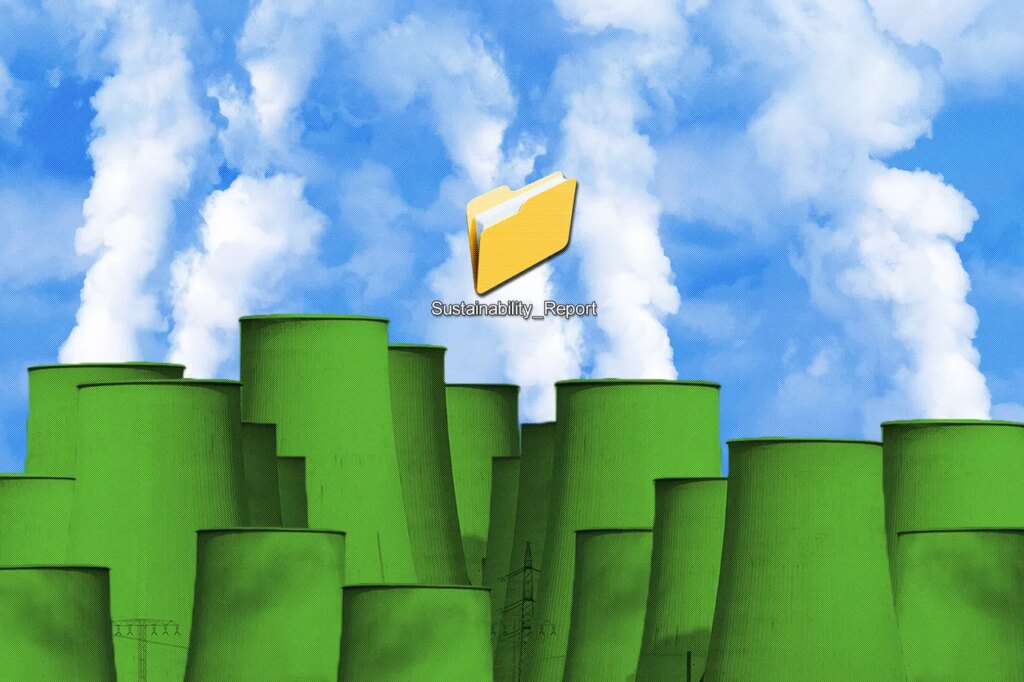
Microsoft’s greenhouse gas pollution increased by roughly 25 percent last year, the company says in its new sustainability report released Thursday.
The report follows similar ones released by Google and Amazon last week. Together, they show a troubling trend of rising tech company emissions, driven by the global race to build out power-hungry data centers.
In a blog post announcing the report, Microsoft vice chair and president Brad Smith and chief sustainability officer Melanie Nakagawa say that the emissions increase is driven “primarily by the expansion of our datacenter infrastructure.”
A significant portion of that increase, they write, was tied to emissions from energy the company purchased or acquired to run its operations. Known as Scope 2 emissions, that greenhouse gas pollution accounted for 13 percent of Microsoft’s total.
Data centers, which use large amounts of energy running artificial intelligence chips, have pushed many large tech companies’ net-zero goals increasingly out of reach over the past few years.
Amazon disclosed a 16 percent increase in its CO2 emissions in its recent sustainability report. Google said in its new sustainability report that annual greenhouse gas emissions rose 18 percent last year compared to 2024, the biggest single-year increase it’s recorded. The company has aggressively invested in renewable energy, but it’s also begun adding fossil fuel power for some of its data centers.
Microsoft highlighted in its sustainability report that it had matched 100 percent of its electricity consumption with carbon-free sources. But the data center build-out is set to accelerate—and some of Microsoft’s recent investments could drive its emissions higher. Notably, the new report covers the 2025 fiscal year, which ended last June, and has made a number of deals since then involving gas-powered data centers.
Last month, the company officially announced a partnership with Chevron, which is building a power plant to supply a future data center for the company in West Texas. Permits show that that power plant could emit more than 11.5 million tons of CO2 equivalent annually, an amount greater than the entire state of Rhode Island. The company has also leased buildings on the Stargate campus in Abilene, Texas, which will be powered by an onsite power plant that could emit more than 7.8 million tons of CO2 equivalent each year. Microsoft has also signed a nonbinding letter of intent for compute at a West Virginia data center, which would be powered by off-grid gas that could emit more than 11 million tons of greenhouse gases.
“Microsoft’s strategy includes exploring a variety of options for mitigating the emissions from its electricity consumption, consistent with our sustainability ambitions,” Nakagawa says in a statement to WIRED.
Microsoft’s approach to offsetting some of its emissions via credits and other investments is also changing. The company says it stopped purchasing unbundled renewable energy certificates, a move that contributed in part to the rise in Scope 2 emissions. Using these types of certificates have been criticized in recent years as greenwashing because they don’t necessarily add more clean power to the grid. Unbundled RECs are essentially a “paper transaction that is physically disconnected from real-world consequences,” says Danny Cullenward, a researcher at the University of Pennsylvania. (Cullenward is also a visiting faculty member at Google but notes he was not speaking on behalf of the company.)
“I think it’s highly commendable that [Microsoft] is moving away from unbundled RECs and prioritizing investments in new clean electricity, where power purchase agreements and other long-term offtake agreements can and do cause new clean electricity to come online,” he adds.
Despite the rise in emissions and its continued investments in AI, Microsoft still says that it plans to become “carbon negative” by 2030. Smith and Nakagawa write that the global race for AI is “increasing demand for … energy, water, land, and materials.” They say that the company “has a responsibility to help ensure that technology strengthens, rather than strains, the systems and communities on which it depends.”
The post Microsoft Reports a Massive 25 Percent Jump in Emissions appeared first on Wired.