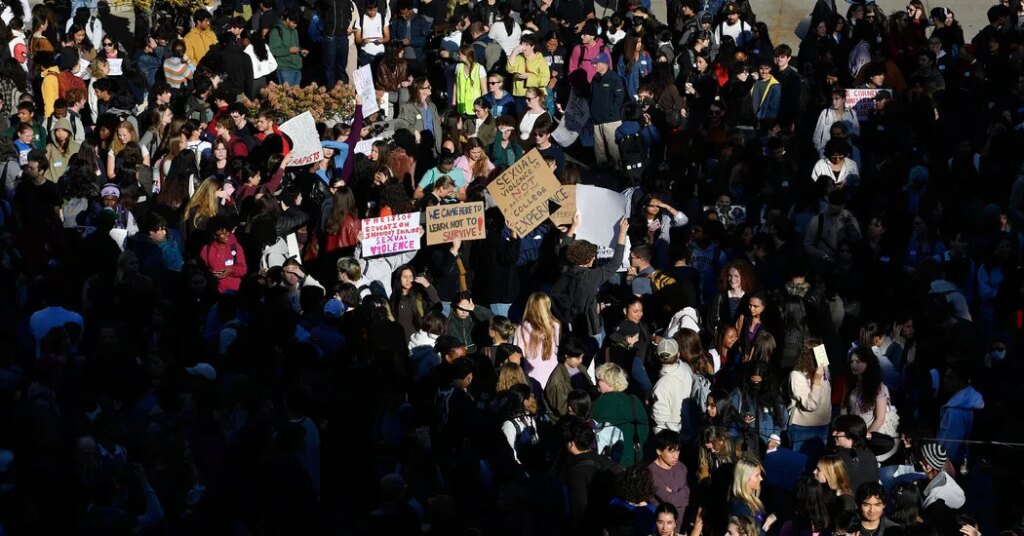
Thousands of students and faculty members gathered in protest at the center of Cornell University’s campus on Monday evening, in an outpouring of the anger that has been building since the school was sued over its handling of a 2024 sexual assault allegation.
After convening on a large campus plaza, students marched to Cornell’s main administrative building, Day Hall, which houses the office of the university president, Michael Kotlikoff. The peaceful protest came only hours after middle-of-the-night vandalism at the building, where activists smashed the glass door and sprayed graffiti on the entrance.
As students descended on the building on Monday evening, they saw that the graffiti had been removed and that the shattered glass door had been covered with a sign that read: “Entrance temporarily closed.”
The protest and the vandalism were both stark demonstrations of the fury that has been building on campus since a woman’s lawsuit — detailing allegations of sexual assault at a fraternity party — ignited outrage around the country. Students expressed solidarity with the woman, known as Jane Doe, who has said she was plied with drugs and raped in an encounter involving seven men at the Chi Phi fraternity house on Oct. 19, 2024. Last month, the woman sued the men, the university, Chi Phi and her sorority.
“I think if you’re not angry there’s something wrong,” said Quin Lewis, a sophomore at Cornell who was standing in the crowd. “Everyone is watching — Cornell has the opportunity to make change.”
The protest was the first large gathering of Cornell community members since the lawsuit put Cornell at the center of a national firestorm. Students wore name tags that read “Jane Doe” and purple pins showing their solidarity with sexual assault survivors, and they held signs posters criticizing the university administration. When a speaker said the name of the president, Mr. Kotlikoff, this was met with cries of “Resign!” There were also shouts of “Ban the frats.” Many students called for the abolition of fraternities, which some say have contributed to an unsafe environment for women.
As the protest came to an end, a masked demonstrator started pounding on the doors of Day Hall, and protest leaders intervened by shouting, “We’re not doing that.”
The protest, called “Justice for Survivors,” was planned by Students for a Democratic Cornell, along with a coalition of more than 20 other student organizations. In an interview, Jack Huber, an undergraduate activist who helped plan the demonstration, said the protesters were calling on the university to remake its policies and procedures for responding to reports of sexual assault.
Organizers said that the university should institute “minimum sanctions” and a standardized timeline for investigating assault allegations. They also demanded improved training for Cornell police officers on how to respond to sexual assault.
“I, like many of you, have felt several emotions this past week — disappointment, sadness and anger at almost every actor involved in Jane Doe’s case,” said one speaker, Madeline Gage, as she faced the thunderous crowd. “We all care about, believe and support both Jane Doe and all survivors.”
Earlier Monday, before most students were awake, vandals shattered the door and sprayed graffiti on the building. It was a turbulent start to the week of planned protest. On one side of the door, graffiti in red paint read: “At Cornell rapists are protected protesters are expelled.” On the other side, also in graffiti, were the words: “Smash the patriarchy.”
The Cornell administration said the vandalism was under investigation.
“We understand the frustration and strong emotions being expressed across our community,” Kyle Kimball, vice president for university relations, said. “Those concerns deserve to be heard, but damaging property is not the answer. We are investigating the vandalism at Day Hall and will address it in accordance with university policy and applicable law.”
While the identity of the overnight vandals was not known, a group whose members referred to themselves as “autonomous activists” released a statement on Monday taking credit for the action and accusing Cornell of using “its power and resources to protect rather than condemn sexual violence.”
The Cornell Police Department did not immediately reply to a request for comment.
Students are planning more gatherings throughout the week. On Tuesday, students are hosting an open town hall co-sponsored by the feminist, gender and sexuality studies department. On Wednesday, some student groups are planning to skip class and hold a seven-hour sit-in in solidarity with Jane Doe.
The protests follow an emotional week on campus, as students expressed frustration with the way the administration and law enforcement officials handled the sexual assault allegations. Many students have questioned why some of the men accused of sexual assault were permitted to remain on campus.
Last week, Gov. Kathy Hochul appointed a special prosecutor, Attorney General Letitia James, to investigate Jane Doe’s allegations.
All the accused students have denied wrongdoing, and none have been charged with a crime.
The New York Times reported on Saturday that two of the seven men were expelled, two more were suspended and another was barred from campus. The remaining two students received lighter punishments. The university, the fraternity and prosecutors have said they responded appropriately given the information they had.
Standing in the crowd at the evening protest, Ms. Lewis, the sophomore, said she had been grieving as she read the details of what Jane Doe said she experienced. “I had an incident that happened to me last semester — the president of my sorority held my hand through it,” she said. “It’s horrible to see the same mercy wasn’t shown to Jane Doe.”
The post Thousands Gather at Cornell in a Peaceful but Angry Protest appeared first on New York Times.