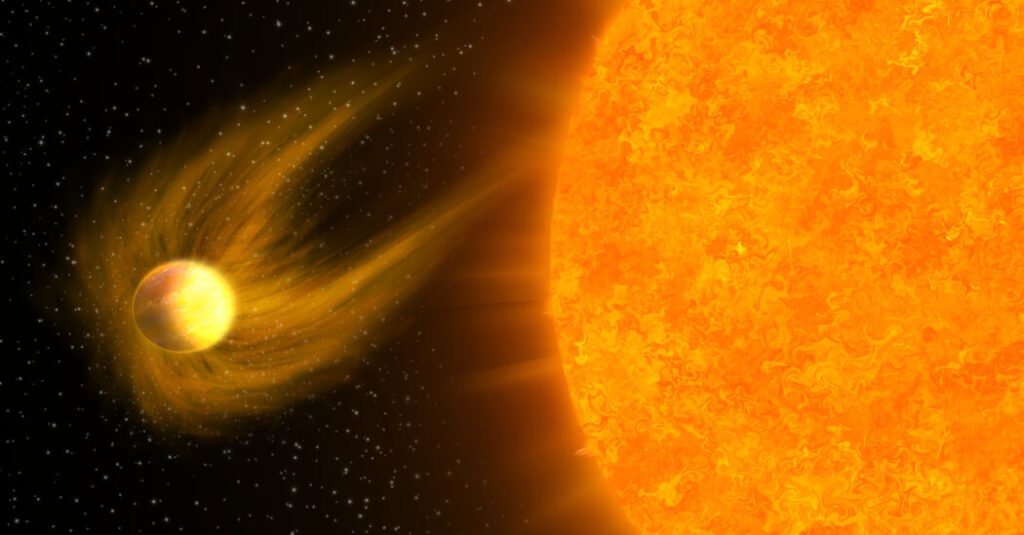
A star located about 1,300 light-years from Earth shows signs of having devoured one of its planets — and is now gearing up for a second helping, according to a pair of new studies.
For many planets, it is their cosmic fate to one day become engulfed within their own stars, then slowly melted down into their constituent elements. This process, known as planetary engulfment, is destined to occur in our own solar system. When the sun balloons into its red giant phase in several billion years, it will envelop Mercury, Venus and perhaps even Earth.
For now, astronomers can see examples of planetary engulfment elsewhere because it leaves behind elemental hints that become imprinted in the star’s light, like cosmic cookie crumbs.
That’s what they saw for the hungry star, which researchers named TOI-5882: It is glowing with the half-digested remains of what was likely once a planet. And that planet may have been flung to its fate by its neighbor, a colossal celestial object called a brown dwarf that is closely orbiting the same star, according to a study published in The Astrophysical Journal.
At 22 times the mass of Jupiter, the brown dwarf could easily disrupt the orbits of neighboring planets. But it will get its own comeuppance when it, too, is inevitably served up to its star, perhaps sooner than once expected, according to another study, published last week in The Astrophysical Journal Letters.
Engulfment events “can tell you something about the star, and it can tell you something about the exoplanet, and that’s the amazing thing,” said Claudia Aguilera-Gómez, a faculty member at the Institute of Astrophysics at the Pontifical Catholic University of Chile and an author of the first study. “It connects these two parts of astronomy that are separated most of the time.”
TOI-5882, which is about 30 percent more massive than the sun, attracted the attention of astronomers last year in part because of its orbiting brown dwarf. The huge object, known as TOI-5882-b, is very close to the star, orbiting it once every week, at a proximity that guarantees that it will be engulfed in the future.
But when astronomers took a closer look at the system, they found that TOI-5882’s starlight revealed unusually high amounts of lithium, an element far more abundant in planets than in stars. Had a planet already succumbed?
Scientists have spotted signs of lithium and other planetary ingredients in many stars, hinting that they may have eaten planets in the past. Although it’s difficult to conclusively prove that these chemical signatures come from planets, TOI-5882 is at a “sweet spot” in the course of its evolution that makes other explanations unlikely, according to Melinda Soares-Furtado, an assistant professor of astronomy and physics at the University of Wisconsin-Madison and an author on both studies. She noted that both young and very old stars can be naturally enriched with lithium, but TOI-5882 is neither a newborn nor a full senior, casting doubt on this possibility.
So TOI-5882 probably ate one of its planets. There was a further mystery to be solved, however. The star is not a red giant just yet, so it is not expanding, and it is unlikely to have engulfed a planet that way.
The presence of the brown dwarf offers an alternate explanation, said Brooke Kotten, a graduate student in astronomy at the University of Michigan who led the first study: With its heft, the gravitational influence of TOI-5882-b may have hurled a planet from its orbit into a collision course with the star, consigning it to an infernal death.
This chaos agent, TOI-5882-b, in combination with the lithium signature, suggest that the doomed planet — which could have been a rocky “super-Earth” or Neptune-mass world — was likely to have been flung into its star sometime within the last two billion years. Its absorption into the star would have been quick, probably lasting days or weeks, even though the elemental traces of its searing death could potentially last for billions of years.
“Engulfment events happen very quickly, which is why we don’t see them happening in real time,” said Ms. Kotten, who started this work as an undergraduate at the University of Wisconsin-Madison.
If the lost world was the appetizer, the brown dwarf, TOI-5882-b, is the entree.
Though previous predictions have suggested that the brown dwarf might be gulped down in about 110 million years, the star might end up receiving faster table service, according to the second study.
Researchers led by Ritvik Narayan, a graduate student pursuing astrophysics at M.I.T., ran models of the tidal dynamics between planets and the interiors of stars. This technique revealed that the brown dwarf is likely to spiral into the star anywhere from two to six times as fast as originally estimated.
“Maybe in the next 25 to 30 million years, it will be in a position where it’s able to start being engulfed,” Mr. Narayan said.
The researchers plan to continue searching for other signs of planetary snacking in TOI-5882. “To me, it’s like being a detective,” Ms. Kotten said. “We just keep gathering the clues.”
The post This Star Just Ate a Planet, and It’s Not Done Yet appeared first on New York Times.