Duran Lantink, the next-gen designer at Jean Paul Gaultier and the first permanent creative director to follow the brand’s founder, is a master provocateur.
It was Lantink, after all, who broke the internet last spring when he opened and closed a show for his own line with a man wearing a female chest prosthetic, pendulous breasts aswingin’, and a woman wearing a man’s. Lantink who in October created a little hoo-ha when he featured a bodysuit silk-screened with a naked male body, detailed genitalia and all, in his first Gaultier ready-to-wear show.
In this, he would seem to be a worthy heir to the fashion rebel who first put men in skirts, created the bullet bra top and otherwise scandalized the hoity-toity gatekeepers of the haute. Little wonder his Gaultier couture was the most anticipated debut this week.
After all, Lantink had never made couture before; never been set loose in the playground of the atelier, where human hands and decades of know-how make the unimaginable possible. What would happen when his seemingly irrepressible desire to poke the bear met up with decades of old-school tradition?
Welcome to the era of meme couture.
Sure, the old standbys were discernible, albeit with a twist: Exactingly tailored jackets warped so that the shoulders rose up in a point behind the head, or the neckline moved down to create a peekaboo keyhole at the chest; a simple white dress covered in hundreds of silk crocodile scales; a mille-feuille jacket in layers upon layers of ivory silk.
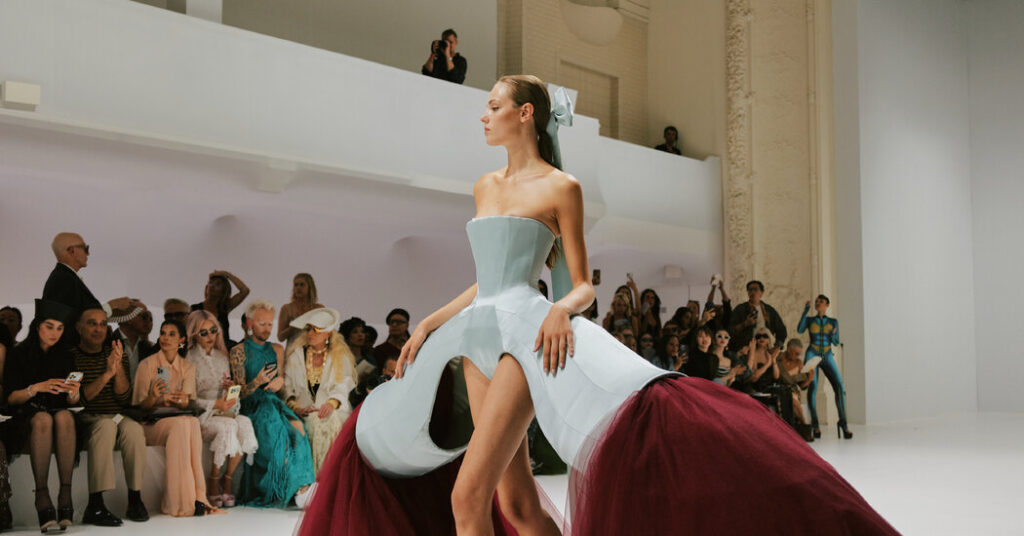
But punctuating them all was a series of dresses — or, ahem, constructions — that looked like a cross between the grand panniered ball gowns of the Sun King‘s court at Versailles and even grander drainage pipes, covered in feathers and velvet flocking and vomiting yards of tulle from either end.
Wearable? Not at all. (The finale gown, which looked sort of like one of Marie Antoinette’s frocks turned into a street sweeper, was more than three meters — almost 10 feet — wide.) Ridiculous? Yeah.
The future? Very possibly.
After all, in the circus that shows have become, increasingly the customer seems beside the point. It’s all just fodder for the stream now, there to drive engagement and name recognition. Lantink even included a dress with a plastic breastplate containing lavender sprigs, a direct reference to the best-selling Gaultier fragrance Le Male, like an implicit acknowledgment of what this is all for.
In that context, the more extreme and ridiculous a look, the better. It’s the fashion show as advertorial, or the style equivalent to that “if a tree falls in the woods” riddle: If a dress doesn’t go viral, does it even matter? After all, there are only a handful of individuals who can buy clothes as expensive as couture pieces. But there are so many millions more who can see them and comment. It’s possible they matter more.
Certainly, Lantink isn’t the only designer who seems to think so. Even Silvana Armani, the Armani women’s wear designer, in her second Privé show, appeared to feel the pressure to break through the endless scroll. How else to interpret the fact that amid the classic sparkling jackets and sparkling evening dresses that define the house, she offered … a pastie dress: an evening gown suspended from two sparkling nipple covers embroidered on illusion tulle.
Then there was Robert Wun, accessorizing his extreme corsetry and mega curves with the accessories of childhood (teddy bears, rubber balls, E.T. helmets, balloons), in a self-indulgent exercise of fashion for fashion’s sake, or fashion for the Met Gala’s sake, rather than fashion for any actual person.
Because here’s the thing: Even if you’re playing to the crowd, it’s possible to do gimmicks with meaning behind them. Gimmicks that aren’t just look-at-me gestures, but more like invitations to look-at-me — and then to think.
Viktor&Rolf are masters of that form. See their show this season, which involved two models — one old, one young, like mirror images — dressing and undressing on a rotating platform. The young woman tried on a series of gold looks (a shift, a miniskirt suit, an opera coat, gowns festooned with various combinations of bows and ruffles); her more mature counterpart, a series of matching styles in beige burlap. In the end, both wore elaborate woven gowns with the words “decadence” and “restraint” spelled out across the arms like a billboard.
It was smartphone catnip of the most obvious kind, but it was also just smart: a meditation on aging as well as the gilded age, not to mention the act of getting ready to face the world.
Just as at Schiaparelli, Daniel Roseberry’s decision to swap his usual surrealist spectacle for a more surrealist, if subtle, approach to the materials actually used to make the spectacle was a clever subversion of the usual hierarchy of materials. Imagine hundreds of real pink and blue hydrangea flowers fed sugar water for preservation and then embroidered onto lace like botanical pointillism, or silicone poured out and then cut like silk into tailored jackets and molded breast plates. Or LED lights sewn into the lining of a skirt dripping in pearlescent bugle beads to create an actual glow from within.
That was a pretty obvious bid for the attention economy, and one that worked: Zendaya, who plays the goddess Athena in the coming film “The Odyssey,” wore the finale look on her press tour appearance the day after the show, to much Instagram kvelling. But the choice of materials was also a reflection of the current tension around man versus the machine, and that gave it relevance.
It’s fine to get social media aflutter. That’s the imperative of fashion today, no matter what the price.
To have real impact, however, clothes can’t just be content, they need to have content. Which brings us back to those drainage pipes. Gaultier-the-designer built his brand on his ability to combine the cartoonish with cultural commentary. Lantink is great at the jokes, but seems skittish about the substance. Given the scale of his ambition, he could try some — well, deeper plumbing.
The post Enter the Era of Meme Couture appeared first on New York Times.