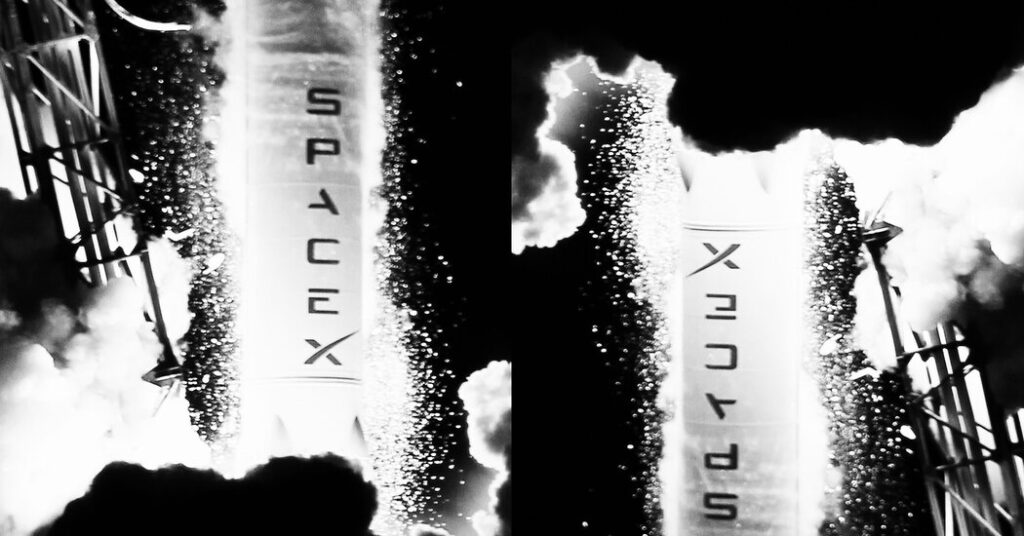
The recent initial public offering for SpaceX was the biggest stock sale the world has ever seen, with shares priced as if life on Mars were a sure thing. The company’s debt, on the other hand, is priced as if it were junk. Is this what F. Scott Fitzgerald meant when, nearly a century ago, he wrote, “The test of a first-rate intelligence is the ability to hold two opposed ideas in the mind at the same time, and still retain the ability to function”? How could the same company simultaneously be viewed as a top-tier investment and something that might not be able to pay its bills?
The answer starts with Wall Street’s long-held distinction between “smart money” and “dumb money.” In that view, the roughly $2 trillion value that the stock market is affording SpaceX — about the same as Amazon’s value, and more than JPMorgan’s and ExxonMobil’s combined — is being set by naïve investors who think Elon Musk’s promises will all miraculously be realized. The debt, on the other hand, is being priced by seasoned investors, the ones who understand that profits actually have to be earned, and who are rightly skeptical of Mr. Musk’s grand pronouncements.
The stock market tends to like big dreams, bold narratives and the men (they are mostly men) who can sell them. So when Mr. Musk says humanity is going to Mars, these equity investors see a civilization in space, not a black hole of costly delusions. There is a kind of logic to their approach: SpaceX’s offering documents claim the size of the company’s market is $28.5 trillion, nearly as large as the entire United States economy. Mr. Musk does have an uncanny ability to bend the world in his direction. If his company can make good on even a fraction of the market it claims, then SpaceX’s valuation of more than 100 times sales — almost 50 percent richer than the closest contender — might not be extreme.
And some of those investors are just gambling. They don’t actually care about the company’s long-term prospects; they’re simply placing a bet that they can cash out before anyone else catches on.
In addition, the company sold just under 5 percent of its shares, a tenth of what the average public company sells. That creates a supply-and-demand imbalance that will help to keep share prices high. SpaceX’s spot in the Nasdaq 100 index forces passive funds that track the index to buy in, straining that imbalance even further. So the equity investors’ optimism has a structural support. Not incidentally, it also has the support of Wall Street analysts, 80 percent of whom this week issued “buy” ratings. Then again, their firms stand to make money when SpaceX sells additional securities.
Debt investors, on the other hand, are supposed to be skeptics. Their job is to look at the numbers, because belief doesn’t pay the bills. Unlike equity investors, they don’t get paid more if Mr. Musk delivers on his promise to “extend the light of consciousness to the stars.” They succeed only if the company pays its debts. Well, promptly after going public, SpaceX issued $25 billion in new debt. Credit rating agencies gave the bonds the lowest investment grade rating possible, meaning the company was viable but much higher risk than, say, Alphabet. The bonds promptly plunged in value. Traders told Bloomberg they couldn’t recall another deal where prices sank that quickly.
Debt investors are often the first to see problems in shaky companies. Long before Enron’s share price started to plunge, its debt investors were demanding sharply higher prices for tools that could insure against a bankruptcy. Their fears were realized in what was at the time the biggest bankruptcy in U.S. history. And in the summer of 2007, while the stocks of investment banks like Bear Stearns and Lehman Brothers were still near their highs, credit spreads for AAA-rated mortgage bonds began to blow out, the first tremors of what by the next year would become a global financial crisis.
Something similar happened at WeWork before it went public. In 2019, SoftBank invested $2 billion, insisting WeWork was a world-transforming technology company, even as the bond market saw a cash-burning real-estate business facing serious risks. Again, the bond market asked the right questions: Within a few years the company had filed for Chapter 11 bankruptcy protection.
But the bond market’s skepticism isn’t always correct. Sometimes the stock market’s irrational beliefs pay off. In 2000, Amazon’s bonds plunged in value amid widespread skepticism that the company could survive, given its negative cash flow and its debt load. Amazon’s stock, which had already begun to decline, followed the bond market’s cue and plunged too, hitting a low of $6 in 2001. If you had invested $10,000 at that point, you’d have almost a half a million dollars today.
More pointedly, take Tesla. It issued $1.8 billion of high-yield bonds in 2017; by March 2018, its high-yield debt was trading around 87.5 cents on the dollar, a sign of skepticism that the company could repay the money. Since that time, its stock has gone up about twentyfold.
Neither equity nor debt investors have a monopoly on truth, especially not when a business is, like SpaceX, a coin still spinning in the air. The future hasn’t declared itself yet. But a few simple lessons help narrow the possibilities.
One is that the more debt a company has, the more risk there is. By that measure, SpaceX is dangerous, now and for the foreseeable future. The Morgan Stanley analyst Adam Jones just predicted that to fund its operations, SpaceX will have to raise $84 billion a year from 2027 to 2034.
Another lesson, courtesy of Enron, is that fraud isn’t good! A third is that you can’t outrun a flawed business model. WeWork had long-term leases funded by short-term rental revenue. Enron had speculative businesses that were losing money, but also a trading business that depended on the confidence of the capital markets. SpaceX? Well, it’s an amalgamation of a very profitable business (Starlink), a business that the U.S. government relies on (SpaceX) and a money pit with an uncertain future (xAI.) There isn’t much clarity.
Probably the most important lesson, though, is that the quality of a company’s management is the decisive variable. Leaders need not just the ability to sell big promises — to make people believe — but also the ability to deliver on those promises. Despite his grand words, Adam Neumann couldn’t make WeWork into more than a purveyor of office space, while Jeff Bezos was able to seize opportunities others didn’t see to make Amazon into far more than a book seller.
As for Mr. Musk: Doubters have argued for years that he’s a just modern-day P.T. Barnum, a showman who never really delivers on his promises, whether those are solar roofs, self-driving cars or Optimus robots. But there’s no denying that he’s done big things. He’s built cars, launched rockets and created a global telecommunications company. Skeptics have been waiting for years for the thing that brings it all crashing down. They’re still waiting.
Fitzgerald wrote his famous line not in a work of fiction, but in an autobiographical essay called “The Crack-Up,” about his attempts to manage his own mental descent. Although most of us remember only the start of the quotation, there’s a second line: “One should, for example, be able to see that things are hopeless and yet be determined to make them otherwise.” As long as something is still in the process of becoming, the belief itself can change the outcome, and that’s no doubt why Mr. Musk promises as much as he does. As long as he can keep his company’s equity aloft, he can keep raising money and delay the day of reckoning its debt requires.
The hardest thing — for investors as much as for novelists — is resisting the urge to choose between the two possible futures before the coin lands. For now, the two opposed ideas exist simultaneously.
Source photograph by Joe Raedle via Getty Images.
Bethany McLean is a financial journalist and the co-author of “The Smartest Guys in the Room.”
The Times is committed to publishing a diversity of letters to the editor. We’d like to hear what you think about this or any of our articles. Here are some tips. And here’s our email: [email protected].
Follow the New York Times Opinion section on Facebook, Instagram, TikTok, Bluesky, WhatsApp and Threads.
The post It’s a World-Class Investment. It’s a Junk Investment. What Is Going on With SpaceX? appeared first on New York Times.