There is no easier city in the world for an American to love than Paris. So it has been since the time of Benjamin Franklin. Love, though, comes with spats and fits of temper, ruptures and reconciliations. So, too, with the United States and France. A recent visit reminded me, however, of why the American relationship with France remains, whatever its difficulties, one to cherish.
Take the ways in which Britain and France deal with the Second World War. The British are busily removing Winston Churchill from their banknotes, replacing him with an engraving of a hedgehog. Meanwhile, the French are flocking to see a two-part, five-hour-long movie, La Bataille de Gaulle, which retells the story—both anguished and heroic—of defeat, collaboration, resistance, and liberation. In elegant Parisian bookstores, you will find tables filled with works by and about Marc Bloch, a gentle historian of the Middle Ages who wrote a stinging account of the defeat after he was demobilized in 1940. He became a hero of the underground, and was taken, tortured, and executed less than two weeks after D-Day. A trembling 16-year-old boy, sentenced to be shot at the same time, asked, “Will this hurt?” The 57-year-old Bloch gently took his hand and said, “No, my boy,” before shouting “Vive la France!” and dying riddled by Nazi bullets.
On June 26 of this year, Bloch, a Jew who identified as such only when dealing with anti-Semites, was interred in the Pantheon, the final resting place of so many of France’s great literary and cultural figures.
The distinctive memories of World War II linger even in music. If for Britain the melodies that still evoke the war are Vera Lynn’s gentle “The White Cliffs of Dover” and “We’ll Meet Again,” in France the anthem is the “Chant des Partisans,” a much grimmer and relentless song of people waking from slumber, of comrades stepping out of the shadows to replace the fallen, of suffering and revenge.
[Read: Europe without America]
World War II shaped modern France, producing not only the Fifth Republic that Charles de Gaulle created around a powerful presidency and elitist institutions but the contradictions inherent in the stories of resistance and the no-less-important tale of collaboration. Bloch’s Strange Defeat is selling; so is a recent biography of Jacques Benoist-Méchin, a brilliant intellectual who served as a minister in the Vichy government, was sentenced to death after the war and then pardoned, and went on to a successful postwar literary and political career as an expert on Middle East affairs.
France eventually forsook formal empire, but not an imperial self-understanding; it reflected de Gaulle’s wariness of the Anglo-Saxon powers that had attempted to control or even subvert him; it retains to this day a sense of itself as a multidimensional power, rooted in a deep literary culture. The admirable Library of America collection of American classics is modeled on the older and rather more elegant French Pléiade library, whose complete sets (unlike the American equivalent) are ubiquitous; they’re found in bookstores, on private bookshelves, and even on the French president’s desk.
American statesmen have always found France an ambivalent ally, but as much because of their own behavior as that of their counterparts. French money underwrote the American Revolution, bankrupting Louis XVI’s government and paving the way for their own revolution within a decade of the end of the American war. There were almost as many French troops at Yorktown as Americans, and French-provided weapons, gunpowder, and expertise, not to mention timely French naval power, sealed the American victory. France’s reward was vengeance on Great Britain for the defeat of the Seven Years War—and betrayal by Americans willing to cut a separate peace with King George III.
Over the following years, the Franco-American relationship fluctuated. An informal Quasi-War flared during the administration of John Adams; in the immediate aftermath of the Civil War, when William Tecumseh Sherman was nearly ordered to evict Napoleon III’s soldiers from Mexico, the crisis could easily have led to war. Many Americans rooted for a besieged Paris during France’s catastrophic war with Prussia in the 1870s, and General John Pershing’s aide told a desperate France in 1917: “Lafayette, we are here.”
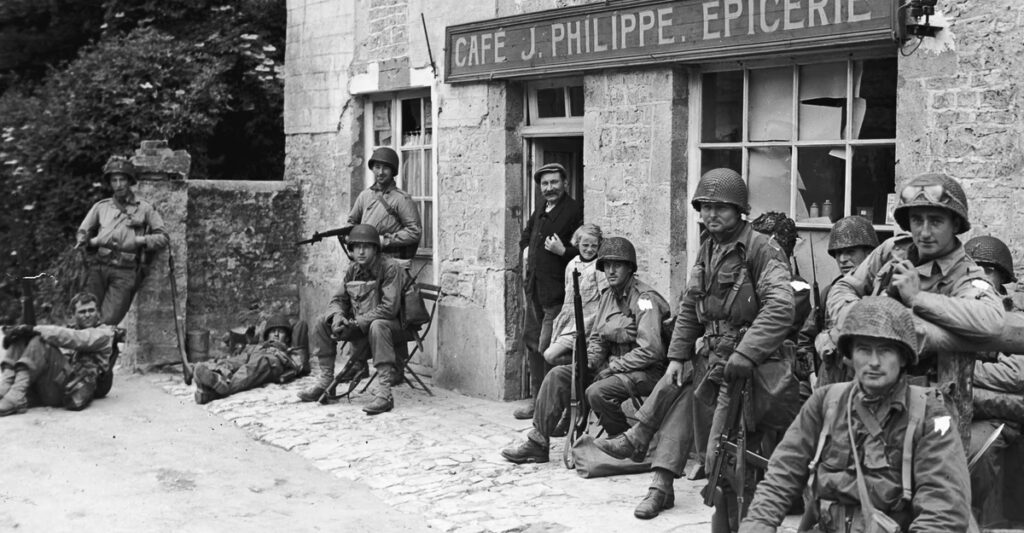
During the Second World War, Franklin D. Roosevelt attempted to undermine de Gaulle, preferring to work with establishment figures, including those in the collaborationist Vichy government. American and French soldiers and sailors killed one another during the 1942 landings in North Africa—and then went off to war together in Italy and the South of France. The United States aided the French in the Indochina War, bullied it during the 1956 Suez crisis, and leaned on it to abandon Algeria a few years later; France supported the United States during the Cuban Missile Crisis, but French demonstrators denounced the Vietnam War, and a particularly damaging rupture occurred during the run up to the 2003 Iraq War. Yet American troops fought side by side with French soldiers in Afghanistan, and behind the scenes, the intelligence services shared information and even cooperated in the shadows. Lingering French gratitude is evident in the various museums honoring the D-Day landings.
[Adam Serwer: Trashing American allies turns out to be bad for national security]
France still matters as a great power. Its defense budget is somewhat smaller than that of Great Britain, but it gets considerably more bang for its euro. Its nuclear deterrent is modernized and efficient; its army is larger, and its navy far more deployable than that of its British counterpart. “The British do us a favor by showing us the mistakes to avoid,” a worried French bureaucrat told me. (My conversations with him and others were held under an assumption of confidentiality.) France is a minor but not an inconsequential Pacific power, and if it has been humiliatingly driven out of Africa, where it retained for many decades a shadowy, quasi-imperial role, it still has reach.
Today’s French officials are calmer in their appraisal of the Trump administration than are many of their European counterparts. “It’s because we never really trusted you,” a French diplomat remarked to me with a grin over our breakfast croissants. Their chief concerns are more immediate. For the first time in many years, the 2025 French national-security-strategy document is focused on a conventional threat in Europe. Russia is unambiguously the chief adversary, and the possibility of all-out war by 2030 is considered severe. French national-security officials are seeking to build resiliency against that threat—including against hybrid warfare of sabotage, cyberattack, and assassination—as well as against Islamist terrorism, which has struck their country repeatedly.
France’s resources are scantier than its needs. Its deficit is more than 5 percent of GDP, and debt servicing, as in other countries, eats at what is available for defense. And, as in other countries, there is internal turmoil on both the populist right and the populist left. President Emmanuel Macron is limping to the end of his administration as an unpopular and more and more ineffective-looking figure.
Despite all this, France remains vital not only to NATO but to the broader West, including the United States. In few other countries is the sense of cultural heritage so powerful, and it reaches across the Atlantic. My visit to France began at the Château de Tocqueville, not much more than half an hour from Utah Beach. Through many activities, including a thoughtful annual conference, the family carries on the legacy of Alexis de Tocqueville, the wisest and still one of the most relevant commentators on what America is and can be, and what it means for the democratic world. Like the best of today’s Frenchmen, he was shrewd. He saw America’s weaknesses and failures but also its tremendous strengths. And he understood, as we should on this side of the Atlantic as well, that the fates of both countries are tied together.
The post Our Oldest Ally appeared first on The Atlantic.