ANKARA, Turkey — Donald Trump voiced skepticism about defending America’s allies long before his rise to the White House.
As a real estate and casino magnate, he complained in a 1990 interview with Playboy magazine that the United States was “defending wealthy nations for nothing” which would otherwise be “wiped off the face of the earth in about 15 minutes.”
Two presidential wins later, Trump has suggested repeatedly that he could quit NATO, the U.S.-led alliance built around the core premise that an attack against one is an attack on all.
Trump has often treated allies with disdain, threatening earlier this year to seize Greenland, a territory of NATO ally Denmark. He claimed during his last campaign that he would encourage Russia to attack nationsthat don’t spend enough on defense, and this year, angry at European criticism of the Iran war, Trump said the U.S. might stop promising to defend its allies.
As leaders of NATO’s 32 nations gather in Turkey, they are set Wednesday to reaffirm commitment to the mutual defense clause, known as Article 5, which covers the Euro-Atlantic space.
But in Europe, Trump’s wavering on this core tenet of the Western alliance has forced a reckoning over whether the U.S. would in fact come to the rescue of its allies in an attack. That seed of doubt alone suggests that the president might not need to withdraw the U.S. from NATO to undermine it, officials say.
The fraught questioning is now complicated by U.S. plans to withdraw troops from the continent, as European leaders increasingly warn that Russian may soon try to test their defenses.
“With Article 5, as with any security commitment, is that until it’s tested, it is debated,” said Camille Grand, a former NATO official who is now secretary general of the main European defense industry association.
Action under Article 5 is not automatic. In the event of an attack on an ally and request for assistance, the member states must agree unanimously to respond and decide what steps to take.
Despite Trump’s gripe, which he reasserted this weekend, that U.S. allies are “not there for us,” the only time in its history that NATO triggered Article 5 was after the Sept. 11, 2001, terrorist attack on the United States.
Trump has shaken the pillars of NATO by defining the promise as transactional and questioning what is meant to be unquestionable — Article 5 is part of the Washington Treaty that created NATO.
“It’s supposed to be a no-brainer, the sort of musketeer one for all, all for one commitment, no matter what and so on,” Grand said. “So we end up in a situation where there are more doubts than with any other president in recent history at least, which makes the Europeans nervous.”
Some European leaders recently have become more blunt about the impact. French President Emmanuel Macron warned, after Trump’s last threat to leave NATO, that the alliance is “worth what is left unsaid: that is, the trust behind it.”
“If you create doubt every day about your commitment, you strip it of substance,” Macron said.
The faltering confidence in U.S. guarantees has propelled Europe’s complex, costly mission to rearm and take more ownership of NATO, which the U.S. has led since its founding after World War II.
The U.S. still has nuclear warheads and tens of thousands of troops scattered across Europe, and maintains a firm grip on NATO’s command and control structure. European officials say they would be capable of defending the continent alone if it comes to that, while seeking to keep Washington engaged.
Yet more are now calling for Europe to mount a concrete push to replace much of the U.S. role, from frontline troops to fighter jets, in a bid to lessen the blow of any pullback.
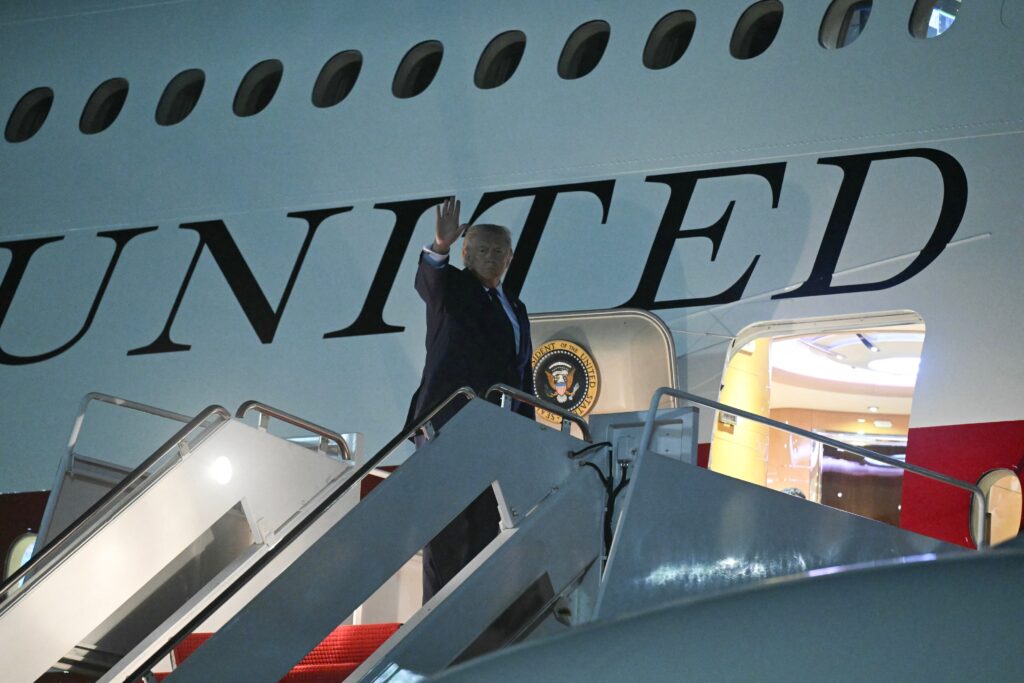
Ahead of Trump’s arrival in Ankara on Tuesday, the U.S. ambassador to NATO, Matthew G. Whitaker, said “the United States is not going anywhere” but expects European nations to take charge of their defenses — now a common narrative of Europeans and the White House.
“If the Europeans are capable of providing the cavalry in a crisis, demonstrating they’re not just going to call Washington and panic if Washington doesn’t act … that makes our deterrence effective,” Grand said.
What Article 5 implies, especially for smaller nations and the former Soviet satellite states in Eastern Europe, is the prospect that a U.S. president would bring the full force of American military might to bear if any one of them is attacked.
For a NATO ally such as Denmark, which faced Trump’s bid for Greenland, the promise of U.S. help in an attack can ring hollow after staring down the prospect of being attacked itself by U.S. forces.
A European diplomat, who like others spoke on the condition of anonymity to discuss sensitive diplomacy, said this was a question of confidence rather than hardware stationed in Europe.
“If the psychological belief that the U.S. will help defend us is gone, then do the assets matter?” the diplomat asked.
NATO Secretary General Mark Rutte managed to defuse tensions over Greenland this year, but it was not long before Trump grew irritated at European leaders seeking distance from the U.S.-Israeli war on Iran.
The president — who once questioned the wisdom of triggering “World War III” by theoretically coming to the defense of tiny NATO ally Montenegro — was frustrated that European leaders shied away from joining a war that he and Israel unleashed outside the NATO realm.
After the 9/11 attacks, NATO allies deployed aircraft to help patrol U.S. airspace and naval forces to the Mediterranean.
European nations, including Germany and Denmark, also sent troops to fight alongside U.S. forces in Afghanistan, getting embroiled in America’s longest war, which some in Europe later regretted after the chaotic 2021 withdrawal.
NATO officials insist the Trump administration has made clear its commitment to Article 5, and that the alliance retains its full deterrence capabilities. Despite plans to pull forces and systems available to Europe, U.S. officials have offered assurances the U.S. nuclear umbrella remains intact.
European diplomats say that NATO’s sprawling military infrastructure, which draws on forces and bases from Canada to Turkey to Estonia, would activate in a crisis regardless of Trump’s social media musings.
A second European diplomat acknowledged that Trump’s threats created uncertainty, but added that in case of an attack, “our military is not going to wait for Trump, they will fight.”
Some also believe that pressure from Congress, especially hawkish Republican lawmakers, would compel Trump to defend longtime allies.
One official compared the ambiguity to Russian roulette, a potentially deadly game of chance. So long as there’s a sliver of doubt that Washington would respond, that could make the Kremlin think twice about testing it, the official said.
A senior NATO diplomat said the alliance was going through “a difficult time” as Europe seeks more control while the U.S. retrenches.
“We’re in this period of transformation which will have consequences that we can’t even foresee,” the senior diplomat said. “Is that always easy? No, but I see true commitment.”
The looming U.S. drawdown has spurred once-unthinkable planning in European capitals on how to replace U.S. capabilities, such as aircraft or warships, and how the continent’s militaries might fight a war with little to no American backup. Some officials stress that European nations don’t need to backfill U.S. gaps one for one, but simply need to have enough to fight alone.
Alice Rufo, France’s deputy defense minister, suggested there was little use in contemplating the volatility of U.S. policy when there is work to do.
“What is predictable is that the U.S. wants Europeans to do more, and that … there may simultaneously be several theaters of conflict in which we must assume our responsibility,” Rufo said, noting recent Russian drone incursions into NATO airspace. “That’s what we must prepare for,” she said.
“In any case, our approach to alliances rests on credibility, trust, and predictability,” Rufo added, “which I believe is a very powerful strategic tool in the current context.”
Michael Birnbaum contributed to this report.
The post Trump’s NATO-bashing casts shadow over U.S. pledge to defend allies appeared first on Washington Post.