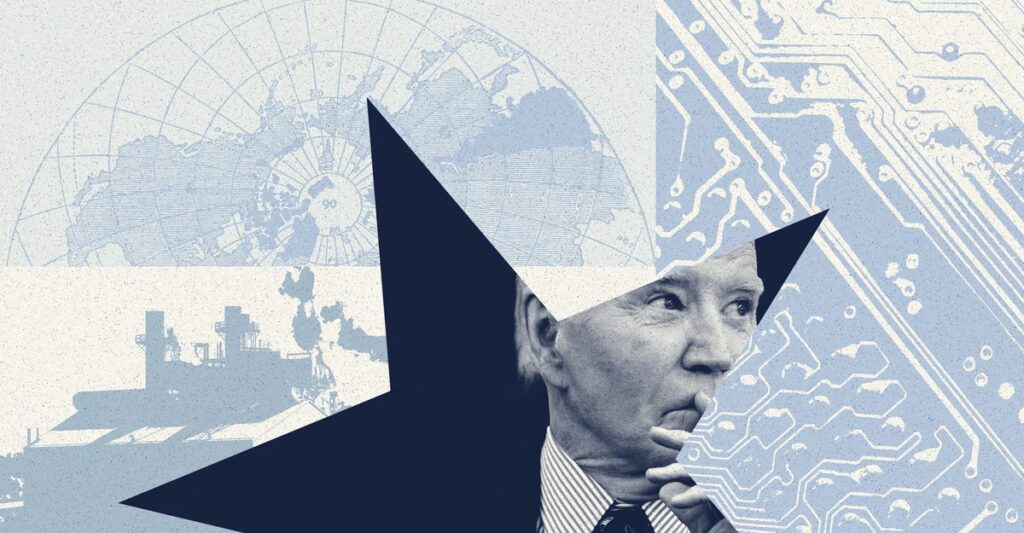
The debate over the future of the Democratic Party’s foreign policy has become intensely personal. In May, Senator Brian Schatz of Hawaii posted on social media that although he did not favor “black listing,” he thought it nevertheless “fair to want a whole new crop of foreign policy staffers in the next democratic administration.” After all, he added, “it’s not like the same 120 people are the only people who know anything.”
His post followed a stream of stories and social-media commentary calling for many of the Biden administration’s senior foreign-policy officials to be excluded from future Democratic campaigns and administrations.
The focus on these individuals stands in for a more consequential argument about the Biden administration’s foreign-policy legacy and the alternative now emerging within the party. And the divide is between two very different accounts of the world Democrats will inherit. One envisions a globe defined by strategic competition and the erosion of the old order. The other rejects that framework as self-fulfilling and favors a foreign policy built around restraint and cooperation with China on shared global problems.
[Missy Ryan: What is the Democrats’ answer to ‘America first’?]
I served on Joe Biden’s National Security Council with responsibility for strategic planning, so I am perhaps not a wholly disinterested observer. But I have no doubt that a debate is necessary—and only natural after an electoral defeat as politically and psychologically devastating as 2024’s. That discussion, however, should rest on ideas rather than personalities, and on an accurate view of history.
Biden is often portrayed as a defender of the old liberal international order—a restorationist who tried to rewind history to a time before Donald Trump’s first term. Some Democrats who remember Biden this way believe that the party now needs an entirely new foreign policy, designed by a younger and more progressive generation. But although Biden often spoke like a restorationist—remember “America is back”?—he did not actually govern like one.
For decades, Democratic administrations had been guided by the belief that expanding globalization, integrating supply chains, and prioritizing free trade would naturally strengthen both American prosperity and international stability. This belief was based on an expectation of great-power cooperation, which would allow any country to get anything it wanted, no matter where it was produced, just in time.
The Biden administration left these neoliberal assumptions behind. Its wager was that domestic industrial strength, not global integration, would become the foundation of national power. National Security Adviser Jake Sullivan gave clear expression to this shift in a 2023 speech at the Brookings Institution, in which he called for an active industrial policy, supply-chain resilience, export controls, and technological competition with China.
Biden’s approach to Russia and China was more confrontational and competitive than those of his Democratic predecessors. His administration armed Ukraine, through the largest American security-assistance effort since the World War II–era Lend-Lease Act, and provided Ukraine with extensive intelligence to help it fight Russia. At the same time, the Biden administration pursued a policy of managed competition with China. This meant that Washington limited the export of advanced semiconductor chips, regulated U.S. investment in Chinese firms, pushed diplomatically to limit the number of military bases China maintained globally, and deepened its alliances—even as it pursued high-level diplomacy to prevent this competition from escalating into conflict.
This was not, in fact, the Democratic foreign policy of the past. It was riskier and more ambitious, designed for a far more dangerous world. It was not simply a return to old alliances, following a post–Cold War template. Rather, it emphasized new agreements, including AUKUS, which encompasses Australia and the United Kingdom, and other accords with the Philippines, India, and Vietnam. Under Biden, Finland and Sweden joined NATO, and the United States held annual summits with Japan and South Korea.
Biden did seek to cooperate with China on issues of mutual concern, such as AI. But he insisted that this had to be done without preconditions. That’s because those of us who worked on these policies inside the administration knew the Chinese playbook well. Beijing had little interest in cooperating on climate or anything else. It would stall by demanding that the U.S. make a concession on some matter of strategic importance, such as Taiwan and export controls. If that demand was met, Beijing would start a dialogue that wouldn’t go anywhere. And whenever the United States did something to displease them, they’d cancel the dialogue and start again. So Biden’s position was to stand ready to cooperate with China wherever our interests overlapped but never to offer unrelated concessions in exchange. This approach did produce some breakthroughs, such as restricting chemical exports used in fentanyl and limiting the use of AI models in decision making around nuclear weapons.
In the 18 months since the Biden administration left office, we national-security alumni have tried to come to terms with our legacy. Many of us feel most uneasy about the policy toward Israel’s war in Gaza, where we failed to persuade or compel the government of Benjamin Netanyahu to do more to minimize civilian casualties and mass displacement. Biden could have conditioned aid to Israel on its actions, but with the one exception of the provision of 2,000-pound bombs, he did not do this. He also could have put more pressure on Netanyahu to limit settler violence and expansion in the West Bank. There is no consensus on the path forward, but many broadly agree that America’s relationship with Israel should look more like its alliances with other nations. That means that Israel would no longer automatically receive an aid package, Washington would show less deference to Jerusalem when the two countries’ interests diverge, and there should be a greater role for a reformed Palestinian Authority in Gaza.
Biden alumni are discussing a lot of other questions too, including whether and how to end Trump’s tariffs, whether technology export controls can be restored—and also how exactly to overhaul the defense industrial base, re-form alliances, balance climate change and energy needs, and rebuild American development aid after the dismantlement of USAID.
All of this falls under the category of building on Biden’s legacy. But a clear and coherent alternative to that is emerging from the Democratic Party’s progressive wing, which appears to be ascendant. This vision begins with criticism of Biden’s Middle East policy—particularly his refusal to condition military support for Israel during the Gaza war—but has grown much bigger and more consequential.
The progressives seek more distance from Israel, even if Netanyahu is no longer prime minister. They favor restricting arms sales as well as ending military assistance, significantly downgrading the strategic relationship, and reducing the broader American military presence in the Middle East. Some progressives also argue for a public reckoning with all aspects of Biden’s Gaza policy and for officials associated with it to be excluded from future administrations.
A more comprehensive worldview is emerging in the writings and arguments of figures such as Ben Rhodes, the deputy national security adviser under Barack Obama; Matt Duss, who advises Representative Alexandria Ocasio-Cortez; and Jessica Chen Weiss, a professor at Johns Hopkins University who served in the State Department during the Biden administration but broke with it over its China policy.
These experts generally argue that the foreign-policy establishment has treated military dominance as strategy and subordinated global cooperation to geopolitical rivalry. They hold that Democrats should, as Rhodes put it, “slash a bloated and out-of-control Pentagon budget” and move toward a more affirmative agenda focused on transnational concerns, such as climate change, public health, and artificial intelligence.
Underlying much of this critique is the belief that Washington has become excessively hawkish toward China. Weiss credits Trump with creating “real breathing room” in U.S.-China relations and recommends that the United States deepen its economic ties with China, stop talking about strategic competition, and nurture moderates in Beijing. Duss told Ezra Klein that progressives favor the economic shift away from neoliberalism but object to the emphasis on competing with China. The United States, he said, should make common cause with China on establishing a global minimum wage, among other issues.
These progressive ideas are likely to continue to develop as the primary campaign approaches. Not everything associated with Biden will be abandoned. Many progressives appear comfortable with Biden’s approach to Russia and Ukraine, which combined extensive support for Kyiv with a deliberate effort to avoid direct military conflict between the United States and Russia.
[Robert Kagan: America vs. the world]
The world has changed, and what comes next will be different from what came before. The international system is not deteriorating simply because Trump returned to office. Vladimir Putin launched the largest war in Europe since 1945. Xi Jinping has undermined core assumptions of the global trading system by using China’s national power to dominate the industries of the future. Wars are already under way in Europe and the Middle East. A conflict over Taiwan could quickly become global. The central foreign-policy question facing Democrats is what kind of strategy is best suited to an era of intensifying geopolitical rivalry.
Democrats could accept that the United States is in a long-term strategic competition with China and Russia and seek to manage this by modernizing America’s military, strengthening its alliances, advancing its technology, and selectively disentangling its economy from those of other states. Or Democrats could refuse the competition framework and seek to build a foreign policy around cooperation with other states on shared global problems.
Whatever one thinks of the Biden administration, it clearly chose the first path. Those who support it believe in competing strategically with China and others to deter aggression and shape the world in a way that reflects America’s interests and values. These thinkers worry that the progressive alternative does not recognize how the world has changed and become more dangerous, both because and independent of Trump. For their part, progressives believe that Biden’s approach fed a dangerous trend globally and that Americans must stop treating military primacy as the measure of their leadership. A clean break offers hope of a fresh start.
No Democratic candidate is going to run on Bidenism. But whether the candidates of the near future build on Biden’s break with the post–Cold War consensus and make it their own or repudiate it altogether in favor of a progressive alternative is shaping up to be the defining foreign-policy debate inside the party.
*Illustration sources: Justin Merriman / Bloomberg / Getty; mikroman6 / Getty; Roman Chekhovskoy / Getty; Yuri Gripas / Abaca / Bloomberg; Getty.
The post What Biden Changed About American Foreign Policy appeared first on The Atlantic.