Nearly a decade ago, third-generation Texas oilman Doug Robison was plotting his retirement and the sale of his petroleum company when a trip to his children’s alma mater, Abilene Christian University, changed his career trajectory—at an atomic level.
He heard a brief talk from Rusty Towell, the director of the school’s Nuclear Energy Experimental Testing lab (NEXT), on the potential of next-generation, molten-salt nuclear reactors for affordable power to lift much of the world out of poverty. Robison was sold. “I met him in the back of the room and said, ‘What would you do if you’re fully funded?’ I asked him three times, and he wasn’t ready for the question.” Two weeks later, Towell offered Robison a rough plan. “I said, ‘You’re funded. Let’s go.”
Robison’s $3.2 million research donation kickstarted the effort and news spread. Then-U.S. Energy Secretary Rick Perry—and former Texas governor—sent a team to Abilene to study the research. In 2019, the Department of Energy offered fuel and salt in support of the project if they agreed to build a test reactor. ACU volunteered to host it.
“I held my hand up in the room and said, ‘I’ll fund it,’” Robison said. ACU President Phil Schubert took Robison aside, asking, “Do you have any idea how we’re going to do this?” Robison replied. “Phil, I don’t have a clue.”
A few months later, Natura Resources was born as a next-generation nuclear startup, aiming to build smaller reactors using new technologies for cooling and other functions. Robison took the defunct corporate shell of an organic farming company he’d started in the 1980s—Natura—and turned it into the startup, even if it’s technically over 40 years old. “It’s a transition from organic agriculture to advanced nuclear,” Robison told Fortune with a laugh, adding that they both still involve clean energy.
Since then, Natura has grown, as has its university alliance—more than 150 researchers from ACU, the University of Texas at Austin, Texas A&M University, and the Georgia Institute of Technology.
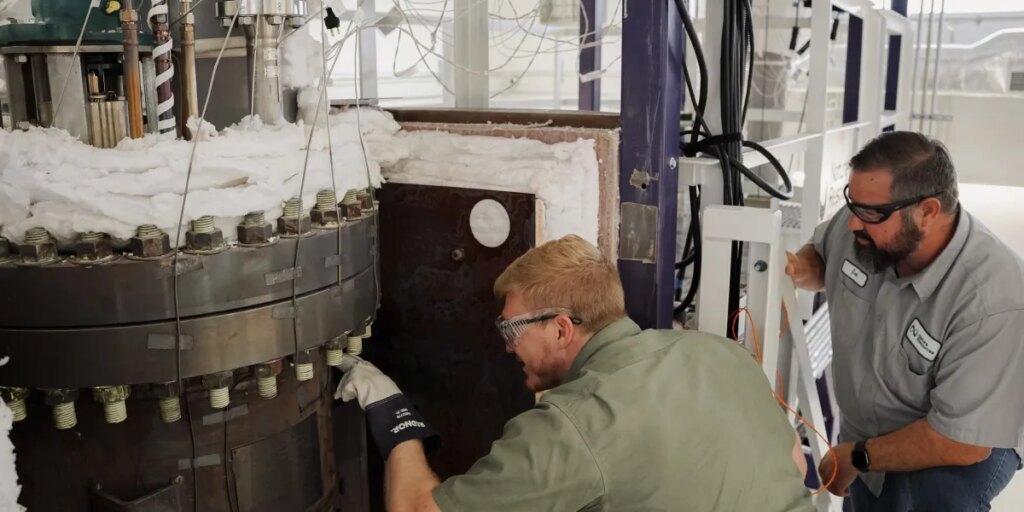
They plan to bring the first reactor, MSR-1, online in 2028 in Abilene. The Nuclear Regulatory Commission approved the construction permit in 2024. A 100-megawatt commercial reactor is planned for West Texas’ Permian Basin or near Texas A&M in Bryan by 2032.
Natura joined the Trump administration’s ambitious Nuclear Reactor Pilot Program—involving 10 companies initially—to achieve criticality on at least three test reactors by the Fourth of July—the same date the administration ends subsidies for wind and solar projects.
Natura is not one of the three meeting that goal this weekend, but it hardly matters.
Leaders of the pack
Natura is focused on bringing its test reactor fully online by 2028—even if 2026 was an early goal—and building up a supply chain to scale up commercially in the 2030s. Late last year Natura bought the advanced nuclear development company, Shepherd Power, from energy technology and manufacturing firm NOV—partnering with NOV in the process.
“What we’re trying to prove more than anything is showing that we can actually build a reactor system,” said Natura chief operating officer Jordan Robison, who is also Doug’s nephew. “There is a difference between a criticality test and building a full reactor system.”
Achieving criticality is the milestone when a nuclear reactor sustains its first chain reaction. It’s a key milestone, but the reactor is not operating continuously and producing electricity. An operating reactor is safely generating power over a long period.
In fact, none of the perceived leaders of the next-gen nuclear race achieved criticality in Trump’s pilot program. In addition to Natura, Google-partnered Kairos Power, Bill Gates-backed TerraPower, Sam Altman-backed Oklo, or Amazon-backed X-energy are all focused on building nuclear reactors for utility-scale grid power and hyperscalers. And Natura will need to attract more outside funding to scale up as well.
The three that announced criticality successes by July 4 are all focused on smaller microreactors to power industry or military bases, and not initially utility-scale power. They are Antares Nuclear’s Mark-0 at the Idaho National Laboratory, Valar Atomics’ Ward 250 at the Utah San Rafael Energy Lab, and Deployable Energy’s Unity reactor, also at the Idaho National Lab.
All the aforementioned are developing next-gen nuclear technology for small modular reactors (SMR) or even smaller microreactors. So-called Gen IV reactors rely on non-water coolants—traditional nuclear plants use light-water reactors—such as liquid metals, molten salts, or high-pressure gases. They’re designed for inherent safety with reactors that cannot physically melt down even if all power is lost.
But speed is of the essence, especially with the burgeoning AI data center boom and their thirst for more power. The Trump administration already is easing and streamlining the regulatory processes for SMRs. That’s why Natura already has plans lined up to build its commercial reactors with Teledyne Brown Engineering in Alabama, and for on-site design and construction to be led by Zachry Nuclear, Doug Robison said. Speed and scale matter.
Unlike traditional reactors that use highly pressurized water, molten salt reactors dissolve the nuclear fuel directly into a liquid salt mixture. The molten salt serves as both the coolant and the fuel carrier. High pressures are not required and, if something does go wrong, the nuclear fuel is trapped in the salt. “It’s radioactive, but it’s contained,” Doug Robison said. “Molten salt reactors I believe are the most eloquent of the solutions.”
“Our reactor is sitting in the middle of Abilene right across the street from a dormitory,” he added. “The reason we can do that is because we don’t operate under pressure. We never lose containment.”
Oil and gas roots
Next will come the process of proving the viability of the reactors to investors, hyperscalers, and utilities. There’s a lot of noise and Natura will need to separate itself from the pack, Robison said.
“There’s probably close to 100 projects out there now because there’s so much money flying around,” he said. “With data centers and AI, people are talking hundreds of billions of dollars. That’s going to attract a crowd.
“Coming from the oil and gas background. I’ve never seen a [blueprint] drawing of a drilling rig. Either you have a rig or you don’t,” he continued. “If you don’t have a rig, you’re not drilling, so you don’t have any production. There’s nothing to talk about.”
That will change when the Abilene test reactor comes online, he said. Only a small handful of companies are actually building next-gen reactors right now.
“Our levelized cost of electricity, we think, will be competitive with natural gas, which means we can deploy power onto the grid at a cost that is competitive in the marketplace without subsidies and mandates,” Robison said.
Now Natura must prove it. “We need to derisk to the point when the financial industry says, ‘Now, we believe it.’ When they did it in the Permian with oil, when that money hit the table, everything changed. Steel mills opened up. Fracking mines opened up to provide sand. An industry was stood up, and we made the nation energy independent. That’s exactly what we’re doing now.”
But Natura isn’t stopping at electricity.
Robison is eyeing West Texas’ Permian Basin as the first potential site for a commercial reactor because—in addition to the rising electricity needs—the Permian also has a growing problem with handling the chemically polluted water extracted during oil and gas production.
The heat generated from the reactors can be used to desalinate water, Robison argued. Natura already is working with NGL Energy Partners, which has a large water solutions business.
At least one-quarter of the world’s population doesn’t have access to clean drinking water, he said, but Natura will start in Texas.
“We can generate clean power. And we solve the air emissions issue in the Permian Basin. We start solving the water problem, and we return usable water to the inventory of Texas,” Robison said. “Check, check, check.”
The post How a third-generation Texas oilman transformed an organic farming company into a leading advanced nuclear startup at a small Christian college appeared first on Fortune.