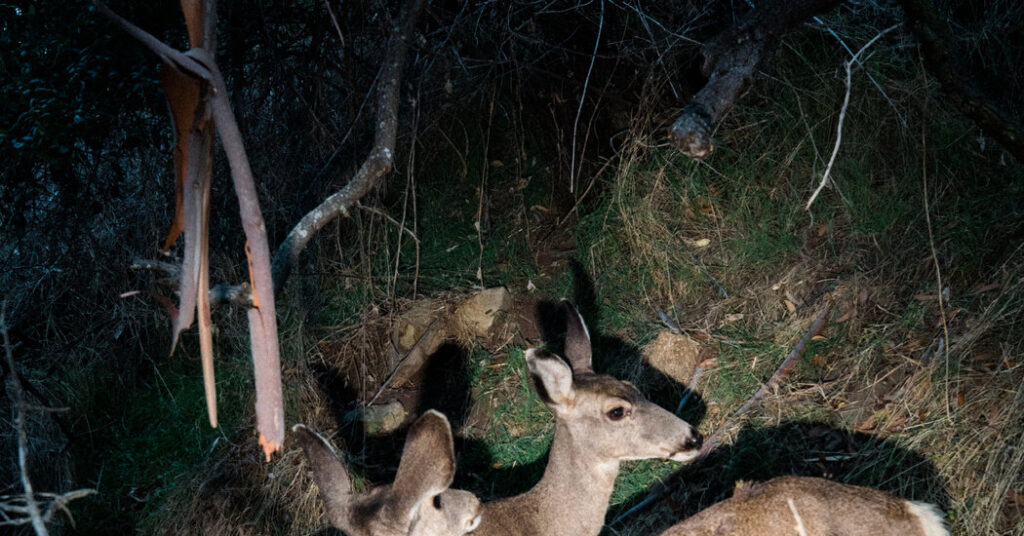
The deer on Catalina Island have long charmed residents and tourists alike, with the creatures often spotted bounding across rugged hillsides or wandering the sun-drenched streets in search of scraps.
Soon, however, all of the deer will be gone.
The Catalina Island Conservancy, a nonprofit that owns 88 percent of the island off the coast of Los Angeles, said Tuesday that it would begin the first phase of a multiyear project to kill nearly all of the island’s 2,000 deer. The eradication is part of an effort to restore natural ecosystems and reduce fire danger on the 75-square-mile island.
A Los Angeles County judge issued a tentative ruling on Tuesday denying a preliminary injunction requested by opponents of the plan. After a hearing in the case, the conservancy said it had decided to proceed with plans to kill the first 200 deer between now and the end of October.
The judge’s final ruling on the injunction is expected within 90 days.
Mule deer aren’t native to Catalina, and their grazing on native, fire-resistant plants is making the island particularly susceptible to catastrophic blazes similar to the one that tore through a large swath of Maui in 2023, scientists say.
The proposal has faced tremendous backlash. An unusual coalition of animal advocates, locals and hunters sued the conservancy and the state to stop the project from moving forward.
“It was never our first choice,” said Pepe Barton, a spokesman for the conservancy. “But we have to protect the island to the best of our ability.”
Catalina, formally known as Santa Catalina Island, is one of the eight Channel Islands, an archipelago so biodiverse that it is often called North America’s Galápagos. While five of the islands comprise a remote national park, Catalina has long been a tourist destination, made famous generations ago by Golden Age Hollywood stars who partied there in the 1920s.
The contours of the island were also seen as prime ground for hunting, and a few dozen mule deer were introduced from California forests nearly a century ago. Now, their descendants are mowing through the native shrubbery, allowing it to be replaced with grasses that are highly flammable, said Anna Jacobsen, a plant ecology professor at California State University, Bakersfield. Those fires in turn threaten the rest of Catalina’s ecosystem, including 60 plants and animals found nowhere else on earth.
Janice Hahn, a Los Angeles County supervisor who represents the island, which is a few dozen miles from the port of Long Beach, asked Gov. Gavin Newsom on Monday to intervene and revoke the permit granted to the conservancy by the California Department of Fish and Wildlife.
“Eradicating an entire population of animals that have been part of Catalina’s landscape for nearly a century is an extreme, unnecessary response,” Ms. Hahn said in the letter. “Once they are gone, they are gone forever.”
Governor Newsom’s office referred a request for comment to the Department of Fish and Wildlife. The department declined to comment on Tuesday.
Though killing the deer may seem extreme, such projects are fairly common in the field of conservation and have already been carried out on all the other Channel Islands. Worldwide, more than 1,000 eradications of invasive horses, cats, elk and other mammals have occurred on islands to bolster fragile ecosystems.
On Catalina, it would be nearly impossible to capture thousands of deer and sterilize them. Even if that were done, it would take years for the native vegetation to grow back, the conservancy says.
Moving the deer would be unlikely to work. Deer often go into shock and die from the stress of being captured, and when moved somewhere new, they don’t know how to navigate the habitat. When deer were moved off Angel Island in the San Francisco Bay, 85 percent died within the first year from stress, disease and an inability to adapt to a new habitat, according to the conservancy.
That leaves killing as the best option, the conservancy said. It had initially planned, in 2023, to kill all the deer in a seven-week span using sharpshooters in helicopters. But conservancy officials softened their approach following the pushback.
The plan now is spread the killing over at least five years, Mr. Barton said. This month and next, scientists will test their methods to see if the deer respond to watering and bait stations of cracked corn that they have set up in a swath of the island, and the conservancy plans to kill about 200 deer with rifles, according to court documents.
The conservancy also plans to allow residents of the island a final opportunity to hunt the deer from October through December.
The meat will be provided to the California condor program or to tribal partners, and carcasses near roads, trails or other public areas will be removed.
The plan will ramp up in the coming years. The conservancy will rely on nocturnal ground shooting using thermal sensing technology as well as drones and detection dogs to capture the few that remain.
A few deer that hang out in Avalon, the town of 3,300 people, will be sterilized instead of killed. Specialists will attract deer using bait and immobilize them with tranquilizer darts.
”I’ve been in town when deer have walked up to us at 11 a.m. in the morning — I understand the connection people have to the deer,” Mr. Barton said. “We understand the gravity of the decision, but we’re going to see an island in our lifetime that is going to be more resilient against wildfire, more resilient against climate change.”
The post A Plan to Eradicate the Deer on Catalina Island Will Proceed, Organizers Say appeared first on New York Times.