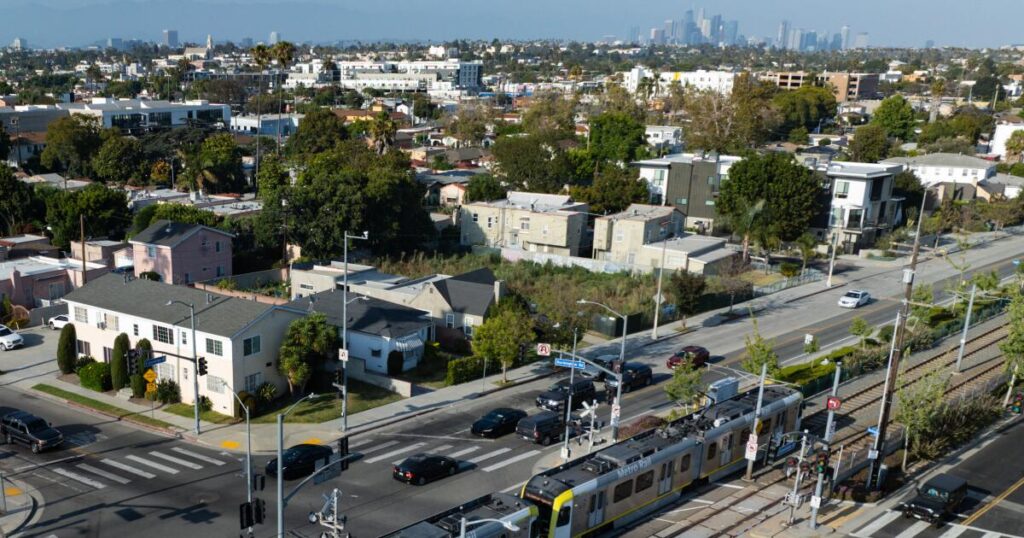
Townhomes, row houses and bungalow courts are likely coming to 57 neighborhoods across L.A. as part of the city’s plan to delay Senate Bill 79.
The historic housing bill, which took effect Wednesday, was written in hopes of addressing California’s housing crisis. It’s designed to boost apartment construction by overriding local zoning laws and allowing taller, denser developments near bus stops and train stations: up to nine stories for buildings adjacent to certain transit stops, seven stories for buildings within a quarter-mile and six stories for buildings within a half-mile.
It serves as a definitive statement from Sacramento lawmakers to cities that have failed to keep up with housing demand in recent years, including Los Angeles, where single-family housing is still king. However, the bill was so contentious that in order to squeak it through, legislators stuffed it full of carve-outs and exemptions, allowing cities to delay implementation by passing their own plans to add density.
That’s exactly what many Southern California cities — including Beverly Hills, Pasadena, Glendale and L.A. — chose to do.
If L.A. had done nothing, the area surrounding more than 150 transit stops would’ve been immediately upzoned as of July 1. To mitigate the effects, L.A. adopted the Low-Rise Ordinance, which allows it to delay SB 79 until 2030 by adding light density across a smaller number of areas.
In other words, L.A. will allow a little more density, but not as much as SB 79 calls for.
Under the ordinance, developers can now build up to four-story buildings with up to 16 units on lots that were previously zoned for single-family homes. The 57 areas are mostly in Central L.A., West L.A. the Eastside and the San Fernando Valley.
Not every lot in these neighborhoods is upzoned, however. Many areas have been exempted for a variety of reasons, including lots in hillside fire zones and lots in Historic Protection Overlay Zones.
To check whether specific parcels are included in the ordinance, follow this link and check the box that says “Opportunity Station Sites Eligible for Low Rise.”
The ordinance marks a brief respite in the monthslong scramble to adapt to the broad changes brought by SB 79.
As the bill wound its way through Sacramento, L.A. City Council passed a resolution opposing it, calling it “chaos” and a “one-size-fits-all mandate.” In September, Los Angeles Mayor Karen Bass urged Gov. Gavin Newsom to veto the bill.
Once it was passed in October, cities, homeowners, developers and even politicians scrambled to figure out the ramifications. Amateur cartographers released homemade maps of potential upzoned areas, while some cities wavered over whether their stops would be included or not.
L.A. City Council adopted its “low-rise” strategy in March and approved it in late June. On Tuesday, a spokesperson for Bass supported the plan.
“This local approach to SB 79 will help create more housing near transit, expand housing options for working families, and support a more sustainable future for LA,” said Kolby Lee, a spokesperson for Bass. “The Mayor appreciates the work of the City Council and City Planning to develop a plan that complies with state law, reflects the needs of our communities, and expands on our ongoing efforts to cut red tape and deliver housing while respecting the character of our neighborhoods.”
The post SB 79 is here. See which neighborhoods are getting upzoned appeared first on Los Angeles Times.