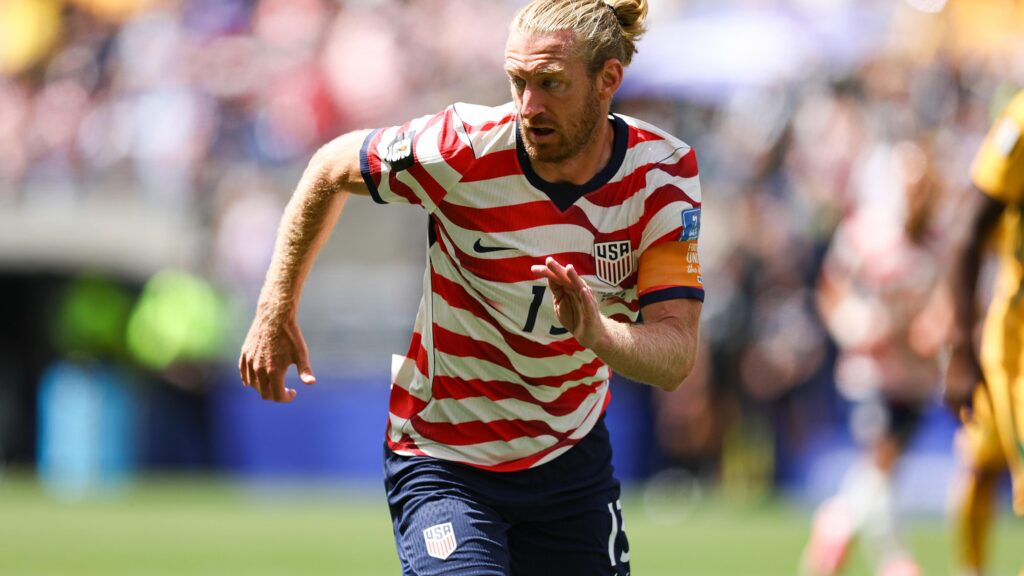
As the United States prepares to face Bosnia and Herzegovinain a round-of-32 World Cup knockout game on Wednesday, a pair of aging players—U.S. defender Tim Ream and Bosnian striker Edin Dzeko—could decide the result. They’re both getting up there, but Dzeko, claims American defender Chris Richards, “is not quite as old as Tim.”
I politely correct Richards: Ream, the 38-year-old man-bunned American captain, is in fact younger than Dzeko, who is 40. Richards seems stunned by this revelation. He cannot believe any World Cup player can be older than Ream. “Tim’s 40 then,” Richards quips.
Ream’s grown accustomed to such indignities, especially from Richards, the Crystal Palace standout who squared off with Ream in the English Premier League when Ream played for Fulham. “It’s on the daily that he’s coming up with all kinds of random things to remind me of how old I am,” says Ream, who now suits up for Charlotte FC of Major League Soccer. “I don’t know why he thinks I’m so much older than everybody else, but I tell them all the time, there’s at least probably 10 guys who are older than me in this World Cup.” (A dozen, in fact, including Cristiano Ronaldoand Lionel Messi.) “And he’s like, ‘Well, it doesn’t matter,’” says Ream. “‘You’re still the oldest.’”
His teammates called Ream “Grandpa” at the last World Cup, when he was the oldest player on the U.S. roster in Qatar. He played every minute of that tournament. After Qatar, Ream figured he’d participated in his first and last World Cup. “I was unequivocally finished,” he says.
What if someone had told Ream four years ago that not only would he be back for another tournament, but he’d be the U.S. captain and again play every meaningful minute of the group stage, where the American defense would allow a single goal in two wins? (Ream sat out against Turkey, on June 25, since the Americans had already clinched the Group D by the final fixture.) That he would become the oldest American man to ever appear in a World Cup game?
“I probably would have laughed at you right in your face,” says Ream during an interview on Tuesday at the U.S. team’s downtown San Jose, Calif., hotel. “I probably would have smirked and bit my lip and bit my tongue and just said, ‘Ok, well, I appreciate the confidence, but the likelihood of that happening is pretty slim.’”
Months after the tournament, however, Ream began to reconsider. “My mindset has never been one to just throw in the towel,” he says. “Never to just say, ‘You know what, I’ve had enough, I’m just going to let somebody else take over.’ My mindset has always been I’m going to push as hard as I can. If I don’t get there because I’m pushing, then I can accept that. If I don’t push myself and don’t get there, I don’t know that I could mentally handle that. So it became almost a countdown. OK, well, there’s only three and a half years.”
Ream nearly passed on the 2022 World Cup due to family commitments. Before the Qatar tournament, Ream was left out of camps and appeared out of the mix, so he planned a Disney World vacation with his wife and three young children during the November 2022 event. But in the weeks prior to the World Cup, then-U.S. coach Gregg Berhalter, impressed with Ream’s fine play for Fulham, gave him a World Cup chance. Ream thought about declining the opportunity, not wanting to disappoint his children. But he told his kids that the World Cup was his dream and went for it.

Four years later, he could have retired to spend more time with his children, who are now 12, 10, and 7. These are prime parenting years, and in a sense, he has chosen soccer. But he insists the decision was a win-win. “If a professional athlete tells you that they’re not selfish in a lot of ways and in a lot of moments in their career, they’re lying to you,” says Ream. “We have to be. As my kids have gotten older, they’re actually to the point now where they’re like, ‘Well, dad, you’re the oldest one, but we don’t want you to retire. We get to enjoy these moments with you. We know you’re away, but it’s also really cool to share in these core memories that we’re making.’”
His body also felt up to the task. “I was someone who always took fitness very seriously,” says Ream. “I took recovery very seriously. Now at 38 and a half, the games are not the hard part. It’s in between the games that you really have to focus.” Pilates, supplements, and red-light therapy are part of his regimen. He’s tried acoustic wave therapy, which utilizes high-energy sound pulses to stimulate blood flow and accelerate tissue repair, but it wasn’t for him. “Sleep is the best recovery tool,” says Ream. “It sounds so simple, but in this day and age, people struggle with that. You have your phones, your constant stimulation around.”
When Ream takes the field against Bosnia in Santa Clara, Calif., he will have enjoyed an 11-day break between games. He didn’t think he needed to be benched for the Turkey game but understands the move. “The staff obviously looked at everybody’s outputs and all the science and the data behind everything, and they made the decision that they felt is best for the group,” says Ream. “I fully respect that.” Ream did roll his eyes at the word data, which is a positive: can’t knock a guy for wanting to play in spite of the stats.
The captain’s drive has permeated to the entire team. “He leads by example and leads by the way he carries himself and how he speaks,” says Richards. “Sometimes you get one or the other. Tim does them both really well. He can be like a father to other guys around here, but he doesn’t do it in a condescending way. He does it in a loving way and makes sure that everybody feels included.”
Ream has talked about how this is the tightest U.S. national team he’s been a part of–and he’s been in and out of the program for more than 15 years. He’s quick to credit U.S. coach Mauricio Pochettino, who started in 2024. “The way that the connection, the togetherness has been rebuilt from the top from Mauricio and his staff is the one of the biggest factors,” says Ream. “They created an atmosphere and a feeling of, guys have to want to be here. It has to be the end-all be-all.” Plus, some of the younger players from 2022, like Tyler Adams, who now has two children, Gio Reyna, whose wife is expecting, and Haji Wright, who has one son, have families of their own. The squad’s core is more experienced and mature, both on and off the pitch.
The team’s not broken into silos. “You can have one lunch, these eight guys are sitting at this table, but the lunch then devolves into absolute chaos, because you’re having a conversation here but someone hears that conversation from this table, and all of a sudden the chairs open up, and you’re throwing insults or answering back and forth,” says Ream. “And then someone over here at this table catches a stray. There’s not just four or five guys who go and they sit by each other all the time. It doesn’t happen because we don’t allow it to happen.”
Such chemistry is difficult to replicate. “Everybody is interested in what others are interested in,” says Ream. “That’s why I’ve said this team is very different than any that I’ve been on. Because it’s not cliquey.”

Fair or not, all this positive energy dissipates if the U.S. loses to Bosnia. The World Cup is cruel like that. Especially with co-hosts Canadaand Mexico advancing to the round of 16, an early exit for the U.S. would be embarrassing.
But Ream swears he’s feeling no pressure. “I look at everything that the team has done up to this point, all the work, all the hours, all the effort, all the training, all the meetings, everything, there’s not been a stone left unturned,” he says. “So at the end of the day, I’ve said if you’re feeling pressure, or you’re feeling anxiety, or you’re feeling, ‘I’m not really sure,’ it just means that the preparation probably wasn’t what you needed it to be. The pressure was to make the team, the pressure was all the lead-up and the buildup to being a part of a home World Cup. That was the pressure. Now I get to go out and do something that I love to do.”
Ream doesn’t see a 2030 World Cup in his future. “My World Cup dreams end after this one,” he says. “I’ve racked up a lot of miles.” Does the U.S. need to make a quarterfinal, or even a semi, to make his final World Cup a success? “I don’t want to cap it,” says Ream. “You play these tournaments to win things, right? We want to be able to say that we were the team to lift a trophy. There’s nothing wrong with believing.”
The post America’s Captain Grandpa Has Heard All the Old Jokes appeared first on TIME.