After the U.S. Men’s National Soccer Team’s (USMNT) emphatic victory over Paraguay and then dominating defeat of Australia, a historically soccer-ambivalent American public is suddenly paying attention—and reaching for explanations about the team’s surprising success.
Some hail an American “golden generation” nurtured by youth soccer programs, come of age to fight on their native soil: Weston McKennie from Little Elm, Texas; Tyler Adams from Wappingers Falls, New York; and Christian Pulisic from Hershey, Pennsylvania. We read that McKennie was born on an army base. Adams was raised by a soccer coach. Pulisic is nicknamed “Captain America.”
The story writes itself. But this narrative of the USMNT winning formula is, at worst, wrong and at best, incomplete.
Certainly, this cohort is rich in talent, and it is shining far more brightly on its home turf than it did four years ago in Qatar. But to interpret this as the light of a purely American ethos is to misunderstand both this U.S. team and national teams generally.
World Cup commentary often lapses into cultural shorthand, portraying matches as contests of national character: Teutonic discipline versus Brazilian beauty, Italian cynicism versus English heart. These stereotypes satisfy our deep-seated essentialist intuitions about nationality. But they are hard to square with the fact that most elite soccer players are globetrotting expatriates who play for clubs outside of their home nation.
Yesterday, Fox Sports analyst Zlatan Ibrahimović blamed the Netherlands’ loss to Morocco on Coach Ronald Koeman’s decision to adopt a defensive formation: “This is not the Dutch identity. Today, Koeman looked like an Italian coach, playing not to lose, whereas the Netherlands always play to win. If you lose, at least lose with your own identity.” The Swedish-Bosnian legend implied that success comes from hewing to national tradition.
If cultural similarity were the sine qua non of syncing up, then homogenous rosters would be the recipe for success. Recent Cup history says otherwise. The 2018 champion French squad was built largely on the children of immigrants. Morocco’s 2022 semifinal team drew mostly from its diaspora across Spain, Italy, and the Netherlands, a rising trend. Even Argentina—the most ethnically homogeneous of recent championship rosters—was composed almost entirely of athletes playing abroad, including the iconic Lionel Messi, who left for Barcelona, Spain at just 13.
The USMNT incorporates all these kinds of diversity. Seventy-three percent of its players compete for foreign clubs. Malik Tillman grew up in Germany; Folarin Balogun was raised in England; Alejandro Zendejas and Ricardo Pepi are Mexican Americans. Coach Mauricio Pochettino is Argentine, long based in Europe, living in the U.S. only part-time the past few years. If common national culture were the crucial glue for team cohesion, the USMNT would be in disarray.
What actually produces coordination isn’t inherited national ideals—it’s team identity that is constructed afresh each season and updated after every game. The clearest demonstration came in 2002, when Dutch coach Guus Hiddink took charge of a flailing South Korean squad 18 months before it hosted the World Cup. Rookies struggled to play with veterans and locals with internationals. An outsider to the country’s traditions, Hiddink overhauled rosters, training methods, and playing formations to remold the team’s identity and playing style. Uneven early results panicked the Korean sports press to call for his head. But by tournament time, the transformed team upset former champions, stirred their nation into celebration, and rode waves of surging fan support all the way to the semifinals.
Pochettino’s work with USMNT echoes Hiddink’s playbook almost point for point—introducing fluid tactics, intense conditioning, and extended camps to forge a collective identity from disparate cultural elements. It’s no accident. In this Cup, 26 of 48 nations have hired foreign coaches, including England and Brazil. The soccer world has moved on from the idea that a coach must share his players’ blood and that a team’s identity is just a reflection of an unchanging national character.
The remaining question is whether American fans have too. And whether they recognize their needed role in the USMNT’s potential future success.
Throughout the tournament’s history, hosts have hugely overperformed at the World Cup, reaching knockout rounds 91% of the time, semifinals 57%, and the championship 26%. Sports fans tend to discuss “home-court advantage” as though it’s all about players’ familiarity with physical conditions: the field, temperature, wind. These material factors matter very little at elite levels, where facilities are highly consistent. What matters more are often less-appreciated factors that happen off the field, starting with policies such as automatic qualification and seeding, and continuing with increased resources that host teams receive from their governments, federations, and sponsors.
However, I would argue that the most dynamic driver is fan support—the kind that pushes exhausted athletes beyond what they knew they had in them. Athletes find a new gear when playing in front of throngs of chanting countrymen. A deafening fan roar can also disrupt visiting teams’ communication and subconsciously sway referees. Sports science consistently shows that the home-court advantage rises with crowd size. Conversely, in COVID-era seasons played in empty stadiums, the advantage nearly vanished. During 2002 and 2006 World Cups, cascading rallies shook the stadiums and filled the streets, galvanizing the home team to play at new heights.
In 1994, when the U.S. last hosted, this broad support from fans didn’t entirely materialize. At a pre-tournament friendly at the Rose Bowl, the crowd was overwhelmingly pro-Mexico. In group play against Colombia, it was heavily Colombian. I was among the many Americans who attended these games out of curiosity, not out of identification. The atmosphere was more like a home game for the other side. The USMNT performed better than they had in half a century, but they were not carried by the crowd into the final rounds. Home turf becomes a clinching advantage only when the Cup becomes a collective ritual—when players feel the crowd’s will, opponents struggle against it, and the broader society talks about the team’s as its own.
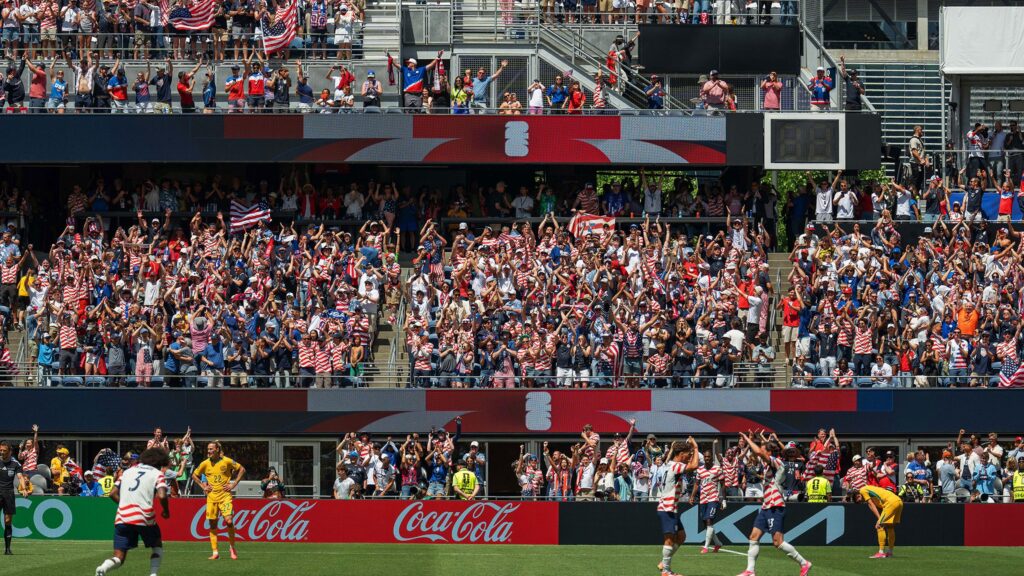
This year feels different. What the public is seeing—Americans recruited abroad at 18, developed in elite foreign systems, now returning to play for passionate U.S. fans—is something unprecedented. The Paraguay match sold out SoFi Stadium with an audibly pro-American crowd. Fans arrived early, stayed late, and cheered with genuine fervor. The game became the most-watched USMNT broadcast on record. For the Australia match in Seattle, 67,000 fans arrived in red, white, and blue, singing in unison to Journey’s “Don’t Stop Believin’” and Bon Jovi’s “Livin’ on a Prayer” and for 90 minutes the energy never dipped. “It was special. So special,” striker Folarin Balogun said afterward. “It’s tough to put into words. It gave us the extra motivation we needed.”
The USMNT’s international identity is not a contradiction of American values; it is an expression of them. It is a reflection of our nation today. This is a team assembled from immigration, diaspora, and expatriate ambition, coached by an outsider who can see what insiders missed. If the American public embraces them—not despite all that, but because of it—the team may be inspired to heroic heights, like the Koreans in 2002.
How far the USMNT goes in this World Cup depends considerably on us.
The post The Myth of the National Team appeared first on TIME.