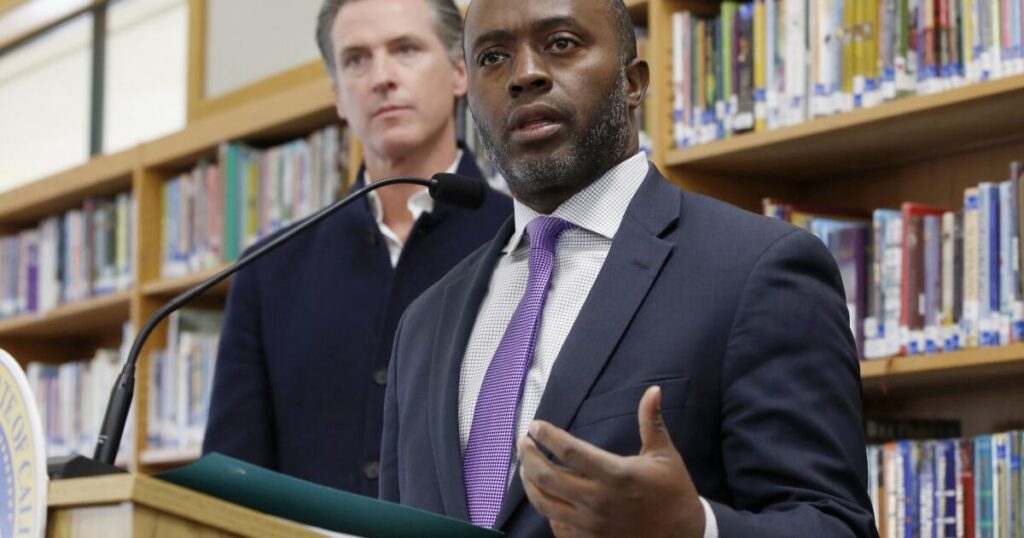
The just-approved state budget strips authority from the elected state superintendent of public instruction, transferring power in January to an appointee of the governor, dramatically changing the oversight and management of a public school system serving more than 6 million students from preschool through 12th grade.
The change was pushed through by Gov. Gavin Newsom at the urging of academics and education reformers who have long criticized how the state’s $149 billionpublic education system is governed.
In essence, the change consolidates increased power within the governor’s office — streamlining and largely replacing a diffuse system in which the state superintendent has significant influence, but no direct control over budget and policy.
Supporters hail the move as bringing accountability and coherence — through the governor — to all the departments and agenices involved in education.
“The approval of education governance reform, over a century in the making, is a monumental victory for California’s students that finally establishes a sensible system to best support them,” said Ted Lempert, president of Children Now, an Oakland-based research and advocacy organization. “We commend Governor Newsom for his leadership in making this much needed change a reality.”
Critics called the change an unjustified, undemocratic side-stepping of the state constitution and the will of voters.
“California’s constitutional architecture deliberately established an independent schools chief to ensure that public education answers directly to the voters,” wrote a labor coalition that included the two largest statewide teacher unions. “Replacing an elected constitutional officer with a partisan bureaucrat serving strictly at the pleasure of the executive branch breaks that model, permanently muting the public voice when democratic transparency matters most.”
The critics noted that voters have defeated every attempt to eliminate the elected state superintendent.
The latest effort bypasses the ballot box by keeping the elected position, but stripping most of its powers. The bill did not go through the typically lengthy legislative process; it was instead folded as a trailer bill into the state budget.
School district management groups, such as the one representing county superintendents, were more supportive of the changes.
Diffuse authority and accountability
Authority over education has long been distributed among different officeholders.
The Legislature passes laws related to education. The governor chooses which to sign. The governor also proposes what to pay for in education through his budget plan. The Legislature can amend the plan and has the responsibility to approve it.
The elected state superintendent runs the state Department of Education and serves as the administrative lead for the state Board of Education, whose members have been appointed by the governor to four-year terms. The superintendent does not have a vote on the board and must follow board authority in some areas but not others.
The board approves state education policy and curriculum.
“The current state system of support and accountability for local districts is uneven,” resulting in “islands of high quality surrounded by deserts where nothing much has improved,” said former State Board of Education President Michael Kirst, an emeritus Stanford professor of education. Instruction across the entire state was “unlikely to improve” under the status quo, he said.
How the office will change
All of the state superintendent’s authority will transfer to the education commissioner, who will be named by the governor and then approved by the state Senate.
That means the next governor will gain direct control or control through appointees over developing and spending the education budget — including state and federal grants — and developing education policies.
Under the old system, the state superintendent has overseen grants while also interpreting state education law and making sure schools complied.
The new law sets out the superintendent’s role instead as the “independently elected nonpartisan voice for the public interest in the governance of the state’s educational systems.” This role includes reporting to the Legislature “on the condition of education based on statewide engagement and travel to identify significant trends, challenges, and emerging issues.”
Critics worry that amounts to a whole lot of nothing.
That may be literally the case initially, as the new law gives governor’s new education commissioner until Oct. 1, 2027 to propose further reforms including “the future role and staffing” of the elected superintendent.
Until then, the new law provides for the superintendent to have several deputies and a skeleton clerical staff.
The superintendent also becomes one of 11 members of the state Board of Education and one of 19 members of the Board of Governors of the California Community Colleges.
Change opposed by candidates for the office
The overhaul occurs as two candidates vie to become the elected superintendent in November. Both have strongly opposed the change.
The race pits Republican Sonja Shaw, who finished first in the primary, against Democrat Richard Barrera.
Shaw, who decried the change as a “blatant power grab” that “silences voters,” said she had a game plan for how she intended to use the previous powers of the office if elected.
“An outsider serving as state superintendent who refuses to simply defer to Sacramento could use the office’s authority over grants, contracts, federal programs, accountability systems, fiscal standards, parent resources, and administrative functions to prioritize results over ideology,” Shaw said.
“In practice, that could mean focusing resources on proven reading and math instruction, increasing transparency, fostering increased parental involvement, protecting fairness and safety for girls in sports,” she said.
If elected, Barrera said he hopes to work immediately to fill in the blanks with a meaningful role for the superintendent and to bring in important education voices that he said have been left out so far.
“The whole purpose of this restructuring is bringing people into alignment, with the focus on goals for student learning, and I’d say we have a long way to go,” Barrera said.
Both candidates said there was potential grounds for a legal challenge to the rewritten duties.
California Teachers Assn. President David Goldberg also was among the opposing voices.
“There’s always tons of issues going on for a governor, and education issues are likely to be put on the back burner.” State voters, he added, “have really wanted an independent voice around public education,” someone willing at times to stand up to the governor.
Supporters of the change counter that the governor — who has to answer to a broad base of interests — would be less susceptible to education special-interest groups, including teacher unions.
The central tenets of the new framework are based on a December 2025 report from Policy Analysis for California Education, a nonpartisan center that brings together researchers from Stanford, UC Berkeley, UCLA, UC Davis and USC.
The post Power is stripped from state schools superintendents in major education overhaul appeared first on Los Angeles Times.