To the Editor:
Re “To Cover Flood Recovery, Nepal Asks for $5 Billion” (news article, Sept. 2):
The climate crisis is not a future threat in Nepal. It is here, and it is deadly.
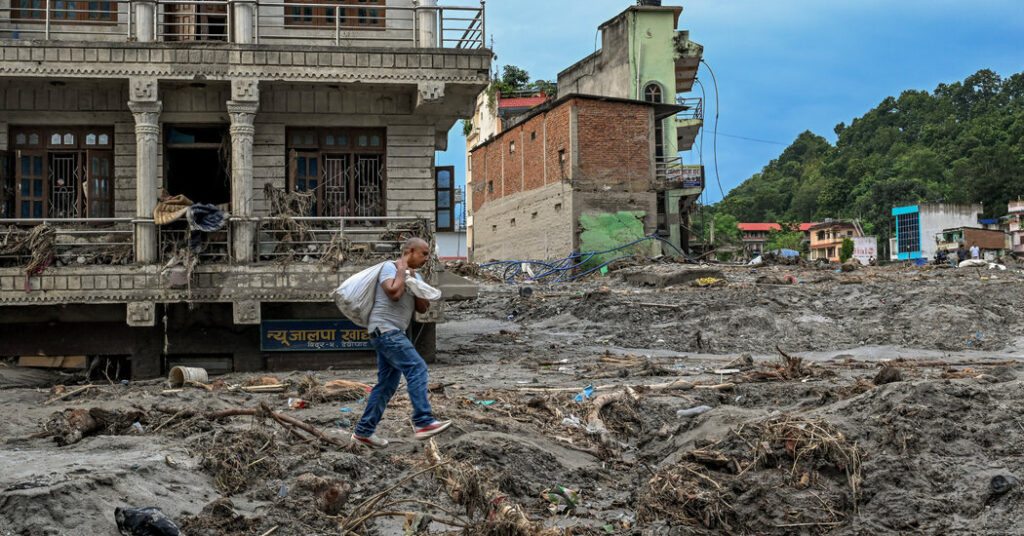
Only a month ago, as temperatures topped 107 degrees, I warned that extreme heat was draining water sources, damaging crops and forcing workers to choose between protecting their health and earning enough to eat. Now, a glacier collapse and flash floods have swept away homes, roads and bridges and killed more than 1,200 people.
These are not isolated emergencies. They are the real-world cost of a crisis that Nepal did little to create. In Nuwakot, families are without water or electricity, food stocks are dwindling and relatives remain missing. Rebuilding could cost nearly a tenth of our economy.
The United Nations’ Fund for Responding to Loss and Damage was created precisely for moments like this. Nepal’s request for urgent support should be met swiftly. Governments — particularly wealthy and high-polluting countries — must provide new, grant-based funding commensurate with the losses.
In the coming months, at global forums including the United Nations General Assembly and COP31 in Turkey, leaders should do more than deliver speeches about climate solidarity and actually fund the mechanism they created. Otherwise, “loss and damage” will remain merely a description of what countries like Nepal are forced to endure — not a solution.
Suraj Sigdel Kathmandu, Nepal The writer is the Nepal country director for Mercy Corps.
To the Editor:
Re “Climate Change Is Tearing Down Mountains,” by Jonathan Mingle (Opinion guest essay, Sept. 1):
The Nepal glacier collapse underlines Mr. Mingle’s point: “Worldwide, climate change is causing glaciers to disappear at an accelerating rate.” Death, destruction, water shortages and rising seas result.
How can President Trump say climate change is a hoax when glaciers are melting before our eyes?
Instead of blocking clean energy projects, the United States could be the world leader in battling climate change, thereby gaining jobs, economic activity and prestige for protecting our planet.
Richard Barsanti Western Springs, Ill.
Justice for Afghan Girls
To the Editor:
“Inside Secret Girls’ Schools That Defy Taliban Rules” (front page, Aug. 30) highlights the extraordinary resilience of Afghan girls who defy the ban on their education. It also points to a broader reality: Many Afghans continue to fight for their rights despite immense risks.
The most damaging misconception about Afghanistan today is that nothing can be done within the country’s justice system to push back against repression and defend individual rights. But the Afghan lawyers I work with don’t think that way. They understand that rights are preserved by defending them in court, case by case, day by day.
Recently, lawyers at my organization won the acquittal of an Afghan woman detained after accusations brought by her abusive husband.
This acquittal won’t change the system by itself. It does not overturn unjust decrees or end gender discrimination. But throughout history, the fight for justice has depended on lawyers willing to challenge injustice one case at a time.
For more than two decades, my organization has trained and supported Afghan lawyers to do exactly that. We will continue to stand with them as they prove, every day, that justice is not lost in Afghanistan.
Jennifer Smith New York The writer is the executive director of the International Legal Foundation.
A Bad Deal in Yosemite
To the Editor:
Re “Trump Administration Looks to Give Parcel of Yosemite to Developer” (news article, Aug. 30):
It’s incredible that President Trump supports a land swap involving Yosemite National Park that would grant access to a portion of the park to a private developer. Such attempts have been repeatedly rejected in the past. It’s even more incredible that the president supports something so historically unpopular when midterm elections are only two months away.
As a regular visitor to Yosemite, I have endured the winding roads and long entrance lines, so I understand why the developer, Jeff Pori, would like a special access road into the park for his residents. This will allow them to skip the lines to the park and increase the value of his investment.
The Department of Interior suggests that taxpayers can pay for any transfer costs through the Land and Water Conservation Fund — a fund created to acquire and protect national land, not sell it. Taxpayers paying to lose part of Yosemite is one more thing to consider when voting in November.
Mary Griswold Gordon Rancho Palos Verdes, Calif.
A Plea for Help for Struggling Farmers
To the Editor:
Re “Farmers Report Struggle to Get Federal Services” (front page, Aug. 25):
This article echoes what we’re hearing from farmers across the country. They’re trying to stay afloat in a bleak farm economy in which farm bankruptcies reached a six-year high this spring. Meanwhile, multiple crises, both political and environmental, threaten to sink them. Few in government are paying any attention.
The Trump administration has decimated staffing levels in U.S. Department of Agriculture offices around the country, making it harder, and sometimes nearly impossible, for farmers to find local help with loan applications and sustainable farming practices.
The farm bill currently working its way through Congress not only fails to reverse these staffing cuts, but also proposes multi-billion-dollar cuts to U.S.D.A. conservation programs that are already oversubscribed.
All of these decisions leave farmers even more vulnerable to another crisis — the droughts, heat waves and extreme weather fueled by climate change.
Farmers deserve a government that’s actively making things easier for them, not harder. Taking the local expertise and conservation programs that they rely on to be successful off the chopping block is a good place to start.
Andrew Hutson Durham, N.C. The writer is vice president, agriculture, at the Environmental Defense Fund.
Saving Wild Horses
To the Editor:
Re “Loophole Leads to the Slaughter of Protected Wild Horses” (front page, Aug. 22):
This article exposes a devastating reality: As long as loopholes allow American horses to enter the slaughter pipeline, no horse — wild or domestic — is safe.
For years, the A.S.P.C.A. has worked alongside industry leaders to advance humane, sustainable management of America’s wild horses and burros. This includes a greater use of safe and effective fertility control and humane outcomes for horses removed from the range, while opposing policies that could send these federally protected animals to slaughter. But temporary protections are not enough.
The bipartisan SAFE Act would permanently prohibit horse slaughter for human consumption in the United States and the export of horses for slaughter abroad. With support from more than half of the House of Representatives, it reflects a broad consensus that this cruel practice must end.
The disturbing cases documented by The Times show what is at stake. Congress must close the slaughter pipeline for good and ensure that wild and domestic horses alike are permanently protected from slaughter.
Matt Bershadker New York The writer is the president and chief executive of the A.S.P.C.A.
The post A Deadly and Costly Climate Crisis in Nepal appeared first on New York Times.