The largest digital camera on Earth has finally started filming a motion picture of our universe.
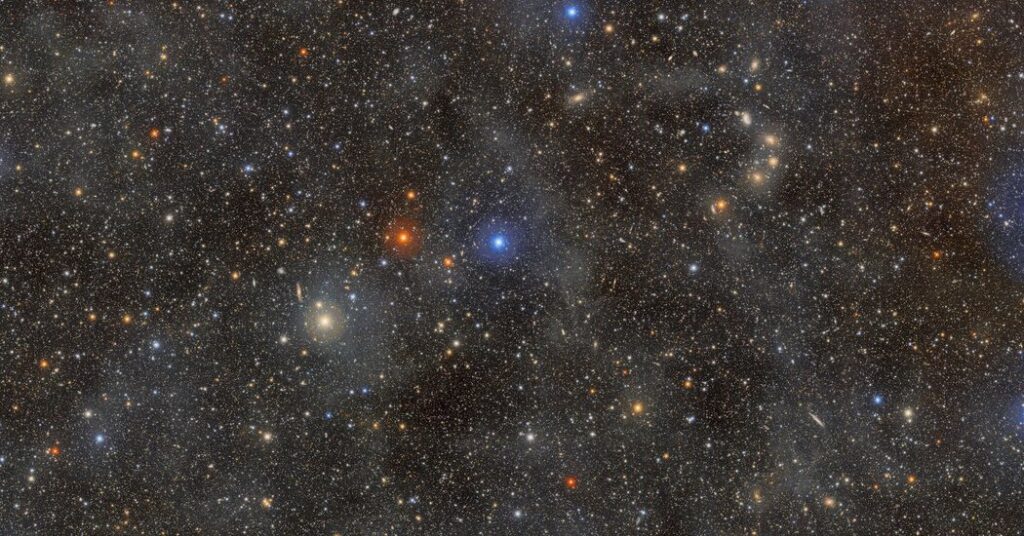
On Tuesday, the Vera C. Rubin Observatory, a telescope perched atop a mountain at the edge of the Atacama Desert in Chile, began the widest, deepest survey yet of the entirety of the southern sky. Over the next 10 years, the telescope will drink in light from billions of galaxies and stars, creating a crisp record of how objects streak, pulse and explode in our solar system, the Milky Way and beyond.
“This is the end of a 30-year wait,” said Phil Marshall, the deputy director of the telescope’s operations at SLAC National Accelerator Laboratory in California, in a statement to The New York Times. “It’s a major milestone for us.”
Astronomers expect this collection of data, known as the Legacy Survey of Space and Time, to revolutionize their knowledge of our galaxy’s birth, the invisible matter permeating the cosmos, what shaped the universe into the structure it has today and more. According to Dr. Marshall, the survey is designed to see everything, “even the things we don’t know we’re looking for yet,” he said.
The team behind the observatory, a joint effort funded by the U.S. Department of Energy and the National Science Foundation, unveiled several images of the cosmos that were jampacked with celestial goodness — a peek at what the Rubin could do — last year.
Since then, scientists have been busy conducting final tests and reviews of the telescope’s operations and systems. According to Bob Blum, the director of Rubin operations at the National Optical-Infrared Astronomy Research Laboratory, the team has also been hard at work ensuring that the telescope can operate reliably in different environmental conditions for the next decade.
During the Legacy Survey of Space and Time, the Rubin will capture the entire southern sky every couple of nights. But “we are already seeing glimpses of new science,” Dr. Blum said, including more than 11,000 new asteroids and views of Comet 3I/ATLAS, which originated outside our solar system.
In the coming years, thousands of astronomers will comb through the gigantic quantity of data the telescope will collect, peering into some of the faintest corners of the cosmos, where celestial objects beyond imagination may lie.
The survey, Dr. Marshall said, “will be an absolute gold mine for science.”
The post A Dazzling Census of Our Cosmos Begins appeared first on New York Times.