The Trump administration released new rules that could revoke tax-exempt status from any school offering targeted support to Black or other minority students, a sweeping change that opens another front in the president’s campaign to reshape American education.
The proposed regulations, which the Treasury Department published on Thursday, would add another element to the guidelines schools and other organizations must follow to qualify for tax-exempt status with the Internal Revenue Service. The rules would deny tax-exempt status to any school, including secondary schools and universities, if it has any policy or program, including admissions and scholarships, that the I.R.S. finds to be racially discriminatory.
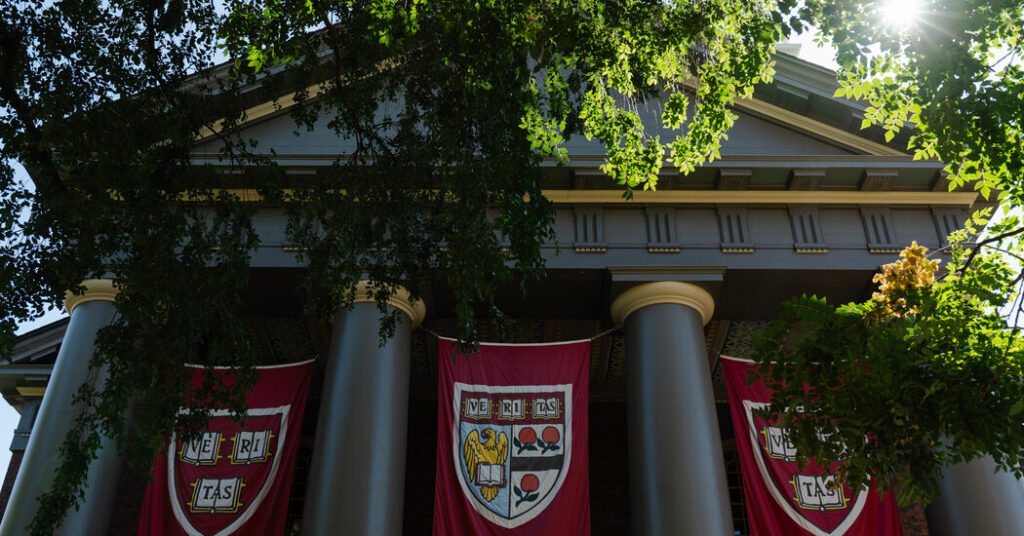
Such a change would thrust the I.R.S. into the center of the Trump administration’s effort to pressure schools to abandon initiatives aimed at supporting Black and other minority students. Trump officials view such programs as a form of discrimination against white and Asian Americans, and federal civil rights lawyers have opened investigations on those grounds into admissions policies at Harvard, Yale and other schools.
The threat of losing tax-exempt status would tighten the financial squeeze the administration has applied to higher education by withholding federal research funding. Last year, President Trump called for the I.R.S. to strip Harvard of its tax-exempt status, which experts said would be contrary to a federal law prohibiting the I.R.S. from carrying out politically directed audits.
While schools may still not owe much in federal income taxes even if they lost their tax-exempt status, the exemption is valuable because it allows donors to deduct donations they make directly to the school, helping fund-raising efforts. The rules will take effect after May 31 and apply to as many as 18,000 schools, the Treasury said.
“This just opens up the door to the weaponization of tax-exempt status,” said Roger Colinvaux, a law professor at the Catholic University of America. “It potentially gives the I.R.S. a weapon to use to chill speech or try to leverage behavior at schools.”
While the rules would focus on schools and universities, the Trump administration has more broadly sought to push the I.R.S. to be more aggressive in investigating left-leaning nonprofits, including those that Trump officials accuse of supporting terrorism. I.R.S. officials have in recent weeks discussed creating a faster process for revoking tax-exempt status from nonprofits, according to people familiar with the conversations.
“Schools rebranding race-based preferences as equitable, inclusive or diversity-enhancing does not change their discriminatory nature,” Treasury Secretary Scott Bessent said in a statement. “Today’s Treasury and I.R.S. proposed regulations establish a clear standard, and the institutions that continue to use discriminatory practices will no longer receive the benefits of federal tax-exempt status.”
The Trump administration said the tax regulations would draw on a 1983 Supreme Court case that found an organization could not receive tax-exempt status if it was in opposition to a “fundamental public policy.” In that case, the I.R.S. revoked the tax-exempt status of Bob Jones University, a conservative Christian school, because the school had a policy banning interracial relationships. The Supreme Court upheld the I.R.S. decision because “racial discrimination in education violates a fundamental public policy.”
But what counts as a fundamental public policy has otherwise been left largely undefined, and the standard has been rarely used to deny a group’s tax exemption. The Trump administration first said last year that it would develop guidelines on the application of the fundamental public policy concept. In June, the Treasury Department submitted regulations on the topic to a White House regulatory office, which approved them last month.
Trump Administration: Live Updates
Updated
- An Interest-rate increase is in play as Federal Reserve officials await inflation data.
- Trump puts tariffs of up to 100% on foreign-made drones.
- White House plans a $250,000 renovation of a two-lane bowling alley.
Based on how the Trump administration had described its plans for the regulations, nonprofit experts had expected they will state that giving a preference to Black or other minority applicants in admissions runs counter to fundamental public policy. The administration said it would rely on a 2023 Supreme Court ruling, in the Students for Fair Admissions case, to set a standard for what counts as a fundamental public policy.
In the majority opinion in that case, Chief Justice John G. Roberts Jr. declared that any applicant “must be treated based on his or her experiences as an individual — not on the basis of race.” He also said, though, that the court’s opinion should not be “construed as prohibiting universities from considering an applicant’s discussion of how race affected his or her life, be it through discrimination, inspiration or otherwise.”
University officials have said that the ruling allows schools to consider race as part of a broader review of an applicant’s character. But the Trump administration has adopted a narrow view of the ruling, dismissing holistic reviews of applicants as workarounds for universities to pursue diversity goals.
“They will state that what we used to call affirmative action is now a violation of fundamental public policy,” said Darryll K. Jones, a law professor at Florida Agricultural and Mechanical University. “They have announced that they are going to use the new regulations to implement Students for Fair Admissions as far and as wide as possible.”
But Phil Hackney, a law professor at the University of Pittsburgh, was skeptical of whether courts would agree with how the Trump administration defines a fundamental public policy.
“Fundamental public policy is not something that the I.R.S. can just go and grab; it needs to be something that is deeply anchored,” he said. “Clearly, we are quite divided on this issue right now, there is nowhere close to overwhelming agreement.”
The Treasury’s proposed regulations will be subject to a potentially lengthy public comment period that could result in changes. Once the rules are finalized, their enforcement is likely to involve I.R.S. audits of the schools and universities to determine whether they were impermissibly considering race.
Such audits could go on for months and give a university the opportunity to challenge any revocation of tax-exempt status in court, where a judge could strike down the Treasury’s regulations.
“If a new administration is ever in position, I would think they would revoke these regs, but in the meantime a lot of damage can be done because people are running scared,” said Ellen Aprill, an expert in nonprofit taxes at the University of California, Los Angeles.
The post Trump Administration Renews Push to Strip Schools of Tax-Exempt Status appeared first on New York Times.