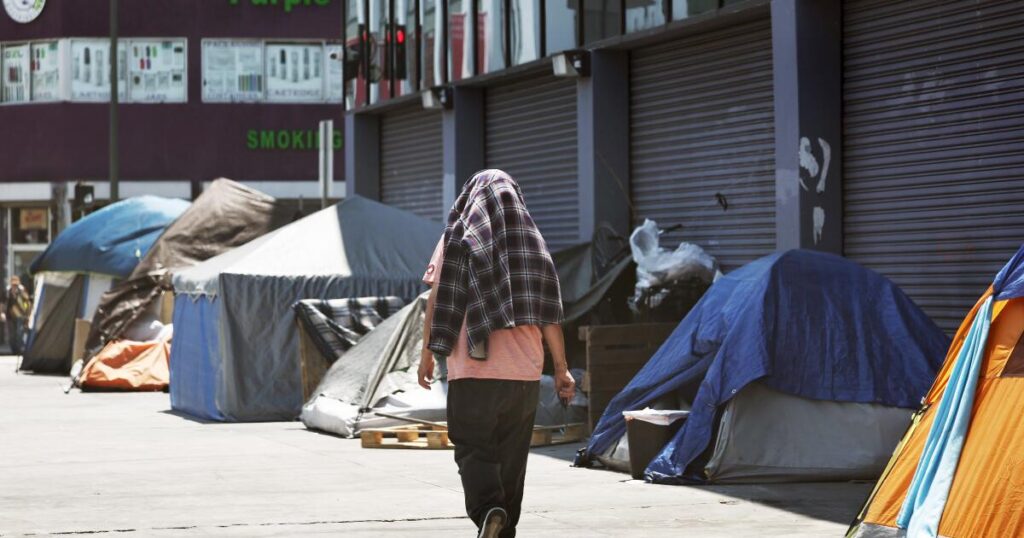
Four years ago, outreach workers in Hollywood knew where to find their unsheltered clients. Most lived in clusters of tents that workers could visit week after week, delivering services and building trust to help ultimately move people inside. The encampments were ugly signposts of Los Angeles’ homelessness crisis, but they were also a kind of roadmap out of it.
That map is disappearing. What will replace it is a question that the city has not yet asked, let alone answered.
Using professional field staff — not volunteers, like the annual county-wide homelessness count — Rand LA has been taking a census of unsheltered people in Hollywood, Skid Row and Venice every two months since September 2021. The organization tracks not just how many people live on the streets, but how they live: in tents, in vehicles or sleeping rough with no protection overhead.
After those four years, our neighborhoods now host half as many tents. But they also have 20% more people living in their vehicles and sleeping rough.
That means today’s unsheltered population is now 14% smaller overall, but needier, more mobile and harder to engage than before. It is time to think about what comes next.
L.A.’s urban tent encampments are a relatively recent phenomenon. Targeting them for housing interventions — as the city’s Inside Safe program has done since 2022 — makes sense. The encampments create easy-to-find, densely concentrated areas of unhoused people, making outreach more efficient. And the social bonds formed among the unhoused people living in these encampments can be leveraged to help folks get inside and stay inside.
These factors made Inside Safe, and a focus on prioritizing tent dwellers for relocation to interim housing, a sensible policy. And it worked. Since the program’s launch, the number of tents in Hollywood has fallen from roughly 250 to only about 30 — a drop of almost 90%. Venice has seen similar declines. Skid Row remains the last zone in our research area that is thick with encampments.
But there were always some people that this approach didn’t reach or appeal to — people living isolated in vehicles or without any dwelling at all — and now they make up the majority of those still living on the street (at least outside of Skid Row). There’s no route to continued progress on homelessness if we don’t find new strategies to supplement today’s encampment resolutions.
Why won’t the city’s Inside Safe playbook work for these populations? Let’s start with rough sleepers, who now represent a plurality of unsheltered people at roughly 40% to 45%.
Rough sleepers have the highest needs of anyone on L.A.’s streets. Across four years of surveys, rough sleepers scored worse than tent dwellers in 14 of 20 indicators, including physical health, mental health, substance use and experiences with the justice system. In some cases rough sleepers have been physically exposed to the elements and socially isolated for years. Setting aside their needs, rough sleepers simply have no fixed location where outreach workers can contact them regularly. Most also lack cellphones or the documents needed to be placed in housing.
Vehicle dwellers, while also mobile, present different challenges. First, they possess an asset in their vehicles that they may not be able to keep due to parking limits at housing facilities. Second, nearly 20% of vehicle dwellers have jobs, and 54% report looking for work. In those cases, a vehicle can be more integral to their journey out of homelessness than a bed in interim housing — especially a congregate shelter that may present serious risks to personal safety. Programs pitching little more than a roof over vehicle-dwellers heads may not appeal to them.
So how does the city continue to make practical progress in reducing the number of Angelenos who are unsheltered?
One option is to pivot: Instead of bringing help to people, we must bring people to centralized service hubs. At the very least, that would be more efficient. Outreach workers would then spend less time searching for individuals and more time informing unsheltered people about neighborhood centers and transporting them to those nearby locations. To work, those centers — few of which even exist now — need to offer same-day housing matching, low-barrier behavioral health treatment, on-site documentation clinics and access to basic cellphones.
For vehicle dwellers, the toolkit might look slightly different: scaled safe parking programs and employment supports paired with rapid rehousing initiatives. In all cases, service hubs need to provide comfortable space, bathrooms, showers and laundry for the unhoused.
Hollywood, Skid Row and Venice are not the whole city, but they are areas of concentrated homelessness and intensive interventions. They are where trends surface first, and their trend away from tent encampments towards rough sleeping and vehicle dwelling is clear. Strategies that succeeded in reducing that form of homelessness will not get us the rest of the way.
Louis Abramson is an adjunct physical scientist at Rand and lead author of the LA LEADS study. He also chairs the board of the SELAH Neighborhood Homeless Coalition.
The post Los Angeles’ homelessness strategy needs a next act appeared first on Los Angeles Times.