It has become a constant refrain from Democrats: President Donald Trump’s decision to go to war in Iran backfired, leaving Tehran stronger than it was before. “How has this in any way made things better?” asks House Minority Leader Hakeem Jeffries (D-New York). “Iran is stronger now, not weaker, and the American people are less safe.”
Trump went to war to stop Iran from acquiring a game-changing nuclear weapon, the regime’s project for imposing its will on the region and making the American people “less safe.” So is Iran stronger now than it was on Jan. 1?
I put the question to physicist and nuclear weapons expert David Albright, founder of the Institute for Science and International Security. Albright is one of the world’s leading experts on the Iranian nuclear program.
“You’d have to be delirious to think that’s the case,” he told me in a podcast interview, adding later, “When we look at it strictly technically, this war was — whatever you feel about the war — was very successful in seriously setting back Iran’s ability to make a nuclear weapon.”
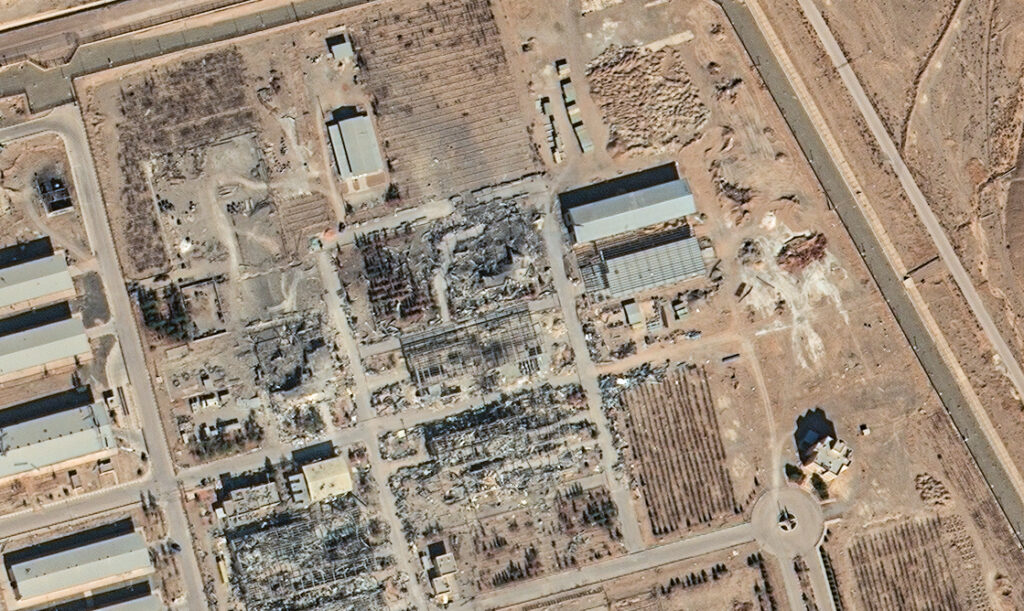
Albright offered a stark assessment of the damage done to Iran’s nuclear program: The regime’s “gas centrifuge program, the enrichment program, the secret program to turn weapon-grade uranium into a nuclear weapon … is severely damaged,” he said. “The centrifuge program as it was no longer exists. And what we’re essentially discussing are remnants.” Those remnants, he said, “are dangerous, but nonetheless this is an enrichment program — it’s not enriching, it’s not making centrifuges, and it’s going to have a very hard time reconstituting anything close to what it had for years and years.”
Not only did the United States and Israel strike Iran’s known nuclear sites at Fordow, Isfahan and Natanz, he said, “Israel revealed sites that it struck that were not known publicly that they said were related to making the nuclear weapon itself.” In all, Albright said, you have “roughly 10 nuclear-weapons-related sites destroyed” — including Iran’s storage, conversion, and research and development facilities — and “many scientists and engineers killed.”
One surprise was that there were no strikes on the nuclear site at Pickaxe Mountain, an underground complex near Natanz. “We wondered why was that never attacked,” he said. When his team queried the U.S. intelligence community, “the response we got back was: ‘Not enough has happened there to warrant hitting it.’” The site, he said, “is under construction, it’s a dangerous site, it needs to be dealt with in the negotiations at least.”
But here’s the bottom line: Albright said that before Trump launched Operation Midnight Hammer in June 2025, Iran had “a program that had 22,000 centrifuges, many of which were operating, enriching all the way up to 60 percent. Now they’re not enriching at all and most of those centrifuges are destroyed.”
What does that mean for the future of Iran’s pursuit of a weapon? In June 2025, he said, the world faced an “imminent threat” that Iran could build a nuclear weapon within months and several weapons within six months to a year — and do so with 100 percent certainty. Now, he said, “It would take them at least a year, and given the damage, there would be much more uncertainty it would work.” This makes it far less likely an Iranian supreme leader will make the decision to build a bomb — because not only would it take a year or more but the effort “is by no means certain to succeed.” The risk of trying to secretly build a bomb — which could at any point be detected, resulting in military action by Israel and the U.S. — without any guarantee of success is a serious deterrent.
I asked him about the claim from senior Trump administration officials that Iran’s nuclear material is now buried so deep that Iran has indicated it can’t reach it to hand over; the U.S. will have to come dig it up itself. “We think these bunker-busters going down through the ventilation shafts really destroyed [Fordow],” he said. “If the blast wave hit the cylinders, and we think [it] did, and crushed them or opened them in some ways,” then the facility has been “entombed” and likely reduced to a “nuclear waste site.”
“But if you go to Natanz, you go to Isfahan, that’s not the case,” he said. At Isfahan, “some damage was done probably deep into the complex, but it may not have been sufficient damage to break open these canisters” holding enriched uranium that remain buried inside the tunnel complex, while at Natanz, he says, “it’s anyone’s guess what was destroyed.” Operation Epic Fury “ended too quickly,” he said.
Now, as the Trump administration pursues a nuclear deal, the fundamental test is whether Iran will admit it had a nuclear weapons program. “Does [Iran] say, ‘Okay, yeah, we did have a nuclear weapons program. Here’s what it was about. Here’s where it took place.’ And all these lies that they’ve been perpetuating for years over this question should be settled.” Unless Iran is willing to do so, then it is not serious. It needs to “come clean,” he said.
Right now, Albright worries that “Iran is setting up a process to stall … and they’ll figure that it’s too late for Trump to go back to war.” But regardless of what happens at the negotiating table, he said, “what was accomplished [by military action] was pretty significant on the nuclear front.”
The idea that Iran is stronger today is bunk.
The post A top nuclear expert on what the Iran war accomplished appeared first on Washington Post.