Meteorologists with the National Weather Service issued a rare forecast alert for “extremely critical” fire conditions in the Southwest on Friday, warning that storms moving across the parched landscapes of Arizona, Utah and Nevada could set the stage for an intense weekend of wildfires.
Fires have already broken out across the region this week amid days of serious warnings, including one that Utah’s governor said might already be the most destructive in state history.
Forecasters said they were most concerned now by the conditions that were developing on the heels of storms hitting the region on Thursday.
“Our main concern is getting lightning with dry fuels and then a whole bunch of wind with already active large wildfires on the landscape,” Nick Nauslar, the fire science and operations officer for the Storm Prediction Center, said on Thursday. He added that the threat was expected to unfold over the next four to five days, meaning “these areas are not going to see meaningful relief anytime soon.”
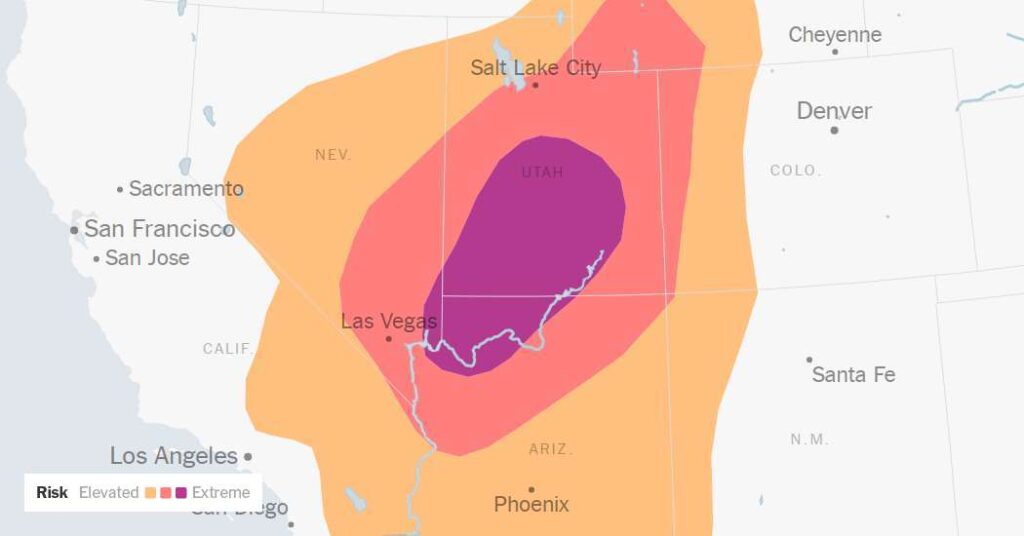
The “extremely critical” designation is the highest risk level issued by the Prediction Center for wildfire conditions. It means that fires are more likely to spark — and will be harder to contain if they do.
“When we issue extremely critical, we don’t pull that lever very often,” Dr. Nauslar said, noting that forecasters are trained to reserve the category for “an exceptional situation.” It is used, he said, only a handful of times a year.
The worst conditions are expected across an area of about 50,000 square miles that mostly includes parts of Utah and Arizona with an estimated population of 350,000, according to the Prediction Center.
Like a bull’s-eye on the map, additional rings spread outward, where millions more people face slightly less intense, but still critical, conditions. Las Vegas, Flagstaff in Arizona, Provo and Salt Lake City in Utah, and Grand Junction in Colorado are all in this next tier. A third ring stretches north into Wyoming, south to Arizona’s border with Mexico, and west into Southern California, where the conditions are considered “elevated.”
While wildfires can occur at any time in the West, June is the start of a more active season that runs through October. This week, meteorologists have watched closely as the end of the school year and the arrival of summer send more people outdoors to take part in the types of activities that can lead to wildfires — such as gathering around campfires.
Multiple wildfires were already burning on Thursday, particularly in Utah, where Gov. Spencer Cox said the state had endured a “no good, very bad week.”
The Cottonwood fire burned at least 61,000 acres by Thursday afternoon, set off evacuations across Beaver and Piute counties, and caused significant damage to a ski resort. After touring the blaze on Wednesday, Governor Cox told reporters that within just 48 hours, “there is a very good chance that this is already the most destructive fire in the state’s history.” No deaths have been reported.
The Iron fire, 80 miles south of Salt Lake City near the small city of Eureka, has burned more than 37,000 acres since it began on Friday.
Like every other state in the West, Utah recorded historically low amounts of snow last winter, resulting in drier conditions this spring and summer that have left the landscape parched and highly flammable.
“The conditions we’re seeing right now, we usually we don’t see until mid-July to August,” said Karl Hunt, a spokesman for the Utah department that oversees forestry and wildfires.
The fires have pumped out a lot of smoke, and the view of the mountains from Salt Lake City has at times this week been shrouded by a blanket of acrid air. The smoke, which reached as far as Colorado, has reduced air quality across the region — but it could also keep thunderstorms from spreading as much as they might without it.
Summer across the Southwest is also monsoon season, when the weather pattern pushes moisture across the region. These storms can wet the landscape, and even cause flooding in some areas. But they also bring lightning, even in areas that get no rain — a phenomenon called dry lightning.
When lightning occurs under a blanket of moist air, the strikes can trigger what are known as holdover fires, which may not start out as very active. When conditions turn drier, as they are expected to on Friday and Saturday, the fires that were quietly smoldering in the ground can burst into life.
“A holdover fire may start but not fully emerge until a few days later,” said Lexy Elizalde-Garcia, the lead fire forecaster at the Storm Prediction Center.
The post Its Landscape Parched, Southwest Faces ‘Extremely Critical’ Fire Weather on Friday appeared first on New York Times.