
Hugh Ryan is an absolute superstar of queer history. His first two books, “When Brooklyn Was Queer” and “The Women’s House of Detention: A Queer History of a Forgotten Prison,” were magnets for awards and accolades. After spending recent years immersed in cultural stories, he’s turned his investigative eye on his own coming of age with the rollicking, raw, funny and sharp memoir “My Bad: A Personal History of the Queer Nineties and Beyond.” Pivoting from scholar of history to student of life, Ryan shares lessons learned from beloved but homophobic middle school teachers (“The nicest mother— I knew could accidentally curb-stomp my heart at any moment”) to ones acquired on the dance floor (“Dancing is sex on a communal level: an embodied ecstatic ritual of union”).
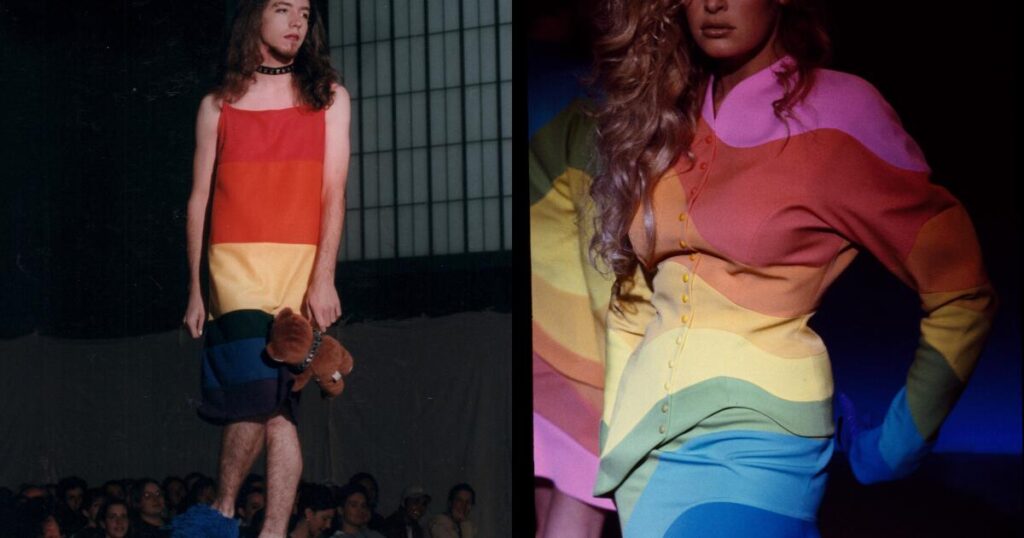
Ryan swung through L.A. on his book tour, and what better place to host a paean to the ’90s than the ASU FIDM Museum, where the exhibit “Obsessed: Fashion and Nostalgia in the ’90s” is serving Westwood plaids, Calvin Klein’s minimalist silk parachute sheath and Donatella’s zipper-slashed, leather mourning dress. A fellow survivor of the era, I interviewed Ryan and the evening was introduced by the exhibition’s sparkling curator, Christina Frank, who cheekily shared period photos of the author alongside images from the museum’s ’90s archives, asking: Who wore it best? Whether it was Ryan channeling designer inspo or fashion-snatching looks from the streets, the display — like the book that inspired it — was colorful and daring, inspired and eccentric and wholly unique. At a time when nostalgia for the ’90s is seemingly everywhere, “My Bad” places the decade into context, including its paradoxical freedoms and oppressions, with the intimate, funny rough language of your freakiest, funnest bestie.
Michelle Tea: Your previous books are this amazing, accessible scholarship. In “My Bad,” your language is so different — you’re cussing! The academic gloves are off — which isn’t to say that it’s not brainy. Was this just the voice that the book wanted? It’s like, “Oh, so we’re just like sitting on the curb having a cigarette together.”
Hugh Ryan: I actually wanted to buy a box of clove cigarettes while I was doing the research, but apparently they’re illegal now because they’re deadly and full of fiberglass.
So much of it is about writing it for people today who are younger, who look up to my books and are like, “I’m going to get my PhD and be just like you!,” and I was like, I didn’t do that, I’ve misrepresented myself somehow, and I want to be really real. Also, I had this job for four or five years where I ghost wrote a kids’ books series, and I was eventually fired, because I took a beloved character — who I am not allowed to name — and made her curse, which she had apparently never done in her 100-year history. When I made her say ‘hell’ and ‘damn’ while solving a mystery, the internet went wild, and you can find the Amazon page where I am ruined. So, the ability to curse in my work and have a real voice was something that, from very early on in my career, I was like, “Oh no, I got to be real careful about being too much myself on the page.”
MT: You needed to break that pattern of self-censoring. What was it like to shift the focus of your intellectual investigation onto yourself?
HR: Excruciating. At first I really enjoyed it, when it was just this idea. I’ve never really told these stories. In the early versions of it, everything I wrote was jokey, silly, overly stylized, not honest. I wasn’t ready to really dig in. I think that I had a lot of layers of defensiveness that I didn’t even understand I had until I had to write things down. My agent kept being, “No, no, this isn’t real, stop with these jokes, it is funny, but you have to get into the serious issues.” There was a large resistance inside me. Asking, “OK, how did my experiences relate to the ’90s as a whole?” actually let me talk about myself and the time period I emerged from. I needed that scaffolding to feel comfortable.
MT: How do you feel about Gen X’s legacy as basically the coolest generation?
HR: I mean, I kind of love it.
MT: We’re having the most sex, even though we’re so old now. And we’re tough, because we’ve survived so much queer trauma. You write in “My Bad” about having Snapple bottles thrown out windows at you.
HR: If you looked queer and you were out in the world, it was just accepted that at some point during the day someone was going to be violent towards you. Verbally, maybe physically. It just was what it was. Though I will say, having now, later in my life, thrown some Snapple bottles really hard just to feel it, it does feel very good. They’re heavy, they’re glass, they explode. If you can get your hands on some classic ’90s Snapple, just throw them, just try it.
MT: We have to have a queer, Gen X ritual of throwing Snapple bottles, like a rage room.
HR: I do think that it’s easy to forget all of that, because I think we all wanted to forget it to a certain degree. We wanted to let go of our pain. Both the people who were hurt and the people who caused those hurts had some amount of evolution. This is something I think about a lot with my family. If you read the book, in the early chapters it’s rough with my folks. They were loving, but also had no idea what to do with me. I was not just gay, I was weird and trans and confused, and always making noise and acting out and being inappropriate. There’s all this tough stuff, and then we try to forgive each other and let it go, but without saying it. Writing the book was this moment of, “Oh no, am I making us talk about all the bad times again?” It took me sitting with that and realizing — that’s the only way to get to the other side. I’ve seen this change in my family, and it felt important to document how shitty it was, so we could see the change.
MT: What sign are you?
HR: Cancer.
MT: You’re Cancer?!
HR: Yeah, tell me about it. I know so little about astrology. It’s the straightest thing about me, how little I know about astrology.
MT: I don’t even know what to say, because I’m getting such Aquarius-Virgo-Gemini from you that Cancer is just blowing my mind.
HR: I do have a shell, I know that about myself. And that was my first two books. Now I’m trying to invite people in.
MT: Will you talk about the club kid scene in New York City in the ’90s?
HR: I just touched up on the edges of it. The club kid movement really stopped after effective retrovirals come in, in 1996. Suddenly club kids saw a future for themselves, and did not all imagine that they were going to die of AIDS imminently. The ones who I’ve interviewed have said, “That’s the moment at which suddenly, dressing for Friday night no longer felt like what you spend two weeks doing.” But when it was happening, it was amazing. There were these free magazines in New York City, HX and Next, little queer rags full of party promotions and photos of half-naked people in clubs, and ads for those awful viatical companies that would buy up your life insurance if you had AIDS. They were very weird, but they’re like style bibles for me. And then you would go to the clubs.
When you went to Limelight, there would be two entrances, one for straight people and one for gay people. The bouncer at the line for the straight entrance was a giant gay guy, who — this was abusive, and probably wrong, but it was very funny — he’d be like, “You two make out if you’re gonna tell me you’re gay, make out or you don’t come in.” You only got access to half the club if you went in the straight entrance — the other half was only for queer people, and so you would have these straight folks trying to get in. It was amazing, and it was a place where I came to really love my body, because up until then the only things I had been told my body were for were sports, and that was never going to be me. There, I could dance all night.
Limelight was the coolest, but I loved Tunnel. Tunnel was 80,000 square feet of nightclub in a former railway terminal. There was a room entirely designed by the artist Kenny Scharf, and it was covered in fake fur — in a club when smoking was still allowed! It was the worst smelling place I’ve ever been in my whole life. I would sneak down there wearing giant Jnco raver pants, and watch everyone. These giant pants had these huge pockets in them, and I would put a big, gallon Ziploc bag with a clean T-shirt and clean socks inside the pant pocket. When the night was done I would go out, get food, change my clothes, and put the dirty clothes inside the Ziploc bag. I still had to have the pants on. I carried like the smell of 1,000 humid homosexuals with me everywhere I went.
MT: Speaking of being grimy — you were also really affected by Burning Man.
HR: I had met this guy, we totally fell in love. He was a high school dropout computer hacker who was the epitome of the bisexual ’90s — longhaired, androgynous, everything I wanted to be. You know, that very queer thing of: Do I want you, do I want to be you, should we go on a road trip or a killing spree? We were in love and I did not want to go back to school. I had had a terrible junior year, and I was looking to make new mistakes. He was like, “I’m gonna go to this thing called Burning Man, do you want to go? It’s out in the desert, there’s all this art, and it’s super cool,” and I was like, “When is it?” And it was the very first week of classes my senior year, and I was like, “Yeah, absolutely.”
It was amazing. We got adopted by these people who called themselves the Church of Mez, or Mezbians. They were extremely rich Microsoft engineers. We were completely unprepared, because we’d f—ing come in on the Greyhound bus. You’re supposed to bring a gallon of water per person per day, just to start with, and we had nothing. We had a tent and a sleeping bag, and these people thought we were somewhere between pets and aphrodisiacs.
It felt like such an amazing thing to get to touch. And I know that all of those people ended up being like fascist tech bros of today, I’m sure, and I worry about the environmental degradation that I did not know anything about. And it was so white, so many white people with dreadlocks and those terrible tribal tattoos. Like many things in the book, I have to write about it tenderly, even though I know there are so many problems. I don’t think I would be who I was if I didn’t show some tenderness towards those spaces that made me, or at least allowed me to see myself.
Michelle Tea is the author of more than 20 books for grown-ups, teenagers and children.
The post The ’90s transformed queer life. Hugh Ryan looks back with humor, heartbreak and clarity appeared first on Los Angeles Times.