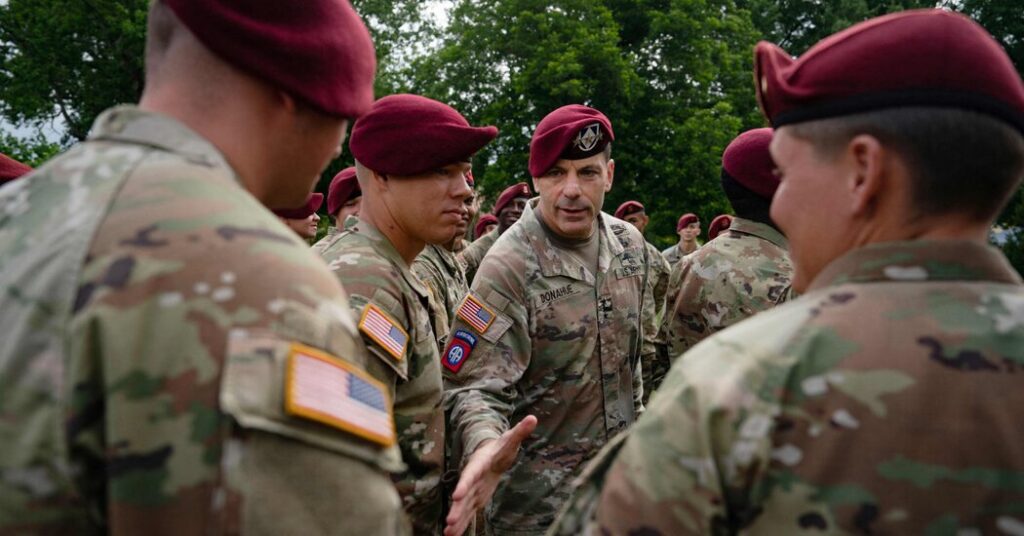
Defense Secretary Pete Hegseth has forced Gen. Christopher T. Donahue, the top U.S. Army commander in Europe, to retire, a blow to those who saw him as a key leader of the military’s push to adapt to a future battlefield dominated by drones and artificial intelligence, defense officials said.
General Donahue is expected to relinquish command of U.S. Army Europe and Africa on July 2, the Army said in a statement. He plans to retire in August.
The general spent most of his Army career in the secretive world of U.S. military special operations, first as an Army Ranger and later as a commando in the elite Delta Force, where he rose to become the unit’s commanding officer.
It is unclear why Mr. Hegseth, who has fired or sidelined many of the Army’s most experienced combat leaders over the last 18 months, viewed General Donahue with skepticism. The general has long been seen as one of the Army’s rising stars.
Mr. Hegseth, who fought in Iraq and served in the National Guard, was forced out of the Army for tattoos the service deemed extremist. “The military I loved, I fought for, I revered,” he wrote in a 2024 book, “spit me out.”
General Donahue and Mr. Hegseth have met only once, during a troop visit by Mr. Hegseth to Poland in February 2025, and their brief interaction there has been described as friendly. The Pentagon declined to comment on General Donahue’s future, referring questions to the Army. The Army said in a statement that General Donahue will relinquish command on July 2.
In August 2021, while serving as the commander of the 82nd Airborne Division, General Donahue helped lead the evacuation of Afghan allies from the airport in Kabul as the country fell to the Taliban. During the chaotic U.S. withdrawal, a suicide bomber killed 13 American troops and more than 150 Afghans at an entry to Hamid Karzai International Airport.
As defense secretary, Mr. Hegseth has vowed to investigate and hold accountable those who were responsible for the chaos at the airport and the American deaths. General Donahue and his troops were not responsible for security at Abbey Gate, the site of the airport bombing, a defense official said.
Instead, he and his soldiers were rushed to the airport to restore order as the Taliban closed in on Kabul and desperate Afghans tried to flee the country.
His troops enabled the evacuation of as many as 124,000 Afghan allies, one of the largest airlifts in U.S. military history.
A photograph, fluorescent green because it was taken with night vision optics, captured the moment when General Donahue stepped on board a C-17 transport plane at the airport, becoming the last U.S. service member to leave Afghanistan.
General Donahue was promoted the following year to lead the 18th Airborne Corps. In that role, he oversaw the establishment of a partnership that supplied the Ukrainians with weapons, intelligence and battlefield advice that helped them fend off a full-scale Russian invasion.
Those efforts culminated that fall when the Ukrainians successfully retook large swaths of their territory during a U.S.-backed counteroffensive in the eastern regions of Kharkiv and Kherson.
In his role over the last 18 months as the commander of U.S. Army Europe and Africa, General Donahue established the so-called Eastern Flank Deterrence Initiative, a warfighting concept and network of physical barriers, manned and unmanned weapons systems, advanced ground and airborne sensors, one-way attack drones, affordable drone interceptors and other capabilities designed to defend NATO against Russia and other threats. The initiative drew on lessons learned from Ukraine and other conflicts.
General Donahue was widely seen as Army Secretary Daniel P. Driscoll’s top choice to become Army chief of staff after Mr. Hegseth fired Gen. Randy George in early April, according to defense officials, who spoke on the condition of anonymity to discuss sensitive personnel matters. Mr. Driscoll and General George had worked closely together to modernize the Army for an era in which low-cost, deadly drones play a larger role on the battlefield.
General Donahue’s retirement from the Army was reported earlier by The Atlantic.
General Donahue also had strong backing from Democratic and Republican senators in Congress who saw him as the best choice to lead the Army at a moment when ground warfare was being revolutionized by robotics and artificial intelligence.
Mr. Hegseth’s decision to bypass General Donahue for the top Army job cements his control over the Army, whose top generals Mr. Hegseth has systematically replaced with leaders he views as in line with his vision for the military.
Maj. Gen. Christopher Norrie, General Donahue’s deputy at U.S. Army Europe and Africa, will perform the duties of the commanding general until a replacement is named. General Donahue’s four-star command is expected to be reduced to a three-star position, a sign of the Pentagon’s efforts to shift the focus of U.S. troops from Europe to Asia.
“General Donahue has been a driver, reimagining how NATO, including the U.S., needs to adapt and use A.I. and data to dominate future battlefields based on what we are seeing in Europe and around the world, especially the use of drones,” said U.S. Army Col. Martin O’Donnell, a spokesman for the Supreme Headquarters Allied Powers Europe.
Lara Jakes contributed reporting.
The post A General Many Hoped Would Lead the Army Is Forced to Step Aside appeared first on New York Times.