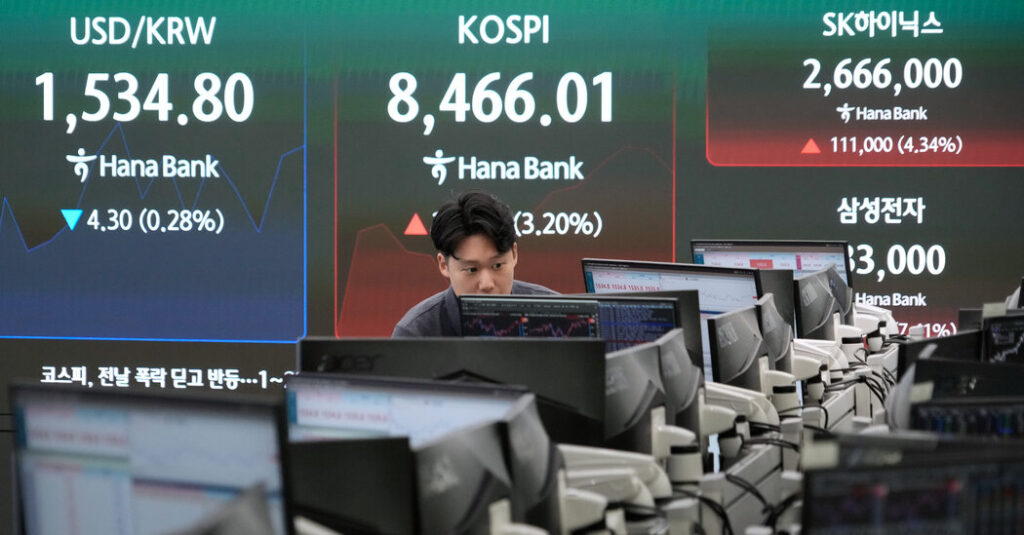
It was another dizzying day for Asia’s technology shares.
A day after falling 10 percent, South Korea’s benchmark KOSPI rebounded on Wednesday in a volatile trading session. The index surged as much as 4 percent in morning trading before a sharp sell-off briefly drove it down 2 percent. By late afternoon, it had clawed its way back to a gain of nearly 3 percent.
South Korea’s stock market, the world’s best performer since the start of last year, triggered a global sell-off in technology shares when the KOSPI nosedived on Tuesday. The rout reflected growing investor unease over whether the rally fueled by enthusiasm for artificial intelligence had run too far, too fast.
Futures on the S&P 500 rose 0.2 percent, pointing to a modest increase when stocks resume trading in the United States on Wednesday.
In Asia, no markets are more exposed to the A.I. boom than South Korea and Taiwan, where a trio of semiconductor companies exerts an outsized influence over broader stock indexes.
In South Korea, the rebound was led by Samsung Electronics and SK Hynix, the country’s two chip giants. Samsung jumped 8 percent, while SK Hynix gained 1 percent.
Taiwan moved in the opposite direction. The benchmark index fell more than 2 percent as shares of Taiwan Semiconductor Manufacturing Company — the world’s largest contract chip manufacturer — slid 4 percent.
Oil prices ease.
-
The price of Brent crude, the global benchmark for oil, fell 1 percent to about $76 a barrel for September delivery, currently the most heavily traded contract.
-
West Texas Intermediate crude, the U.S. benchmark, was down a similar amount to around $72 a barrel for August delivery, currently its most popular contract.
-
Investors and analysts are focused on the continued disruption to shipping in the Strait of Hormuz, the narrow waterway between Iran and Oman that is a vital trading route for oil and natural gas, normally carrying as much as one-fifth of the world’s oil supply.
Gasoline prices hold steady.
-
Gas prices held firm on Tuesday at a national average of $3.93 a gallon, according to the AAA motor club. Gasoline prices have risen 32 percent since the war began.
-
On social media, President Trump accused oil companies of “gouging” consumers because he said prices at the pump had not fallen in line with the recent decline in oil prices. He said he would order the Justice Department to look into the matter.
-
Gas prices don’t move in lock step with crude, usually trailing increases or drops by a few days.
-
The average price of diesel fell by a penny to $5.00 on Tuesday, up 33 percent since the start of the war.
The post Asia Tech Shares Swing Wildly as A.I. Jitters Persist appeared first on New York Times.