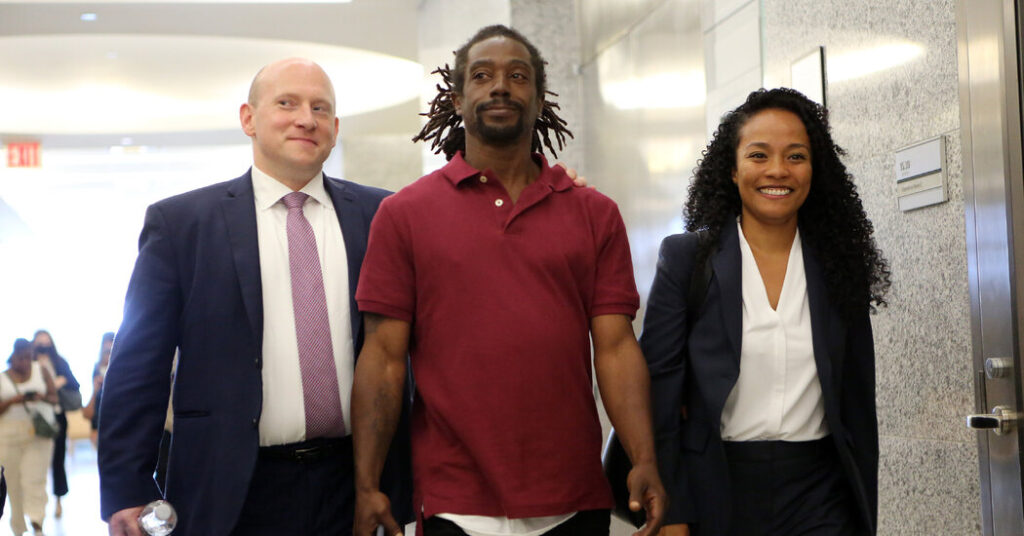
James Irons sat in the second row of a courtroom in Lower Manhattan in November, sobbing and shaking. He pressed his hands firmly against his ears, an orange towel draped over his head.
His fiancée wrapped her arm around his shoulders as his lawyer described a night in Brooklyn in 1995, when Mr. Irons was 18 years old. Detectives, the lawyer said, held Mr. Irons overnight in a police interrogation room, struck him over the head with their hands and showed him a gun as they repeatedly fed him false statements to say. Mr. Irons, who has cognitive impairment, his lawyer said, confessed to the crime and was later convicted in the murder of a subway booth attendant.
Mr. Irons, now 49, had his conviction cleared by a judge in 2022, after spending most of his life behind bars. But last year, he found himself back in a courtroom. His lawyers were arguing his innocence in an effort to win a lawsuit against the state of New York for his wrongful conviction.
People who believe they were deprived of their constitutional rights, such as through wrongful convictions, can sue state or local government officials under federal civil rights law. In New York, they can sue the state government in the Court of Claims, which requires a burden of proof closer to beyond a reasonable doubt than federal law calls for.
Lawyers for exonerated people say the city has a fairly straightforward process to reach settlements, often going through mediation with a judge. However, those who have had their convictions overturned say the state process can be harrowing and tortuous.
Someone can be exonerated, meaning cleared of wrongdoing, based on new evidence like DNA. Others can have their convictions reversed because of prosecutorial misconduct or other reasons, and be given a new trial or have their charges dismissed.
Although nearly half of the claims against New York since 2016 are settled before a full trial, according to data from the Office of Court Administration, the state sometimes makes claimants sit through depositions and forces them back into a courtroom to defend themselves, said Samuel Hershey, a bankruptcy litigator with the White & Case law firm who takes on exoneration cases pro bono.
State Senator Zellnor Myrie said the legislature should “strongly consider” changing the laws about exoneration compensation.
“The same resources that we invest in putting people away and keeping them incarcerated for, in some instances, decades should be the same level of resources that we avail to those who are innocent,” Mr. Myrie said.
The state is represented by the office of the attorney general, Letitia James, who has been vocal about wrongful convictions, which have disproportionately affected Black and Hispanic men. However, some lawyers have said that her office’s treatment of such cases is at odds with Ms. James’s stated values.
In response to questions about the state claims process, Alexis Richards, a spokeswoman for Ms. James, said in a statement: “The office of the attorney general has a legal responsibility to represent the state, and we work hard to fulfill that obligation while also supporting wrongfully incarcerated individuals in their pursuit of justice. Every person is entitled to fair treatment under the law, and our office will continue to ensure they receive it.”
Since 1989, there have been 376 exonerations across New York State, according to the National Registry of Exonerations. Only two other states, Illinois and Texas, have overturned more convictions, according to the registry. New York has paid $397 million to exonerated people, more than any other state.
In both federal and state courts, settlement amounts are negotiated on a case-by-case basis while considering factors like time spent in prison, estimated earnings lost and psychological harm.
Mr. Irons had already received more than $16 million in a settlement with New York City. In Lower Manhattan, he was trying to see what he could get from the state. Some lawyers have said that New York prolongs the process to wait until there is a city payout to offset what it pays in a settlement.
For Shawn Williams, 51, receiving money through city and state settlements would have been a financial lifeline. He was 19 years old in 1993 when he was accused of killing his childhood friend in Brooklyn. Mr. Williams was convicted and spent his adulthood behind bars before he was released in 2018.
He is one of the many exonerated people who are thrust back into society with no money or job after decades in prison. As many others often do, Mr. Williams ended up taking a high-interest cash advance while awaiting potential settlements for his wrongful conviction.
He figured he had a pretty good shot at a payout. Like Mr. Irons’s, his conviction was overturned after investigations into cases linked to the former detective Louis N. Scarcella, who has been accused of misconduct in several homicide investigations in the 1980s and 1990s. Cases handled by Mr. Scarcella have cost the city and state at least $110 million.
New York City settled Mr. Williams’s claim for $10.5 million in 2022. The state, on the other hand, worked to discredit it in a trial decided by a judge.
“I just had to relive it, relive that trial, all over again,” Mr. Williams said in an interview earlier this year. “That’s what it felt like.”
The state called witnesses, and in 2020, Mr. Williams took the stand and answered questions stemming from his arrest in 1993. A lawyer for the attorney general’s office asked him where he was at the time of his friend’s killing, he recalled.
“When he was asking me about my friend, the last time I seen him, I broke down and cried in the courtroom,” Mr. Williams said.
The judge, Jeanette Rodriguez-Morick, determined that Mr. Williams had not proved his case and dismissed his claim. Mr. Williams is appealing the decision, and after another ruling against him at the start of June, his suit against the state has entered its eighth year.
“I had the same feeling I had at trial,” Mr. Williams said in June. “The system failed me again.”
In the case of Eric DeBerry, 50, his lawyers thought they had a compelling argument to avoid a trial in his state lawsuit. He had been convicted of first-degree assault and robbery in a 1999 shooting, putting him behind bars for 20 years before he was exonerated. Mr. DeBerry was found actually innocent, an unusual legal outcome in which the judge finds that someone did not commit a crime.
However, the attorney general’s office decided that Mr. DeBerry had to prove his innocence again, and a Court of Claims judge agreed.
Mr. DeBerry has appealed the decision. In 2024, as the state case wound its way through the court, Mr. DeBerry received $9.45 million settlement as part of the civil rights lawsuit against the city.
“I’m out of prison, but I’m still attached to this case,” Mr. DeBerry said. “As bad as I want to leave this in the past, it’s like another form of torture.”
As for Mr. Irons, his lawyer, David Shanies, has been pleading for a settlement from the state since the beginning of the case, eventually writing a letter addressed to Ms. James, the attorney general.
“You have built a reputation on doing what is right, not merely what is expedient,” Mr. Shanies wrote. A settlement, he argued, would “spare an already vulnerable man from needless suffering, and it would stand as a clear statement that your office remains firmly dedicated to the cause of justice.”
But Ms. James did not respond, he said.
So Mr. Irons moved forward with the trial, dreading the experience but believing it was what his mother, who died while he was in prison, would have wanted, he said.
Mr. Irons was pushed past an emotional breaking point in court in November, according to his lawyer. Halfway through the trial, his lawyer said, the state offered a settlement of $1.5 million. He accepted.
“I don’t want to understate it,” Mr. Shanies said. “What he went through there caused significant psychological damage, and it just was so unnecessary.”
The post Exonerated New Yorkers Say Compensation Process Is Traumatic appeared first on New York Times.