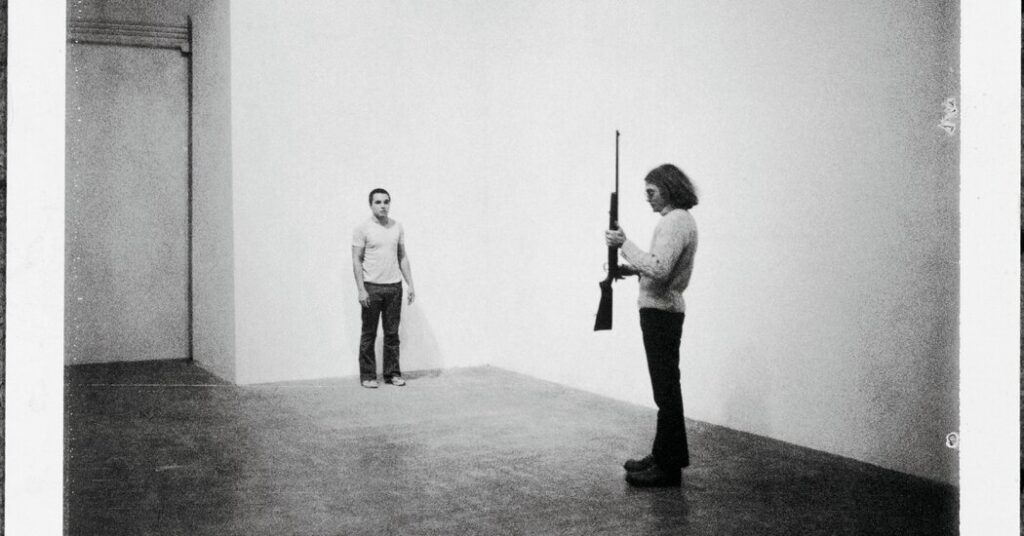
The artist Chris Burden had a complicated relationship with the law. When he went to the hospital in 1971 for a gunshot wound to his arm, he told the police it was an “accident.” But he had really asked a friend to shoot him with a small caliber rifle for a performance. A year later, he was arrested for another piece in which he reclined on a Los Angeles street under a tarp near flares.
This week, visitors to Art Basel in Switzerland can view 10 Burden works that could present their own legal issues: oversize Los Angeles Police Department uniforms with disabled Beretta handguns. Owners and borrowers of the pieces have to navigate local firearms laws just to keep or display them.
“It’s always fraught with tension when you have to move this stuff around and exhibit it,” said, Mary Anne Friel, an artist who helped Burden develop the pieces during his residency in the early 1990s with the Fabric Workshop and Museum in Philadelphia. Friel, who continued to help install the pieces, recalled them being held up at customs en route to Milan, and said that one of the guns was stolen while the work was in Vienna.
To show the artworks in Switzerland, which has strict firearm laws, the Gagosian Gallery developed silicone rubber replicas of the guns in partnership with Burden’s estate. The artist died in 2015, at 69. These modified copies were approved by the authorities and Art Basel’s security team, the gallery said. Eight of the 10 uniforms are for sale as a set in Unlimited, the part of the fair devoted to large-scale works, which opened on Monday to invited guests. (The gallery declined to state the price.)
A Big Symbol
Burden began developing the uniforms around the time of the 1992 riots that broke out after four Los Angeles police officers were acquitted in state court of the beating of Rodney King, a Black motorist.
“The police uniform became a big symbol,” Burden told the Archives of American Art in 2012. He imagined dropping hundreds of uniforms over the city, picturing “disenfranchised people that are pissed as hell wearing police uniforms.”
The artist ended up producing an edition of 30 uniforms, with belts, batons, enlarged badges and other equipment, and Larry Gagosian, owner of the namesake gallery, showed the complete series at his SoHo space in 1994.
In a phone interview earlier this month, Gagosian, who grew up in Los Angeles, recalled police quelling anti-Vietnam War protests when he was a student at University of California, Los Angeles. He said that the Los Angeles Police Department at the time had a reputation for hiring what its leaders viewed as “tough cops — paramilitary, if you will.”
The uniforms, which are more than seven feet tall and are suspended from clothes hangers, “can be a bit of a Rorschach, depending on how you’re feeling,” said Michael Govan, the director of the Los Angeles County Museum of Art. The museum has lent two of the pieces, which are not for sale, to the Basel showcase. Individually, each piece can be viewed as “a guardian,” Govan said, but when seen in a group, they can have “the scary and menacing quality of an urban army.”
“The scale was a genius idea,” Gagosian said of Burden’s work. “Making them larger than any human made them more imposing.”
“You’re really bringing to it your own sociological experience,” Friel said. For those who “feel you would not be protected by them under certain conditions, it would be more frightening,” she said.
Production Issues
Creating the works involved some distressing moments for Friel, who was initially concerned about the legality of producing police uniforms.
“I was constantly in fear that I’m going to somehow get exposed,” Friel said. She convinced a Los Angeles police officer to pose for photos by telling him that she was doing research for film and television productions, she said, and he provided her with an official manual about uniforms and accessories. “I wasn’t about to say we’re doing 30 oversized police uniforms for a gallery, based on the Rodney King acquittal, to be critical of L.A.P.D. officers,” she said.
Buying the 30 guns was the simple part — “easy as pie,” Friel said. But when asked to disable them permanently, the people working at the shop tried to talk Burden into letting the procedure be reversible, she said, adding, “They thought it was almost a criminal act of disfigurement.”
The post The Police Are Coming to Art Basel appeared first on New York Times.