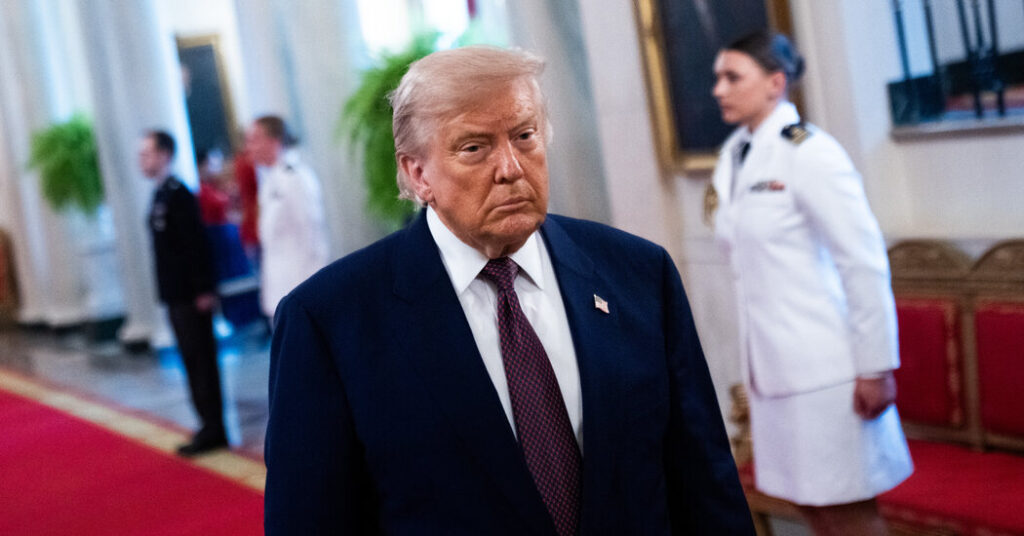
President Trump’s fragile agreement with Iran has introduced a new variable into this year’s midterm elections.
Democratic candidates have assailed the agreement, arguing that the president accepted unfavorable terms to try to end an unnecessary war that hurt the economy. Republicans have been more divided. Some, eager to turn the page on the unpopular war, are hailing falling gas prices and praising Mr. Trump for weakening Iran’s military capabilities, while others are expressing doubts about whether the president is likely to achieve the goals he set out to accomplish with the war.
Although the long-term durability of the accord was unclear — Iran claimed Saturday that it closed the Strait of Hormuz after what it said was a U.S. breach of the deal, while the U.S. military said traffic continued to flow — candidates in battleground states and leaders in both parties had already begun to develop new positions for a new chapter.
Republicans in tough races “have to be happy” that the fighting has stalled and that gas prices are falling after the deal, said Adrian Hemond, a Democratic consultant. But, he added, “the Pandora’s box has been opened, and we’re not stuffing everything back inside at this point.”
Each twist with Iran has the potential to influence the midterms, which are less than five months away. Mr. Trump’s approval ratings have sunk and Democrats believe they are well positioned to win back the House and have a shot of taking the Senate, too. Republicans are hopeful that the agreement with Iran will help them move on from a difficult first half of the year.
Representative Derrick Van Orden of Wisconsin, a Republican and retired Navy SEAL who represents a swing district, said that the deal would help block Iran’s path to a nuclear weapon, and that energy prices would “start normalizing.”
“We’re already seeing gas prices drop,” Mr. Van Orden said. He added: “I fill up my gas tank, too, and I don’t like paying a nickel more for gas, and neither does any American. But I swear to God, I’d pay a thousand dollars for a gallon of gas if I could get just one of my friends back these people murdered.”
Still, there are fissures emerging among Republicans, and some conservative media outlets are questioning the agreement. An editorial in The New York Post was headlined “With Strait of Hormuz held hostage, Trump’s Iran deal is worse than Obama’s.”
Matt Gorman, a Republican strategist, said critical Republicans “probably won’t be for long once they see what it actually means in people’s pocketbooks.”
But Gov. Andy Beshear of Kentucky, chair of the Democratic Governors Association, was skeptical. Republicans “think that if gas prices are a certain place in the November election that everything’s fine,” he said.
“I disagree,” said Mr. Beshear, a potential 2028 presidential candidate, predicting that Americans would not soon forget the economic pain inflicted by the war. “In November, they’re not going to be able to afford the same Thanksgiving because of what this administration did to them over the summer.”
Nearly 60 percent of voters feel pessimistic about the state of the economy, and only 12 percent say they are getting ahead financially, according to a recent Fox News poll.
Representative Marcy Kaptur, an Ohio Democrat in a battleground district, said Republicans who expected economic conditions to improve quickly after the deal were “dreaming.”
“The wild horses are out of the gate,” Ms. Kaptur said, describing the negotiations with Iran as a “very wild process” and suggesting they would not be easily resolved.
As of this weekend, the average price of a gallon of gas in the United States had fallen 60 cents over the last month. But the price was still nearly a dollar higher than it was before Mr. Trump took the country to war and the Strait of Hormuz, a vital oil shipping corridor, promptly closed.
The deal would lift sanctions on Iran and release billions of dollars in frozen Iranian assets. It would push talks about Iran’s nuclear program into a 60-day negotiation period that could be extended, and it says that the United States and its regional partners would develop a $300 billion reconstruction plan for Iran.
Mr. Trump has contended that the war remade the Middle East in America’s favor and protected Israel from nuclear obliteration. “Iran got away with ‘murder’ for 47 years,” he wrote Saturday on social media.
Energy analysts have said that gas prices will probably remain elevated for weeks — or longer — even if the agreement holds. The surge in energy prices has cascaded across the economy. By May, inflation overall accelerated to its fastest rate in three years, according to the Consumer Price Index.
In Georgia, Senator Jon Ossoff, who is considered the most vulnerable Democratic Senate incumbent, recently told MS NOW that the United States had spent “tens of billions of dollars” on a war that “has made America less safe.” His Republican opponent, Representative Mike Collins, said in a statement, “Crippling the world’s worst state sponsor of terror is an important goal that all Americans should support.”
In Maine, Senator Susan Collins, who is considered the most vulnerable Republican Senate incumbent, has approached the deal carefully. On Thursday, she dodged a question from a CNN reporter on Capitol Hill who asked whether the war had been successful, saying she had not yet reviewed the deal.
Graham Platner, the Democratic nominee in Maine, highlighted her response, writing on social media that Ms. Collins would not “even say what her fellow Republicans now admit.” Mr. Platner quoted Senator Bill Cassidy, Republican of Louisiana, who had called the war “the worst foreign policy blunder in decades.”
Mr. Cassidy was not alone among Republicans in his criticism. Senator Ted Cruz, Republican of Texas, said on his podcast that the deal’s framework for a $300 billion recovery fund for Iran was a “very, very bad idea.”
“That money will be used to fund terrorism and to murder Americans,” Mr. Cruz said. “In my view, we shouldn’t send a penny to the ayatollah, and sending $300 billion would be, I think, enormously dangerous.”
Senator Cory Booker, a New Jersey Democrat and a potential presidential candidate, said the public criticism underscored the depth of Republican frustration with the war’s course. “I have watched Republicans in Congress consistently put lipstick on every pig that Donald Trump sent them,” said Mr. Booker. But now, he added, some Republicans are saying “enough is enough.”
He described the deal as a “catastrophic capitulation” that left the United States with “literally nothing” to show from a war that killed at least 13 troops and drove prices higher.
Republicans in battleground districts took a different view.
“For the first time in 47 years, Iran has been forced to come to the negotiating table,” Representative Mike Lawler, a Republican from a swing New York district, wrote on social media, adding that the president had “degraded Iran’s military capabilities and dismantled the leadership of the regime.”
Whit Ayres, a Republican pollster, said the development that would most help Republicans in the midterms would be “if inflation and gas prices come down.”
But with four and a half months to go until the midterms, it was still unclear how quickly they might drop.
Mr. Beshear, the D.G.A. chairman, said “gas prices can come down, and you are still hammered” by inflation across the economy.
“I don’t see this going away,” he said.
The post How Trump’s Fragile Agreement With Iran Is Shaping the Midterms appeared first on New York Times.