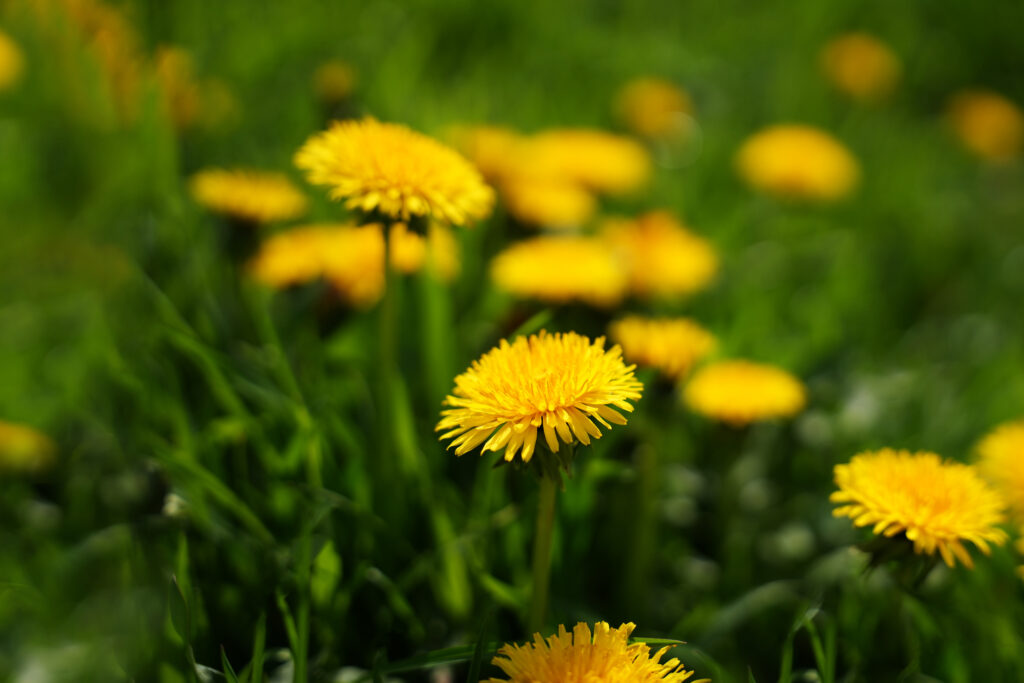
If you were asked to picture a weed, there’s a good chance a dandelion would come to mind. As a child you may have been instructed to pull up as many as possible, or told not to blow their dainty, fluff-ball seed heads to make a wish. (Sorry, kids, that just helps them spread.)
The truth is that although dandelions have been vilified in lawn care commercials and popular imagination, they’re useful in myriad ways. The entire dandelion plant is edible and has medicinal properties. Even in gardens it can be beneficial to other plants.
There are more than 250 species of Taraxacum, otherwise known as the dandelion, a name derived from the French phrase “dent de lion,” or lion’s tooth, for the distinct jagged shape of its leaves. The plants belong to the family Asteraceae, alongside daisies, asters, marigolds and sunflowers. Some are native to North America, but the one we’re most familiar with, the common dandelion (Taraxacum officinale), is an import. It arrived from Europe with the earliest colonists, who brought it along for its medicinal and nutritional qualities.
“We brought them here on purpose in the 1600s, because we’d been using dandelions for a long time,” says Abiya Saeed, an extension horticulture specialist at Montana State University. “The early settlers brought them for cultivation, especially as a food source. They’re nutritionally equivalent to things like spinach and other greens.”
The dandelion plant is rich in vitamins A, C and K, and contains such minerals as calcium, iron and magnesium. Its bright yellow petals are sweet and commonly used to make dandelion tea, wine and jelly. When the leaves are young and tender, they can be eaten raw. They take on a bitter flavor as they mature, but that is easily mellowed by blanching or sautéing. The roots can be cleaned and cooked like other root vegetables, and when dried and roasted, they take on a nutty flavor that mimics coffee.
The plant is featured in traditional dishes of various cuisines, including French and Korean salads, the Lebanese side dish hindbeh and rustic Italian dishes such as cicoria ripassata. The dandelion also has many medicinal properties, says Linda Patterson, director of the Boston School of Herbal Studies.
“One of my herbal teachers used to say if you eat dandelion every day, nothing will be able to kill you,” she says. “They’re incredibly antioxidant and anti-inflammatory. They’re well-known as a diuretic, and we can use it as a blood sugar regulator and a support for the liver.”
Dandelions have other applications, too: Its flowers make a vibrant natural dye, and its latex-rich sap is a source of natural rubber. The plant’s cultivators also prized the dandelion, Saeed says, for the ease with which it reproduces. A single dandelion flower contains several hundred seeds, and a mature plant can produce multiple seed heads in a season. But what historic dandelion lovers saw as a plus is what led to its reputation as a weed.
“The seeds are designed with these really interesting little mini-parachutes, which allow them to hitch a ride on the wind and travel for miles,” Saeed says. Thanks to that bit of natural engineering, it took only a couple of centuries for the common dandelion to spread across North America.
The lawn as we know it originated in Europe around the 17th century, where a patch of grass was a status symbol that meant its owner was wealthy enough to not farm it. In the United States, the trend took off with the rise of the suburbs in the middle of the 20th century. A tidy lawn of close-cropped grass became an integral part of the American Dream.
“We started to really dive into the idea of that monoculture turf grass lawn that’s uniform and spotless,” Saeed says. “People were really interested in getting rid of dandelions from that landscape.” The first chemical weed killers were introduced after World War II, she adds, and dandelions have been a target ever since.
Beyond the quest for a perfect lawn, Saeed says, many people simply want to remove invasive plants from their yards and gardens. But whether dandelions fall into that category is a bit complicated.
“They’re naturalized throughout North America and through much of the world. That just means they’re growing without human cultivation and human propagation, and have been for a long time,” she says. And although some research suggests dandelions might compete with other plants in certain situations, for the most part they don’t have a dramatic impact on native species, Saeed says.
“I like to also remind people that yes, dandelions are non-native, but so are most of the turf grass species we’re growing,” she says. “Kentucky bluegrass, for example, is the most common and most dominant turf grass species in the northern part of the United States, and it is also not a native plant.”
Native or not, dandelions can perform crucial services in the garden. They have a tap root — a thick, central root that grows straight down, which helps aerate compacted or poor quality soil. “Those tap roots also bring nutrients that are really, really deep in the soil up closer to the surface,” Saeed says, “making it so other plants can use them.”
When it comes to supporting pollinators, dandelions provide some nectar, though not nearly as much as many native species, Saeed says. But they thrive in soils and landscapes where other plants don’t, and in those places, less-than-ideal nectar and pollen is better than none.
“In locations where there’s not much else besides dandelions growing,” she says, “they’re a really important source for the pollinators that share those landscapes.”
The plant is also good at drawing other things out of the ground. Studies have shown that in areas near mining or industrial sites, dandelions can help remediate soil contaminated with heavy metals such as cadmium and petrochemicals (though that means it’s important not to eat dandelions grown in polluted soil).
Even if you can’t come around to love the dandelion, you may be able to respect it for its resilience.
“Part of what makes dandelions so adaptable is something called phenotypic plasticity,” Saeed says. “It basically means they can change their shape depending on the environment.”
They tend to grow taller in flower beds, but in lawns that are frequently mowed, dandelions adjust, she says, “to grow just an inch or two off the ground.” And despite your best efforts to yank the plant out of the ground, it can regrow from even the smallest piece of its tap root. It can survive deep freezes, long droughts, and being trampled and plucked. There is perhaps no flower better at enduring harsh conditions.
Of course, not everyone sees the dandelion as a landscaping scourge. There are annual dandelion festivals in Vermont, Colorado and West Virginia, and gardening groups celebrate an unofficial National Dandelion Day on April 5. And there are plenty of people who find their cheery yellow flowers downright pretty, and the round seed head is often used as a decorative motif.
Many people are also moving away from using harsh herbicides, and the cultural definition of the “perfect lawn” is beginning to shift. The dandelion, Patterson says, is due for a reputation upgrade.
“When you understand how useful they really are, you gain this new level of appreciation for something a lot of people turn their nose up at,” says the herbalist. “I think it was Emerson who said, ‘What is a weed? A plant whose virtues have not yet been discovered.’”
The post The surprising ways dandelions are good for us — and our gardens appeared first on Washington Post.