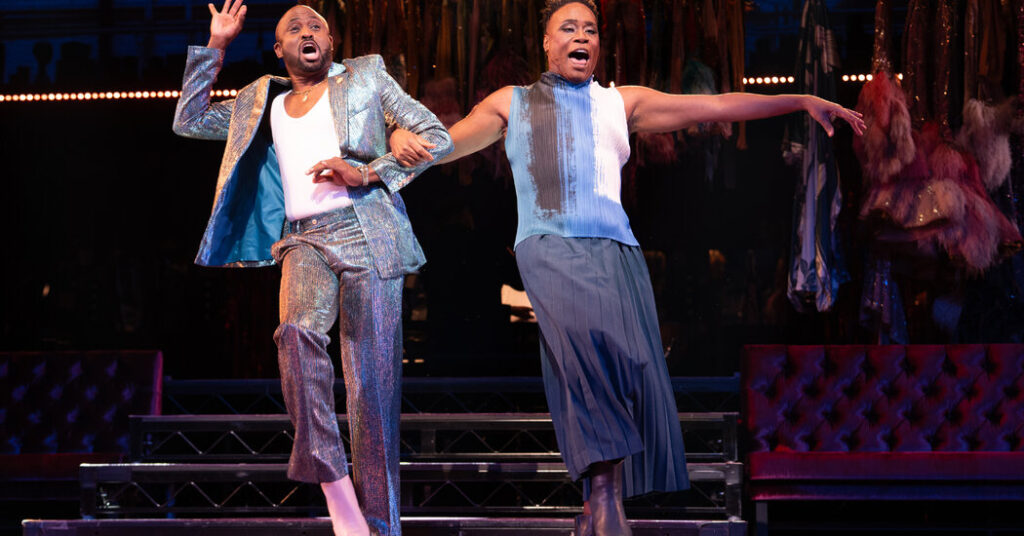
After all these years, Albin and Georges really are good together. The longtime couple at the center of the drag farce “La Cage aux Folles,” they haven’t always seemed that way.
In the show’s many iterations, from French play to art-house movie to Broadway musical to Hollywood redo, their enduring devotion could be hard to spot, let alone believe. But Billy Porter and Wayne Brady are here to fix all that — tender and affectionate, cozy yet combustible — in the Encores! revival of Harvey Fierstein and Jerry Herman’s tuneful 1983 musical, which opened on Wednesday night at New York City Center.
Mind you, “La Cage” is the story of a betrayal in the union of Albin and Georges, who own the titular drag club in St. Tropez: Albin (Porter) the star, Georges (Brady) the M.C. They live upstairs, and have spent 24 years raising Georges’s son, Jean-Michel (Alaman Diadhiou). Given the kid’s beastly streak of selfishness, he arguably still has some growing up to do, but nonetheless he has found himself a fiancée, the daughter of a vehemently anti-gay politician.
With her family arriving for an overnight visit to meet his own, Jean-Michel poses some tiny requests: that his father pretend to be married to his mother, who largely exited both their lives decades ago — and that he kick Albin out for the duration, lest his mannerisms doom the engagement.
“Papa, you know the way he is,” Jean-Michel cajoles. “The way he talks and moves and accessorizes.”
We might want to hate Georges for rolling over and acquiescing to such cruelty, but Brady is simply too charming to let us. Afraid to tell Albin that he’s being banished, Georges serenades him with the romantic “Song on the Sand,” his wistfulness so persuasive that you nearly forget he’s about to perpetrate a terrible double cross. You sense the love between these two, and the sexual chemistry — elements without which any “La Cage” is doomed to fail.
Still, Robert O’Hara’s production feels more germinal than fully figured out. Fair enough; it’s a concert staging at which, as the program says, actors may perform with script in hand. Porter, on Wednesday night, did so for much of the show, and that mostly didn’t get in the way because he understands just who Albin is: his ferocity and vulnerability, his eccentricity and comedy. Very likely, Porter will get more comfortable over the course of the run.
If his voice sounds frayed at times, it doesn’t really matter for Albin and his drag persona, Zaza. “I Am What I Am,” Albin’s wounded cri de coeur of a song — his clear-minded rejection of being rejected by his family — is still a blazing end to Act 1.
On a set by David Zinn that has the air of an unfortunate compromise, the orchestra (conducted by the dynamic Joseph Joubert) occupies much of the upstage floor, leaving cramped quarters for the Cagelles, the company of performers at the drag club. There are 19 of them, yet somehow they get lost in this production, whose forays into spectacle are chiefly in the realm of costume (by Clint Ramos and Michelle Ridley).
Unsurprisingly, Porter makes a gorgeous and shimmery Zaza. He is also pretty, in a suburban matron kind of way, when — slight spoiler — Albin masquerades as Jean-Michel’s “maman.” (Hair and wigs are by Robert Pickens, makeup by Joe Dulude II, lighting by Adam Honoré.)
A soothingly melodic musical, “La Cage” was old-fashioned even when it was new, with Fierstein using a familiar form as a Trojan Horse to smuggle his gay-rights message of love and acceptance — of safety and belonging — into the mainstream. Based on Jean Poiret’s 1973 play, the show’s text has evolved over the years, and has been gently, effectively refreshed and updated here.
Particular pleasures of this all-Black revival include an absolutely savoring performance by the great Tonya Pinkins as Jacqueline, a restaurateur friend of Albin and Georges, and the abundant silliness of James Jackson Jr. as Jacob, their dramatically inclined maid.
Diadhiou, as Jean-Michel, has a somewhat thankless role; the audience’s antipathy for the character is palpable. But he does get a sweet dream ballet with Anne (Rachel Webb), his intended — sprinklings of dance being another element of this production’s appeal. (Choreography is by Edgar Godineaux, tap choreography by Dormeshia.)
More psychologically nuanced than you might expect for what is ultimately a feel-good redemption tale, O’Hara’s interpretation appears to be in the process of finding itself. That makes this a fitful “La Cage.” It also makes me curious about what it might become.
La Cage aux Folles Through June 28 at New York City Center, Manhattan; nycitycenter.org. Running time: 2 hours 45 minutes.
The post ‘La Cage aux Folles’ Review: When the In-Laws Come to Call appeared first on New York Times.