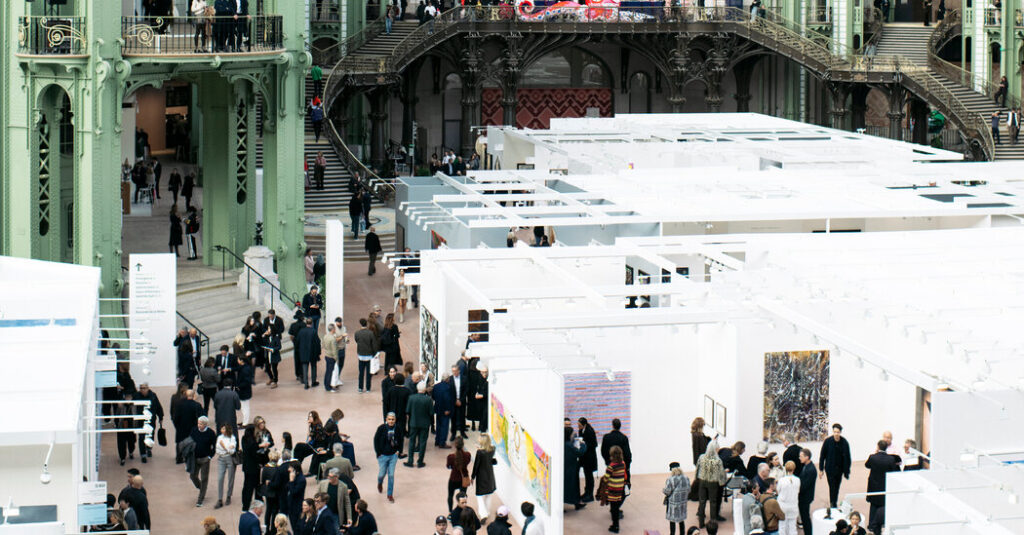
I’ve spent nearly 30 years in the art world. For half that time I led Art Basel, the global art fair now staged five times a year — in Miami Beach; Paris; Hong Kong; Doha, Qatar; and, this week at its namesake original location in Basel, Switzerland.
In many ways, these should be the best of times for the galleries participating in the fair: The number of ultra-high-net-worth individuals — i.e., potential collectors — has grown enormously in the past decade. And auction houses recently grabbed headlines with sales including a $181 million Jackson Pollock and a Brancusi, marketed with a Nicole Kidman video, that sold for $108 million.
Auction sales get a lot of press, but galleries are the art world’s engine. And talking to gallerists recently, as they prepared to gather for the big fair this week, uncertainty abounded. Many are questioning the fundamentals of their business. It’s as if the art world they know has fallen off its axis.
Galleries around the world have been closing at a steady clip this past year. The so-called megagallery Pace, which has locations in New York, Los Angeles, London, Geneva, Seoul, Tokyo and Berlin, shocked the art world in early June by announcing it would cut 50 artists from its roster and reduce the staff by 20 percent. “The art world has changed dramatically over the past decade, and the current gallery model isn’t only broken, it’s unfixable,” explained the Pace C.E.O., Marc Glimcher. “Every gallery is currently making temporary fixes and compromises to prop up a system that no longer works.”
What went wrong? The short answer is: The art world expanded wildly, but the art market — the total dollar volume of art sales — did not. In fact, if you read the Art Basel/UBS Art Market Report for 2026 carefully, and adjust for inflation, the data shows that the art market has stagnated. The 2025 numbers are on par with those from the 2009 recession and the 2020 pandemic periods.
This stagnation has hit many galleries hard, with, as the report puts it, “variable and slower sales for some and consistently rising costs.” The report makes clear that, although there are new galleries opening, there is considerable tumult within the sector. That’s a problem for the larger art world, because galleries are the foundation of the entire market. They bring new artists into play. They offer free access to high culture. They are the shadow financiers of museum shows and biennials and the essential mechanism driving private patronage to artists, at a time when governments, corporations and museums offer ever-dwindling funding. There’s a direct correlation between the health of the gallery system and the ability of artists to produce work long term.
Galleries were once mostly small businesses, often emerging in neighborhoods where artists produced their work. Dealers discovered, nurtured and promoted artists to collectors, many of whom were connoisseurs eager for deep-dive conversations, compelled by both possessive lust and a noblesse oblige. The art market was a cozier, somewhat esoteric place, where gentlemen’s agreements sufficed to keep things rolling.
Over the last two decades, contemporary art became part of pop culture, with flashy museums opening in cities around the world, attracting selfie-taking tourists. Art fairs proliferated, and sometimes, as with Art Basel Miami Beach, became cultural events themselves, attracting celebrities and lots of media attention.
The problem is that the art-selling business itself didn’t keep up with the hype. More museums and biennials means more shows that galleries have to support. Participating in fairs has built in costs that don’t always pay off. There just aren’t enough collectors, especially new collectors, to make the math of this supersized art world add up.
Many galleries made the problem worse by making it harder for potential new clients to buy work. If the “old school” collector was in it to support the artists, many gallerists observed that the newer collector could be driven more by a desire for social cachet or to engage in financial speculation. “Art fund” founders, wealth managers and sometimes even gallerists encouraged this logic, telling clients to consider artworks an “alternative asset class” rather than the product of a creative person’s imagination, valuable for its singularity of vision.
If art is just another asset, then the smart thing is to flip a work by a hot artist for a quick profit, predominately at auction. But auctions are unpredictable, and galleries try to keep their artists’ prices going steadily up, not peaking at moments of maximum hype and then crashing. So galleries started sharing with one another blacklists of “flippers,” by which they meant buyers with purely speculative interests who were looking only for quick profits.
Naturally, those who want to buy art don’t like being told no. Talking with collectors about galleries, and vice versa, I frequently find myself feeling like a friend to both spouses in a codependent marriage. One side effect of handling potential clients with mistrust is that it repels potential collectors, driving them into the welcoming embrace of auction houses.
Adding to the collector problem: Many younger rich people don’t seem to have the penchant for it. One adviser I know hit a wall after months of cultivating a young potential Silicon Valley client. The founder explained that upon analysis, collecting art seemed like a way to turn his money into problems. Indeed, owning art involves costs such as storage, shipping, insurance and potentially restoration.
So what can be done?
Most urgently, galleries need to push for legally enforceable resale agreements that can block flipping and let them be less fearful of unknown potential clients. And galleries need to stop promoting art as an investment. (If you want to store your money in an asset with perception based valuations, there’s always crypto.)
And instead of focusing so much on global expansion, galleries need to prioritize developing markets closer to home, keeping more continuous contact with their potential patrons. In every major urban area there are more wealthy people than ever before. They need to be cultivated through real-life interactions, not D.M.s and PDFs. This approach would mean galleries stop taking on more artists than they can sustain, stop doing more fairs than they can handle and stop chasing the chimera of globalization.
Yes, I realize many readers will find it ironic that the person who launched art fairs in Paris and Hong Kong is arguing for thinking more regionally. Already during my Art Basel time, when young galleries found themselves ardently recruited by art fairs worldwide, I advised them to be highly selective while focusing on building a stable home market. That advice was rarely followed. The art world seemed to be booming, and the young gallerists jumped into the global marathon that appeared to work for their predecessors. Until, suddenly, it didn’t work. For anybody.
I’m not arguing against art fairs — as we see in Basel this week, international fairs remain the most effective way to introduce artists to new collectors. But FOMO is not a business model. Staying closer to home might be a smarter one. We even have a precedent for this: the pandemic period when galleries were forced to go local because of travel restrictions. For many, it proved a revelation. As the pandemic ended, I went to Berlin, and ran into Esther Schipper, one of the city’s most prominent gallerists. “I’ve spent the last year driving around Germany to see collectors and it really worked,” she told me. “We flew all over the world like crazy, to dozens of fairs and biennials, trying to meet collectors when actually there’s so much potential in our backyards.”
Marc Spiegler, a former journalist and Art Basel global director, now works independently from Zurich across a broad range of cultural projects.
The Times is committed to publishing a diversity of letters to the editor. We’d like to hear what you think about this or any of our articles. Here are some tips. And here’s our email: [email protected].
Follow the New York Times Opinion section on Facebook, Instagram, TikTok, Bluesky, WhatsApp and Threads.
The post Art Galleries Are Not OK appeared first on New York Times.