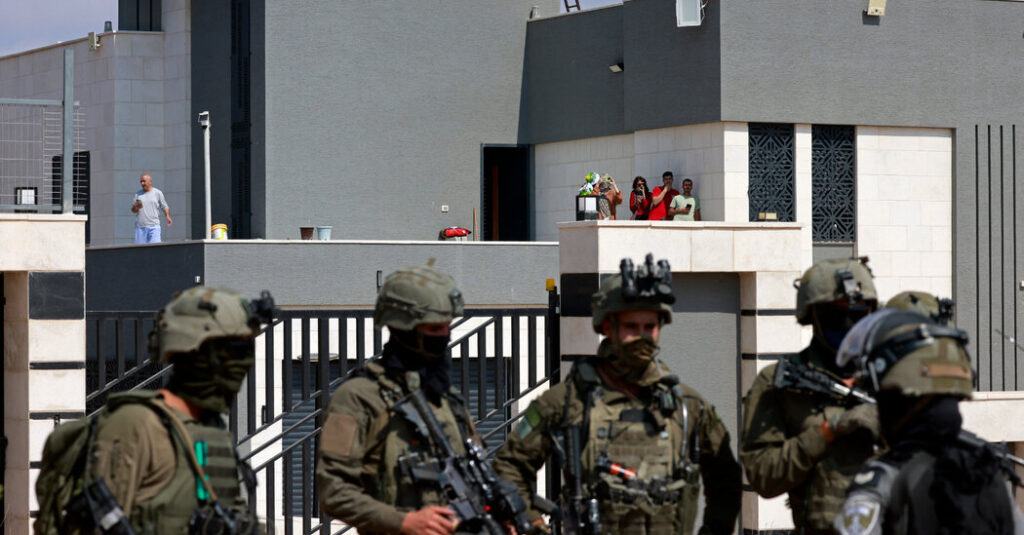
The Israeli army’s faltering attempts this week to rescue two Palestinian families who have been besieged in their West Bank homes by violent Jewish settlers prompted a striking statement on Friday morning from Israel’s defense minister, Israel Katz.
He said he wanted to get the Israeli military out of the business of protecting Palestinians in the occupied West Bank from rampaging settlers and would try to shift the responsibility to the Israeli police.
As a practical matter, only the Israeli Defense Forces have the thousands of personnel needed to patrol and respond quickly to attacks in the scores of communities plagued by settler violence this year. Moreover, experts say that giving responsibility to the Israeli police would essentially put the fox in charge of the henhouse, because the police are overseen by National Security Minister Itamar Ben-Gvir, an extremist settler himself.
For Mr. Katz, an ambitious member of Prime Minister Benjamin Netanyahu’s right-wing Likud party who hopes to succeed him as its leader, his recommendation was a political move to duck responsibility, analysts said.
Rather, for example, than letting the army use administrative detention to lock up settlers who break the law, a crucial tool previously used by the government, Mr. Katz is saying he prefers that soldiers avoid getting between settlers and Palestinians in their moments of “friction,” as some Israelis euphemistically call such attacks.
“It is not the I.D.F.’s role, and it is unable, to address the enforcement of civil matters” in the West Bank in light of the “welcome increase” in the number of Israeli settlers there, Mr. Katz said.
As the occupying power, the Israeli military alone bears responsibility under international law for protecting Palestinian civilians in the West Bank and has held authority for law and order since Israel captured the territory in the 1967 war.
The police have a division in the West Bank, given the hundreds of thousands of Israeli civilians living there in settlements widely considered illegal under international law. But handing the police responsibility for protecting Palestinian civilians could be seen as another step toward creeping annexation of the territory, a goal shared by many in Mr. Netanyahu’s government.
On Friday, settlers who have trapped two Palestinian families in their homes in the village of Qusra all week set up a tent there, before soldiers took it down, according to the local mayor, Abdul Azim al-Wadi, and an Israeli military statement. Settlers, however, remained in the vicinity as of early evening, while soldiers stood nearby, Mr. al-Wadi said.
“If the Israeli authorities want stability, they need to arrest the settlers,” he said. “That’s the only solution.”
In its statement, the military said that throughout the day, “soldiers operating in the area remained engaged in efforts to evacuate the Israeli civilians from the area of the closed military zone.”
For years, Israeli leaders including Mr. Netanyahu have downplayed settler violence as the work of a “handful of kids,” or of a few dozen or a few hundred wayward youth, often saying that many came from broken homes, suggesting they should be pitied rather than prosecuted. The effort to minimize the violence has continued even as the number of Palestinians killed by settlers has climbed since January, paired with beatings and the torching of hundreds of houses, car and mosques.
But now, with an army that has defeated vastly more powerful enemies failing to achieve the task of making it possible for two Palestinian families to live safely in their own homes, members of Mr. Netanyahu’s government are making clear on which side of the issue they stand.
Not surprisingly, Mr. Ben-Gvir, the minister overseeing the police, insisted that the settlers’ siege in Qusra was the military’s responsibility.
In a radio interview Thursday, he said he wasn’t familiar with the details of the Qusra situation but hastened to take the side of settlers encroaching on Palestinian communities. “There are some among them who truly need to be arrested and addressed; I’m not saying all of them are righteous,” he allowed. “But most of these guys, who settle the land of Israel, who build outposts — I admire them.”
Mr. Ben-Gvir, who leads the supremacist Otzma Yehudit, or Jewish Power, party, also argued that the real violence was not being committed by settlers. “I know what’s happening here in Judea and Samaria,” he said, using the biblical names for the West Bank. “I live here. For now, the danger is that the Arabs throw stones, the Arabs throw Molotov cocktails, the Arabs shoot.”
Mr. Netanyahu himself has not addressed the standoff in Qusra. But a lawmaker from his party, Amit Halevi, chose Thursday to meet and be photographed with a group of extremist settlers, including one who has been sanctioned by several countries for violence. Mr. Halevi did not immediately respond to a request for comment.
The events in Qusra are forcing the issue of settler violence — or, as a growing number of prominent Israelis now call it, “Jewish terrorism” — to center stage in the midst of an enormously consequential political campaign ahead of Israeli elections in October.
Members of the political opposition lambasted the government for failing to curb the violence. Naftali Bennett, a former prime minister who once led the umbrella organization for West Bank settlements, called it “acts of terrorism.” He faulted the Netanyahu government for responding so slowly that, according to the U.S. ambassador to Israel, Mike Huckabee, the Trump administration had urged it to intervene in Qusra.
“We need to denounce this and root out violence from within, not wait for the Americans to tell us to do so,” Mr. Bennett said in a radio interview.
Gadi Eisenkot, a former army chief of staff who now is the front-runner in opinion polls for prime minister, called the Qusra situation a “severe expression of the failures and weakness” of the government.
“In the face of anarchy and violent violations of the law by an extremist minority, the government is abandoning I.D.F. commanders to fight the battle alone,” he wrote on social media.
Israeli military officials have long complained that the police take a lax approach to violent settlers and that judges rarely impose tough sentences. But critics of the military say it, too, often hesitates in the face of settler violence and fails to use all the tools at its disposal.
On Wednesday, a group of army reservists released an open letter calling on the military “to act with determination against Jewish terrorism” and “to uproot it.” The letter, addressed to Lt. Gen. Eyal Zamir, the army’s chief of staff, had 465 signatures by Friday, organizers said.
“Nationalistic terror in Judea and Samaria is not stopping,” the letter reads. “We are required again and again to stand between ‘friction incidents’ in territory under our responsibility, without a real mandate to prevent them.”
The letter adds: “The lack of backing and guidance from the I.D.F.’s senior leadership, the turning of a blind eye to Jewish terrorism and to the known places from which it emanates, and at times even the political echelon’s support for it, endanger us and leave us abandoned.”
Moshe Karadi, who commanded the Israeli police from 2004 to 2007, recalled the police taking aggressive action against settlers in the past but said that it was unclear that certain police commanders could be counted upon now, because of Mr. Ben-Gvir’s influence over them.
Mr. Karadi called the handling of the settlers’ siege this week in Qusra a “disgrace,” saying that “terrorists need to be handled with force.”
Still, he said the military made a strategic error by not calling the police to remove the settlers immediately after they started besieging the Palestinians. Soldiers are trained to fight Palestinians, not Israelis, he said, while the police are trained to confront both.
“In my opinion, it appears the officers in the military are afraid of the political level,” he said. “They don’t know how their actions will be interpreted so they prefer to do nothing.”
The post As Army Fails to Protect Palestinians, Israeli Leaders Sympathize With Settlers appeared first on New York Times.