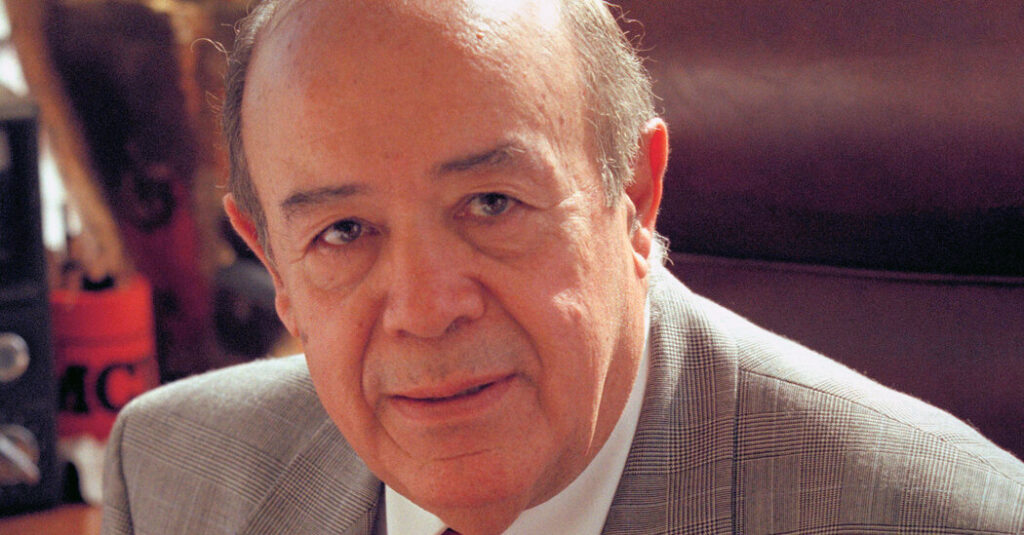
John Carro, a prominent New York jurist who as a young probation officer in the Bronx tried to help a 13-year-old chronic truant named Lee Harvey Oswald a decade before Mr. Oswald was accused of assassinating President John F. Kennedy, died on July 30 at his home in Suffern, N.Y. He was 98.
His son John S. Carro confirmed the death.
Justice Carro spent 25 years on the bench in New York, after working as a police officer, social worker and mayoral aide. Most notably, he was the first Puerto Rican named to the First Department of the State Supreme Court’s Appellate Division, which hears appeals from state trial courts in Manhattan and the Bronx.
Rolando T. Acosta, a Dominican immigrant who was the presiding judge of the Appellate Division’s First Department from 2017 to 2023, said he was inspired to become a lawyer after hearing Mr. Carro speak at his high school in the Bronx in 1975.
“I had just emigrated in 1969, and here was this very eloquent Puerto Rican guy with an accent like mine,” he said in an interview. “I was in awe of him, speaking about the impact of the legal profession. I found myself in him.”
Before Justice Carro became a lawyer, he was a probation officer in children’s court in the Bronx. In 1953, he met Mr. Oswald, who had missed more than 40 days of school and had been sent for a psychological assessment.
During Mr. Carro’s testimony to the Warren Commission in 1964 — which concluded that Mr. Oswald was the lone gunman who killed Mr. Kennedy in Dallas on Nov. 22, 1963 — he recalled how he learned that Mr. Oswald had been charged as the assassin.
“A friend of mine called me up, a social worker, to tell me, ‘Carro, you know who that case is?’” he told the commission. “‘And he said, ‘That was the case you handled. Don’t you remember?’”
As they talked, Mr. Carro recalled feeling numb.
At the time of his testimony, he was an assistant to Mayor Robert F. Wagner, and he offered a largely empathetic portrait of Mr. Oswald, describing him as a desperately lonely boy from Texas living with an ineffectual mother, Marguerite, in a small Bronx apartment. Classmates taunted him for the way he spoke and dressed. Without friends, he watched television and read magazines all day.
“He felt he wasn’t learning anything in school and that he had other, more important things to learn and do,” Mr. Carro testified.
When asked by Wesley Liebeler, an assistant counsel to the commission, if he could have predicted that Mr. Oswald, at 13, would have been capable of committing a violent act like the assassination, he would not speculate.
“It is hard to say what motivated him,” he told the commission. “I don’t really know. I had no inkling of that at that stage.”
Mrs. Oswald, who refused to cooperate with efforts to find help for her son, took him to New Orleans in 1954 before Mr. Carro was able to find an institution where he could get psychiatric care.
Not long after, Mr. Carro left the job for a brief stint with the New York City Police Department.
“They kept wanting me to do undercover and narcotics work in Puerto Rican neighborhoods,” he told The Daily News in 1977, “and all I wanted to do was work with the juvenile division. So I quit after a month and got a job with the Youth Board.”
Juan Francisco Carro was born on Aug. 21, 1927, in Orocovis, Puerto Rico, to Juan and Josefina (Torres) Carro. Following his parents’ divorce, he moved to the United States with his mother, a seamstress, and they settled in the Bronx. He adopted the name John soon after arriving.
After high school, he enlisted in the Navy in 1945, serving as a pharmacist’s mate for two years. He received a bachelor’s degree from Fordham University in 1949.
In 1956, after three years of night classes, he earned a law degree from Brooklyn Law School and went to work for the social services agency Mobilization for Youth.
Starting in 1961, as an assistant to Mayor Wagner, he ran the city’s mobile information center and worked on minority programs. In 1964, he lost his bid for a Congressional seat in the Bronx in the Democratic primary.
His judicial career began in 1969 when Mayor John V. Lindsay named him to the criminal court in the Bronx. There, he angered the Bronx district attorney, Mario Merola, by dismissing a case in 1975 against two robbery suspects because police officers had violated their constitutional rights.
Victims have rights, Mr. Merola told The New York Times, “and these rights cannot be taken away by any possible legality by the police.”
His decision also angered the police union, and Justice Carro subsequently met with hundreds of its members to discuss the rights of defendants.
He was appointed to the Appellate Division in 1979 and served until 1994. Senator Daniel P. Moynihan of New York nominated him for a seat on the federal bench in 1988, but Justice Carro angrily withdrew his name after three years of inaction by the administrations of President Ronald Reagan and President George H.W. Bush.
In a meeting with Edwin Meese III, the U.S. attorney general, he was told, “You’re really not our kind of guy,” his son John said in an interview.
After losing the chance to be a U.S. District Court judge, Justice Carro urged Senator Moynihan, a Democrat, to name another Puerto Rican to the position. Mr. Moynihan did — and it turned out to be Sonia Sotomayor, whom the Senate unanimously confirmed in 1992. She was confirmed as the first Hispanic Supreme Court justice in 2009.
In 1993, Justice Carro was a leading candidate for a seat on the state Court of Appeals. But he withdrew after Gov. Mario M. Cuomo’s nominating panel learned that he had omitted from his application a son he had fathered during a relationship between his divorce and remarriage to the same woman. Newsday reported at the time that the son, whom it did not name, was in his 20s.
Justice Carro told The Associated Press that he had included information about the son on previous judicial applications but had inadvertently left it off the application for the Court of Appeals job. His son John said that the other son was listed on tax returns and that child support had been paid.
A year later, Justice Carro retired and started a law firm with John.
In addition to his son John, Justice Carro’s survivors include his wife, Terry (Parco) Carro, whom he first married in 1947; two other sons, Robert and Gregory, who are also lawyers; four daughters, Sherry Herlihy, Christine Riendeau, Lorna Sackler and Monique Carro, a lawyer; eight grandchildren; and five great-grandchildren.
His son Gregory, a State Supreme Court justice, is presiding over the murder trial of Luigi Mangione, who is accused of fatally shooting Brian Thompson, the chief executive of United Healthcare.
In 1998, after Gregory Carro’s swearing in as a criminal court judge, Justice Carro reflected on his own career as a liberal jurist and a leader in the Latino legal community.
“I was never afraid to speak out, and correct injustices, and do what I thought was right,” he told The Times. “Greg is more Americanized — the kids never had that whole involvement in the Latino community. I have so much respect for him. But it’s a whole different world.”
The post John Carro, Jurist Who Had Early Brush With Lee Harvey Oswald, Dies at 98 appeared first on New York Times.