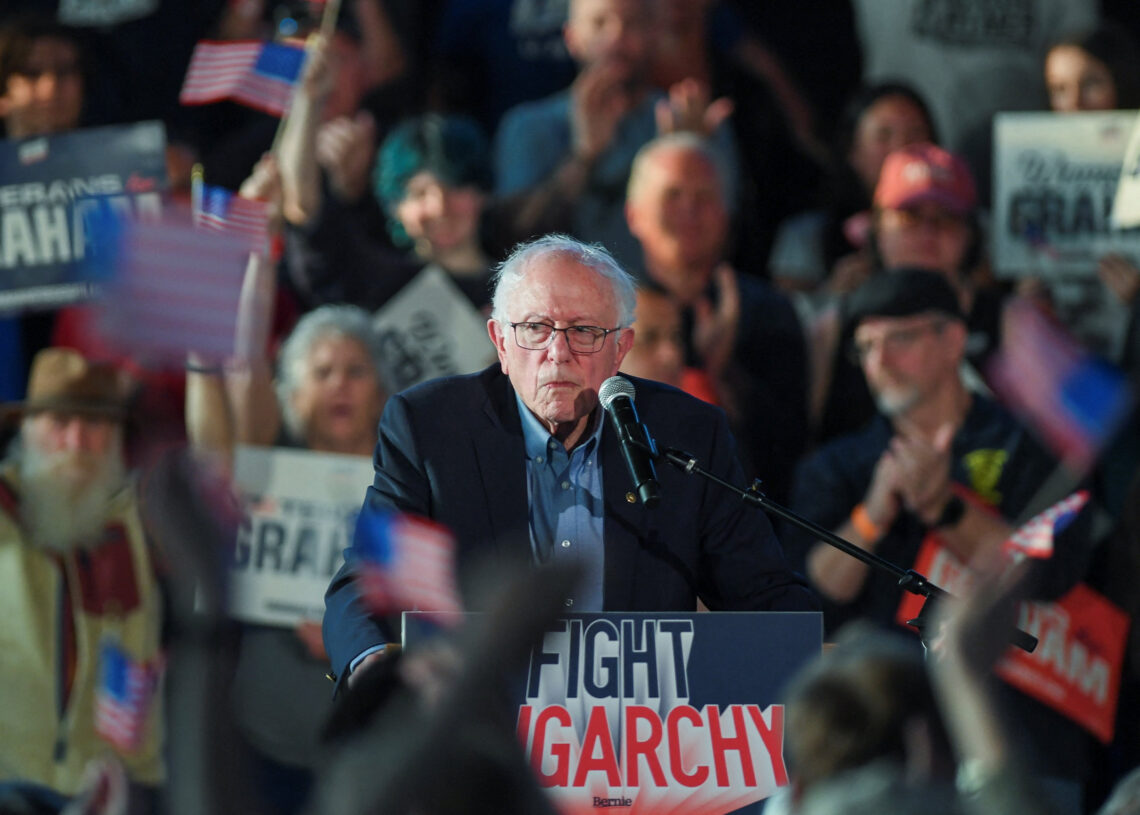
Sen. Bernie Sanders (I-Vermont) greeted the news that Elon Musk had become a trillionaire by — what else? — touting a plan to raise federal spending and taxes. Musk “pays the same amount into Social Security as someone making $184,500,” Sanders tweeted. He said his bill would “end that absurdity,” eliminate the program’s shortfall for 75 years and pay for an expansion of Social Security benefits.
The shortfall certainly needs closing. Last week, the Social Security trustees estimated it at roughly $29 trillion over the next 75 years. And they are probably being optimistic. They assume Americans will have more babies in the coming decades than either the Census Bureau or the Congressional Budget Office does, which would help Social Security’s finances.
Sanders is also correct that Musk, whose net worth is $1.4 trillion and counting, pays no more in Social Security taxes than many of his engineers. But Sanders’s idea is terrible. It would be a much larger and more harmful tax increase than its supporters let on and would further warp the federal government’s already perverse spending priorities.
If the Social Security tax cap that Sanders mentioned is an “absurdity,” it’s one common to government pension programs. In Britain, pension taxes fall substantially after the first $67,000 in income. In Canada, the rate drops at about $53,000 in U.S. dollars.
Social Security has always included a cap because of its basic design. The program’s architects and their political descendants wanted to maintain some relationship between what people contribute to it and what they get. Historically, Democrats have believed so strongly in making the program seem like an “earned benefit” that they have opposed reining in benefit growth even for the richest Americans. The theory was that the public would support the program less if it were openly redistributive.
The tax cap is there to keep benefits related to contributions. Musk won’t pay any more than someone making $184,500, but he also won’t get a bigger check than that person.
Today’s left-wing proposals would alter this arrangement, and not in a small way. The top federal income tax rate is 37 percent. The Sanders plan — and many similar Democratic proposals, such as one from Sen. Ruben Gallego (Arizona) — would make the top rate 49.4 percent. The last time the United States raised tax rates that sharply was in 1932, when President Herbert Hoover mistakenly believed it would help end the Great Depression. In New York City, with state and local taxes included, the top rate would be 64.1 percent.
The Sanders plan would not, however, only raise the cap related to wages; the proposal would also increase top rate for investment income. The maximum capital gains tax would go from 23.8 to 36.2 percent, making it higher than the rates in Britain, Canada and even Sweden.
While the title of Gallego’s bill nods toward the need to preserve the link between contributions and payouts — it’s called the You Earned It, You Keep It Act — all of these proposals would weaken that link. But if it’s now okay to recognize the reality that Social Security redistributes money, why not reduce benefits for the well-off? Unlike higher taxes, cutting future benefit levels can spur people to work and save more, increasing the overall size of the economy. And there is plenty of spending on high earners to cut. Already the richest one-fifth of beneficiaries get 29 percent of the spending, and current law ensures that future retirees get bigger checks than today’s retirees do.
That’s what is, well, absurd about these liberal proposals. They would raise taxes by historically large amounts to finance goals that rank low on any rational list of priorities. Senior citizens in the U.S. report greater financial security than Americans of working age. Why raise taxes to give all of them an extra $2,400 per year, as Sanders would? Why raise taxes to keep benefits rising for the highest earners? That’s what protecting all seniors from “benefit cuts” practically means.
If the Sanders bill became law, progressives would have won their biggest victory on taxes ever — and done nothing to fund a Green New Deal, or early-childhood education, or tuition-free college, or infrastructure improvements. They would not even have advanced the Sanders dream of Medicare-for-all. Or, for that matter, done anything to address Medicare’s own projected shortfall. After raising taxes on the rich as high as plausible and arguably beyond, where do they think they would find the money for any of this?
Taxing the rich and expanding Social Security are some of the more popular ideas progressives have to offer. If they were ever enacted, though, it would be bad for the country and even, in the long run, for progressives themselves.
The post This absurd Social Security plan would take down progressives with it appeared first on Washington Post.